Department of Medicine, University of Texas Health Science Center at San Antonio, San Antonio, Texas.
Department of Comprehensive Dentistry, University of Texas Health Science Center at San Antonio, San Antonio, Texas.
Am J Physiol Endocrinol Metab. 2021 Jul 1;321(1):E90-E104. doi: 10.1152/ajpendo.00651.2020. Epub 2021 May 24.
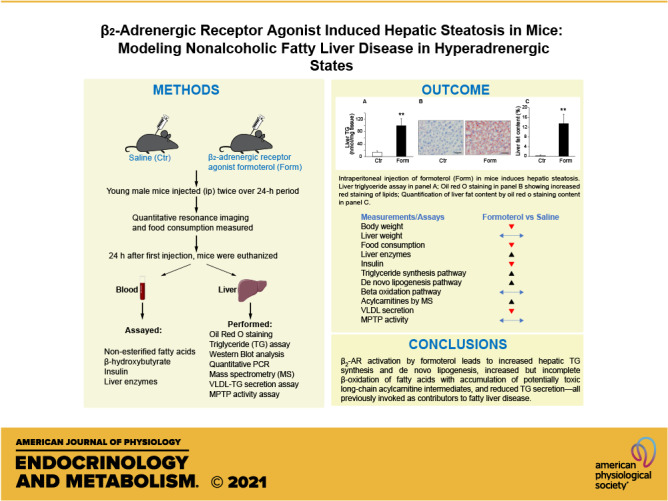
Nonalcoholic fatty liver disease (NAFLD) is a spectrum of disorders ranging from hepatic steatosis [excessive accumulation of triglycerides (TG)] to nonalcoholic steatohepatitis, which can progress to cirrhosis and hepatocellular carcinoma. The molecular pathogenesis of steatosis and progression to more severe NAFLD remains unclear. Obesity and aging, two principal risk factors for NAFLD, are associated with a hyperadrenergic state. β-Adrenergic responsiveness in liver increases in animal models of obesity and aging, and in both is linked to increased hepatic expression of β-adrenergic receptors (β-ARs). We previously showed that in aging rodents intracellular signaling from elevated hepatic levels of β-ARs may contribute to liver steatosis. In this study we demonstrate that injection of formoterol, a highly selective β-AR agonist, to mice acutely results in hepatic TG accumulation. Further, we have sought to define the intrahepatic mechanisms underlying β-AR mediated steatosis by investigating changes in hepatic expression and cellular localization of enzymes, transcription factors, and coactivators involved in processes of lipid accrual and disposition-and also functional aspects thereof-in livers of formoterol-treated animals. Our results suggest that β-AR activation by formoterol leads to increased hepatic TG synthesis and de novo lipogenesis, increased but incomplete β-oxidation of fatty acids with accumulation of potentially toxic long-chain acylcarnitine intermediates, and reduced TG secretion-all previously invoked as contributors to fatty liver disease. Experiments are ongoing to determine whether sustained activation of hepatic β-AR signaling by formoterol might be utilized to model fatty liver changes occurring in hyperadrenergic states of obesity and aging, and thereby identify novel molecular targets for the prevention or treatment of NAFLD. Results of our study suggest that β-adrenergic receptor (β-AR) activation by agonist formoterol leads to increased hepatic TG synthesis and de novo lipogenesis, incomplete β-oxidation of fatty acids with accumulation of long-chain acylcarnitine intermediates, and reduced TG secretion. These findings may, for the first time, implicate a role for β-AR responsive dysregulation of hepatic lipid metabolism in the pathogenetic processes underlying NAFLD in hyperadrenergic states such as obesity and aging.
非酒精性脂肪性肝病(NAFLD)是一种从肝脂肪变性(甘油三酯过多积聚)到非酒精性脂肪性肝炎的疾病谱,可进展为肝硬化和肝细胞癌。脂肪变性和向更严重的 NAFLD 进展的分子发病机制尚不清楚。肥胖和衰老,NAFLD 的两个主要危险因素,与高肾上腺素能状态有关。肥胖和衰老动物模型中肝内β-肾上腺素能反应性增加,两者均与肝内β-肾上腺素能受体(β-AR)表达增加有关。我们之前的研究表明,在衰老啮齿动物中,升高的肝β-AR 水平的细胞内信号可能导致肝脂肪变性。在这项研究中,我们证明了高选择性β-AR 激动剂福莫特罗注射到小鼠体内可导致肝内 TG 积聚。此外,我们通过研究福莫特罗处理动物肝脏中参与脂质积累和处置过程的酶、转录因子和共激活因子的肝内表达和细胞定位,以及其功能方面的变化,试图确定β-AR 介导的脂肪变性的肝内机制。我们的结果表明,福莫特罗激活β-AR 导致肝内 TG 合成和从头脂肪生成增加,脂肪酸β-氧化增加但不完全,长链酰基辅酶 A 中间体积累,TG 分泌减少-所有这些都被认为是导致脂肪肝疾病的原因。正在进行实验以确定福莫特罗持续激活肝β-AR 信号是否可用于模拟肥胖和衰老高肾上腺素能状态下发生的脂肪肝变化,并确定预防或治疗 NAFLD 的新分子靶点。我们的研究结果表明,激动剂福莫特罗激活β-肾上腺素能受体(β-AR)导致肝内 TG 合成和从头脂肪生成增加,脂肪酸β-氧化不完全,长链酰基辅酶 A 中间体积累,TG 分泌减少。这些发现首次表明,激动剂福莫特罗激活β-AR 导致肝内脂质代谢的β-AR 反应失调,可能在肥胖和衰老等高肾上腺素能状态下 NAFLD 的发病机制中起作用。