Department of Psychology, University of Manitoba, Winnipeg, Canada.
Department of Pediatrics and Child Health, University of Manitoba, Winnipeg, Canada.
PLoS One. 2021 May 24;16(5):e0251720. doi: 10.1371/journal.pone.0251720. eCollection 2021.
Supportive parenting is critical for promoting healthy child development in the face of stressors, such as those occurring during COVID-19. Here, we address a knowledge gap regarding specific household risk factors associated with parenting quality during the pandemic and incorporate first-person accounts of family challenges and needs.
Mixed methods were applied to data collected between April 14th - 28th, 2020 from the "Parenting During the Pandemic" survey. Participants included 656 primary caregivers (e.g., mothers, fathers, foster parents) of least one child age 1.5-8 years of which 555 (84.6%) responded to at least one parenting questionnaire. Parenting quality was assessed across stressful, negative, and positive parenting dimensions. Household risk was examined across pandemic- linked (e.g., caregiver depression, unmet childcare needs) and stable factors (i.e., annual income, mental illness history). Significant correlates were examined with regressions in Mplus. Thematic analysis identified caregiver challenges and unmet needs from open-ended questions.
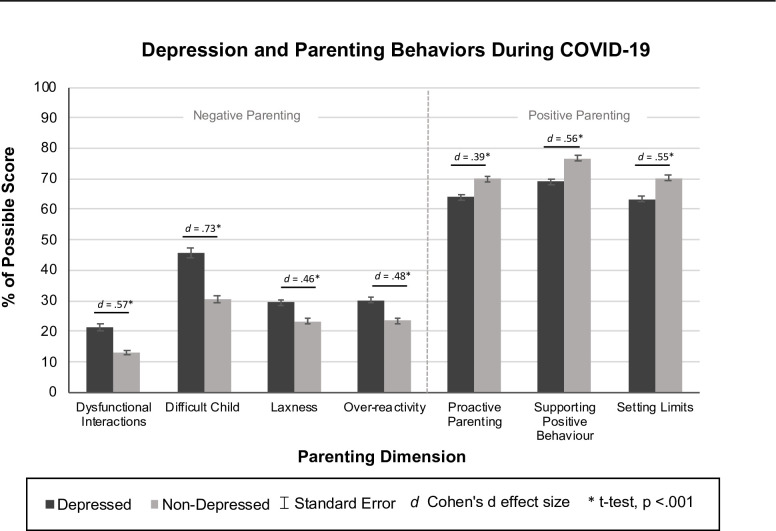
Caregiver depression, higher child parity, unmet childcare needs, and relationship distress predicted lower-quality parenting. Caregiver depression was the most significant predictor across every parenting dimension, with analyses indicating medium effect sizes, ds = .39 - .73. Qualitative findings highlighted severe strains on parent capacities including managing psychological distress, limited social supports, and too much unstructured time.
Lower quality parenting during COVID-19 is associated with multiple household and pandemic risk factors, with caregiver depression consistently linked to parent- child relationship disruptions. Focused efforts are needed to address caregiver mental health to protect child health as part of the pandemic response.
在面对压力时,支持性育儿对于促进儿童健康发展至关重要,例如在 COVID-19 期间。在这里,我们解决了一个关于与大流行期间育儿质量相关的特定家庭风险因素的知识差距,并纳入了家庭挑战和需求的第一人称描述。
混合方法应用于 2020 年 4 月 14 日至 28 日期间从“大流行期间育儿”调查中收集的数据。参与者包括 656 名至少有一名 1.5-8 岁儿童的主要照顾者(例如母亲、父亲、养父母),其中 555 名(84.6%)对至少一个育儿问卷做出了回应。育儿质量是通过压力、消极和积极育儿维度来评估的。家庭风险是通过与大流行相关的因素(例如照顾者抑郁、儿童保育需求未得到满足)和稳定因素(即年收入、精神病史)来检查的。在 Mplus 中使用回归检验显著相关性。主题分析从开放式问题中确定了照顾者的挑战和未满足的需求。
照顾者抑郁、更高的儿童多胎、儿童保育需求未得到满足和关系困扰预测了较差的育儿质量。照顾者抑郁是每个育儿维度中最显著的预测因素,分析表明中等效应大小,ds=.39 -.73。定性研究结果强调了父母能力的严重压力,包括管理心理困扰、有限的社会支持和过多的无组织时间。
COVID-19 期间较低的育儿质量与多个家庭和大流行风险因素相关,照顾者抑郁与亲子关系中断始终相关。需要集中精力解决照顾者的心理健康问题,以保护儿童健康,作为大流行应对的一部分。