Université de Strasbourg, F-67000 Strasbourg, France; Inserm, Institut de Recherche sur les Maladies Virales et Hépatiques UMRS 1110, F-67000 Strasbourg, France.
University Hospital Freiburg, Dept. of Internal Medicine 2/Molecular Biology, D79106 Freiburg, Germany.
Curr Opin Virol. 2021 Aug;49:41-51. doi: 10.1016/j.coviro.2021.04.009. Epub 2021 May 22.
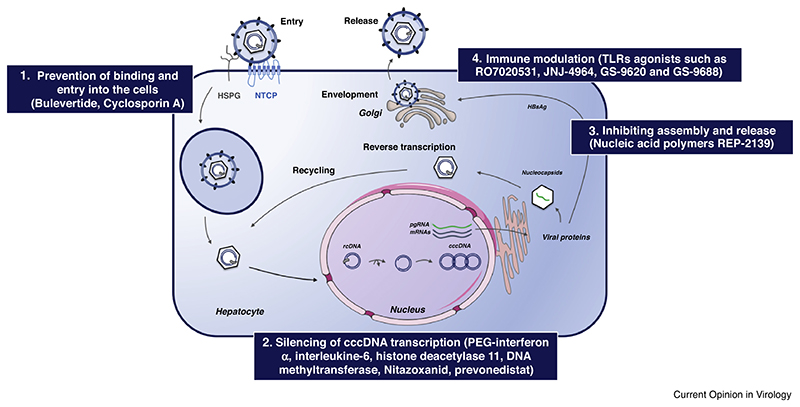
Chronic infection with HBV is a major cause of advanced liver disease and hepatocellular carcinoma. Nucleos(t)ide analogues effectively control HBV replication but viral cure is rare. Hence treatment has often to be administered for an indefinite duration, increasing the risk for selection of drug resistant virus variants. PEG-interferon-α-based therapies can sometimes cure infection but suffer from a low response rate and severe side-effects. CHB is characterized by the persistence of a nuclear covalently closed circular DNA (cccDNA), which is not targeted by approved drugs. Targeting host factors which contribute to the viral life cycle provides new opportunities for the development of innovative therapeutic strategies aiming at HBV cure. An improved understanding of the host immune system has resulted in new potentially curative candidate approaches. Here, we review the recent advances in understanding HBV-host interactions and highlight how this knowledge contributes to exploiting host-targeting strategies for a viral cure.
慢性乙型肝炎病毒(HBV)感染是导致晚期肝病和肝细胞癌的主要原因。核苷(酸)类似物可有效抑制 HBV 复制,但病毒难以被彻底清除。因此,治疗通常需要长期进行,这增加了耐药病毒变异株选择的风险。聚乙二醇干扰素-α为基础的治疗有时可以治愈感染,但应答率低,且副作用严重。慢性乙型肝炎的特征是存在共价闭合环状 DNA(cccDNA),这是已批准药物无法靶向的。针对宿主因素的治疗为开发旨在治愈乙型肝炎的创新治疗策略提供了新的机会。对宿主免疫系统的深入了解产生了新的、有潜在治愈作用的候选方法。在这里,我们回顾了近年来对 HBV-宿主相互作用的理解进展,并强调了这些知识如何有助于利用宿主靶向策略实现病毒的清除。