Department of Molecular Biology, Lewis Thomas Laboratory, Princeton University, Washington Road, Princeton, NJ, USA.
Nat Commun. 2021 Mar 11;12(1):1591. doi: 10.1038/s41467-021-21850-9.
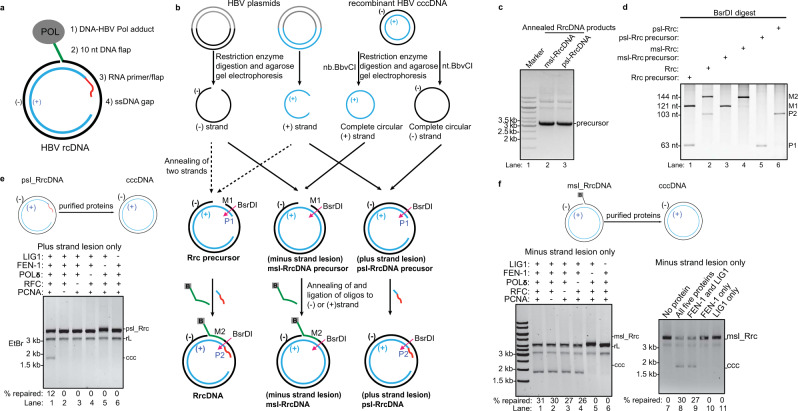
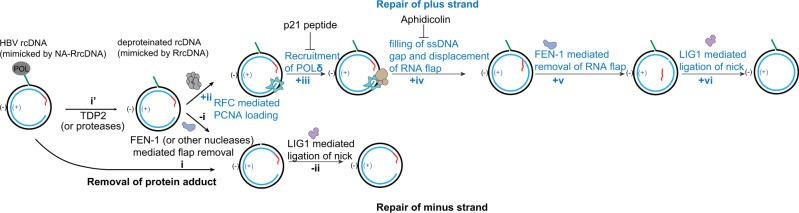
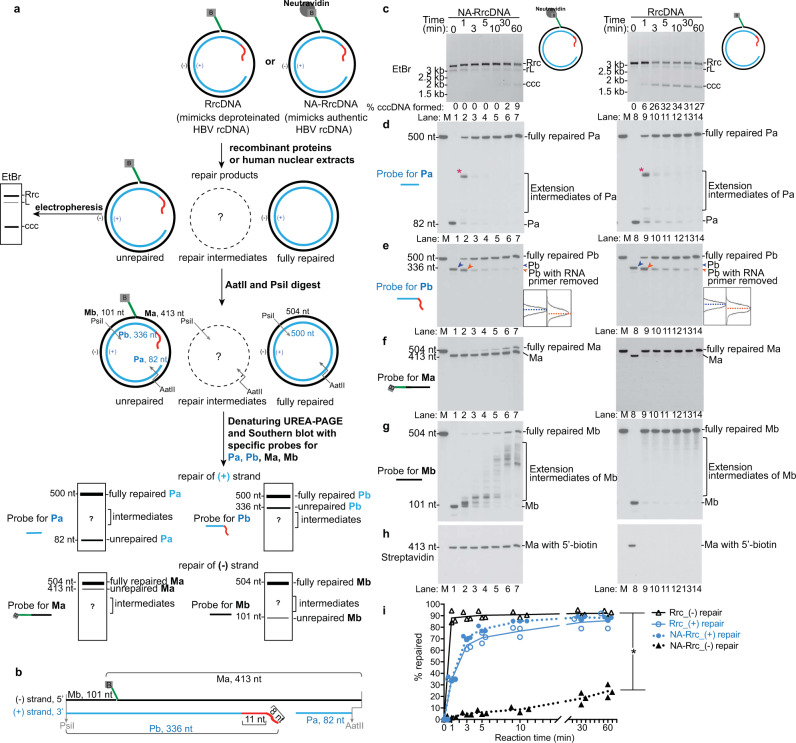
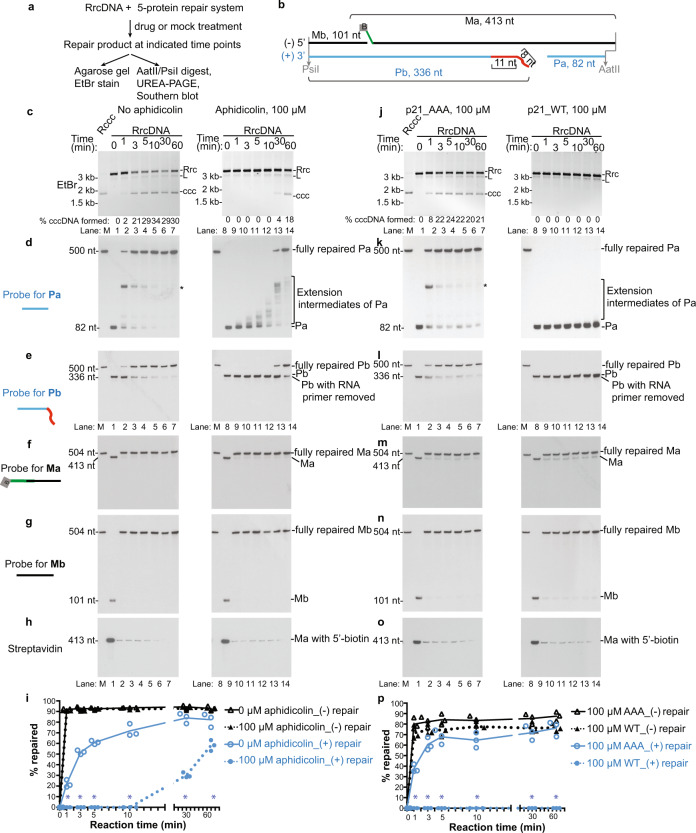
Hepatitis B virus (HBV) is a highly contagious pathogen that afflicts over a third of the world's population, resulting in close to a million deaths annually. The formation and persistence of the HBV covalently closed circular DNA (cccDNA) is the root cause of HBV chronicity. However, the detailed molecular mechanism of cccDNA formation from relaxed circular DNA (rcDNA) remains opaque. Here we show that the minus and plus-strand lesions of HBV rcDNA require different sets of human repair factors in biochemical repair systems. We demonstrate that the plus-strand repair resembles DNA lagging strand synthesis, and requires proliferating cell nuclear antigen (PCNA), the replication factor C (RFC) complex, DNA polymerase delta (POLδ), flap endonuclease 1 (FEN-1), and DNA ligase 1 (LIG1). Only FEN-1 and LIG1 are required for the repair of the minus strand. Our findings provide a detailed mechanistic view of how HBV rcDNA is repaired to form cccDNA in biochemical repair systems.
乙型肝炎病毒(HBV)是一种高度传染性病原体,影响了全球超过三分之一的人口,每年导致近百万人死亡。HBV 共价闭合环状 DNA(cccDNA)的形成和持续存在是 HBV 慢性感染的根本原因。然而,rcDNA 形成 cccDNA 的详细分子机制仍不清楚。在这里,我们表明 HBV rcDNA 的负链和正链损伤在生化修复系统中需要不同的人类修复因子。我们证明,正链修复类似于 DNA 滞后链合成,需要增殖细胞核抗原(PCNA)、复制因子 C(RFC)复合物、DNA 聚合酶 δ(POLδ)、核酸内切酶 1(FEN-1)和 DNA 连接酶 1(LIG1)。只有 FEN-1 和 LIG1 对负链的修复是必需的。我们的研究结果提供了一个详细的机制观点,说明 HBV rcDNA 如何在生化修复系统中修复形成 cccDNA。