Medical School of Chinese PLA, Beijing, China.
Faculty of Hepato-Pancreato-Biliary Surgery, Chinese PLA General Hospital, No.28 Fuxing Road, Haidian District, Beijing, 100853, China.
BMC Cancer. 2021 May 25;21(1):608. doi: 10.1186/s12885-021-08322-5.
Long non-coding RNA (lncRNA) plays a critical role in the malignant progression of intrahepatic cholangiocarcinoma (iCCA). This study aimed to establish a 4-lncRNA prognostic signature and explore corresponding potential mechanisms in patients with iCCA.
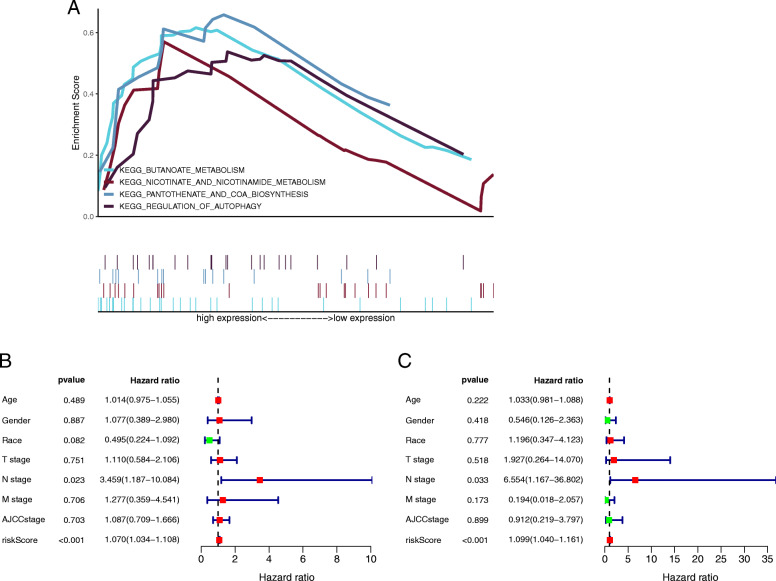
The original lncRNA-seq and clinical data were collected from the TCGA and GEO databases. Overlapping and differentially expressed lncRNAs (DE-lncRNAs) were further identified from transcriptome data. Univariate regression analysis was performed to screen survival-related DE-lncRNAs, which were further selected to develop an optimal signature to predict prognosis using multivariate regression analysis. The Kaplan-Meier survival curve visualized the discrimination of the signature on overall survival (OS). The area under the curve (AUC) and C-index were used to verify the predictive accuracy of the signature. Combined with clinical data, multivariate survival analysis was used to reveal the independent predictive capability of the signature. In addition, a prognostic nomogram was constructed. Finally, the common target genes of 4 lncRNAs were predicted by the co-expression method, and the corresponding functions were annotated by GO and KEGG enrichment analysis. Gene set enrichment analysis (GSEA) was also performed to explore the potential mechanism of the signature. Quantitative real-time PCR was used to evaluated the expression of 4 lncRNAs in an independent cohort.
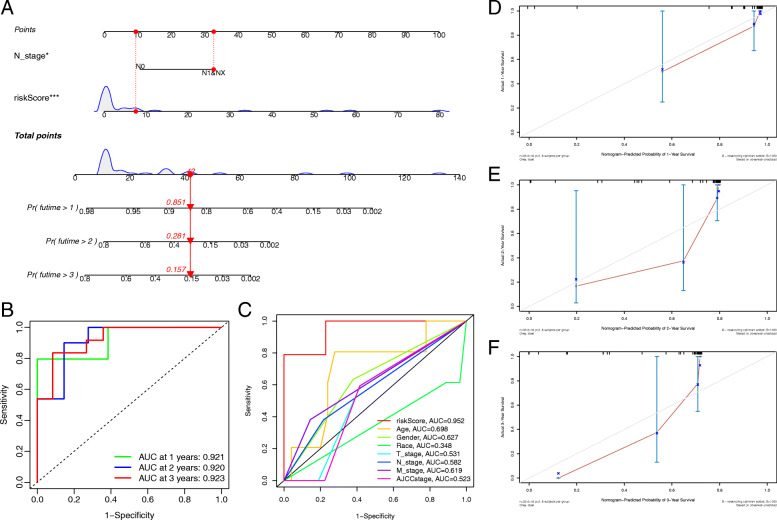
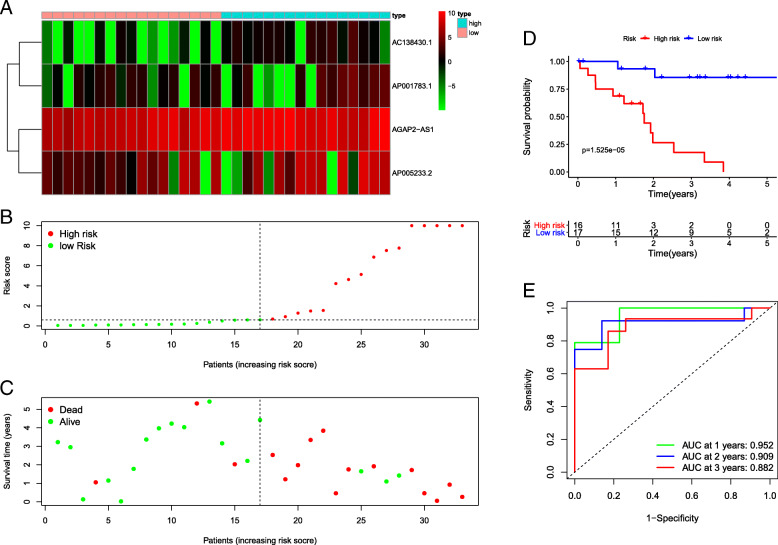
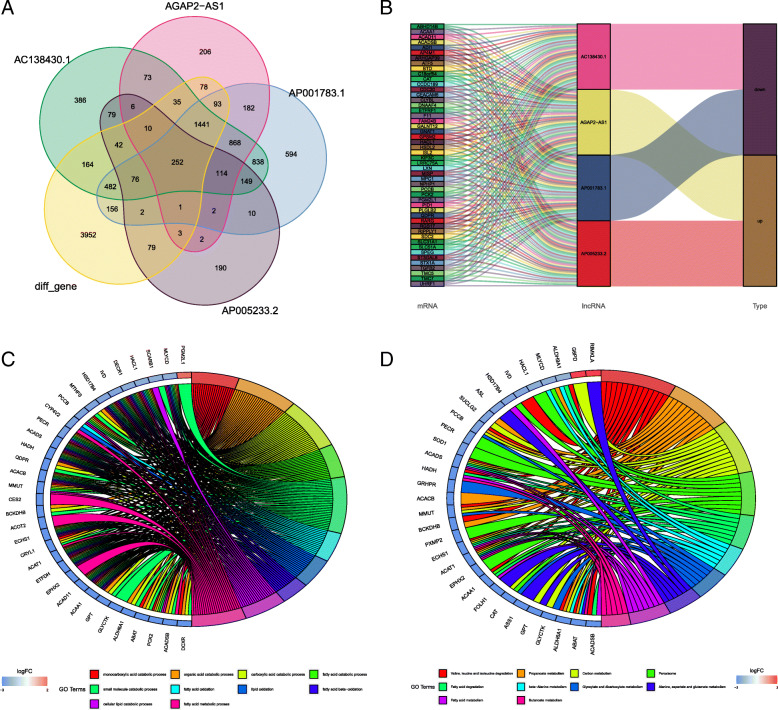
We identified and constructed a 4-lncRNA (AC138430.1, AGAP2-AS1, AP001783.1, and AP005233.2) prognostic signature using regression analysis, and it had the capability to independently predict prognosis. The AUCs were 0.952, 0.909, and 0.882 at 1, 2, and 3 years, respectively, and the C-index was 0.808, which showed good predictive capability. Subsequently, combined with clinical data, we constructed a nomogram with good clinical application. Finally, 252 target genes of all four lncRNAs were identified by the co-expression method, and functional enrichment analysis showed that the signature was strongly correlated with metabolism-related mechanisms in tumourigenesis. The same results were also validated via GSEA.
We demonstrated that a metabolism-related 4-lncRNA prognostic signature could be a novel biomarker and deeply explored the target genes and potential mechanism. This study will provide a promising therapeutic strategy for patients with intrahepatic cholangiocarcinoma.
长链非编码 RNA(lncRNA)在肝内胆管癌(iCCA)的恶性进展中起着关键作用。本研究旨在建立一个 4-lncRNA 预后标志物,并探讨其在 iCCA 患者中的潜在机制。
从 TCGA 和 GEO 数据库中收集原始 lncRNA-seq 和临床数据。从转录组数据中进一步鉴定重叠和差异表达的 lncRNAs(DE-lncRNAs)。使用单变量回归分析筛选与生存相关的 DE-lncRNAs,然后使用多变量回归分析进一步选择最佳标志物来预测预后。Kaplan-Meier 生存曲线可视化了该标志物对总生存期(OS)的区分能力。曲线下面积(AUC)和 C 指数用于验证标志物的预测准确性。结合临床数据,进行多变量生存分析以揭示该标志物的独立预测能力。此外,构建了一个预后列线图。最后,通过共表达方法预测 4 个 lncRNA 的共同靶基因,并通过 GO 和 KEGG 富集分析注释相应功能。还进行了基因集富集分析(GSEA)以探索该标志物的潜在机制。采用实时定量 PCR 在独立队列中评估 4 个 lncRNA 的表达。
我们通过回归分析鉴定并构建了一个 4-lncRNA(AC138430.1、AGAP2-AS1、AP001783.1 和 AP005233.2)预后标志物,该标志物具有独立预测预后的能力。AUC 分别为 1、2 和 3 年时的 0.952、0.909 和 0.882,C 指数为 0.808,显示出良好的预测能力。随后,结合临床数据,我们构建了一个具有良好临床应用的列线图。最后,通过共表达方法鉴定了所有四个 lncRNA 的 252 个靶基因,功能富集分析表明该标志物与肿瘤发生中的代谢相关机制密切相关。通过 GSEA 也验证了相同的结果。
我们证明了一个与代谢相关的 4-lncRNA 预后标志物可以作为一种新的生物标志物,并深入探讨了其靶基因和潜在机制。本研究将为肝内胆管癌患者提供一种有前途的治疗策略。