Department of Health Science and Technology, Aalborg University, 9220, Aalborg, Denmark.
The Second Hospital of Jilin University, Jilin University, Qianjin St. 2699, Changchun, 130021, China.
Chiropr Man Therap. 2021 May 25;29(1):18. doi: 10.1186/s12998-021-00376-3.
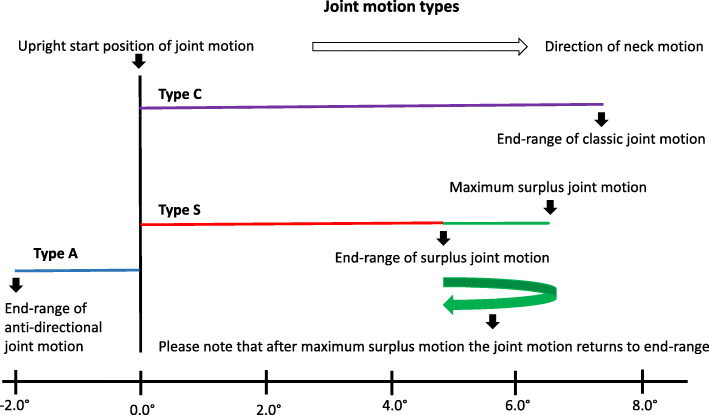
In clinical diagnosis, the maximum motion of a cervical joint is thought to be found at the joint's end-range and it is this perception that forms the basis for the interpretation of flexion/extension imaging studies. There have however, been representative cases of joints producing their maximum motion before end-range, but this phenomenon is yet to be quantified.
To provide a quantitative assessment of the difference between maximum joint motion and joint end-range in healthy subjects. Secondarily to classify joints into type based on their motion and to assess the proportions of these joint types.
This is an observational study.
Thirty-three healthy subjects participated in the study.
Maximum motion, end-range motion and surplus motion (the difference between maximum motion and end-range) in degrees were extracted from each cervical joint.
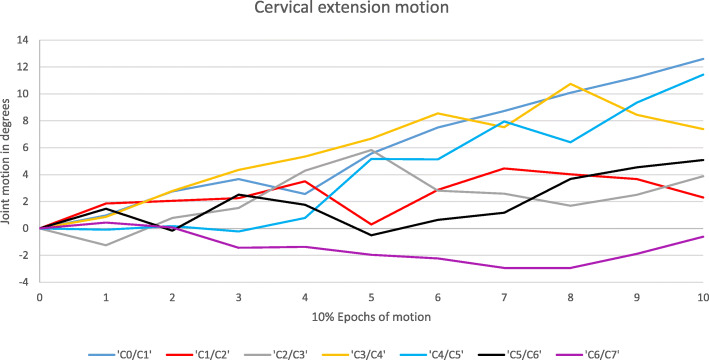
Thirty-three subjects performed one flexion and one extension motion excursion under video fluoroscopy. The motion excursions were divided into 10% epochs, from which maximum motion, end-range and surplus motion were extracted. Surplus motion was then assessed in quartiles and joints were classified into type according to end-range.
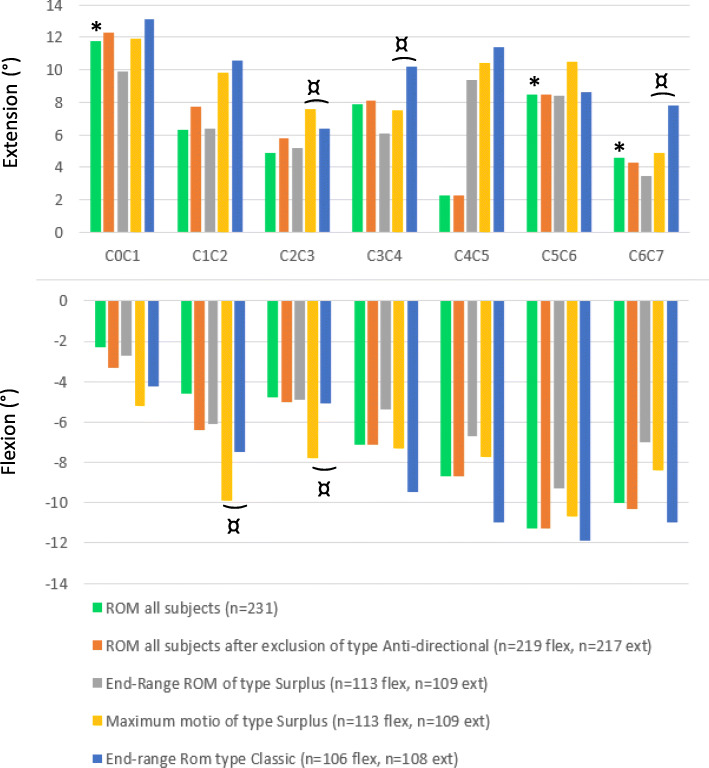
For flexion 48.9% and for extension 47.2% of joints produced maximum motion before joint end-range (type S). For flexion 45.9% and for extension 46.8% of joints produced maximum motion at joint end-range (type C). For flexion 5.2% of joints and for extension 6.1% of joints concluded their motion anti-directionally (type A). Significant differences were found for C2/C3 (P = 0.000), C3/C4 (P = 0.001) and C4/C5 (P = 0.005) in flexion and C1/C2 (P = 0.004), C3/C4 (P = 0.013) and C6/C7 (P = 0.013) in extension when comparing the joint end- range of type C and type S. The average pro-directional (motion in the direction of neck motion) surplus motion was 2.41° ± 2.12° with a range of (0.07° -14.23°) for flexion and 2.02° ± 1.70° with a range of (0.04°-6.97°) for extension.
This is the first study to categorise joints by type of motion. It cannot be assumed that end-range is a demonstration of a joint's maximum motion, as type S constituted approximately half of the joints analysed in this study.
在临床诊断中,人们认为颈椎关节的最大运动发生在关节的末端范围,正是这种观念构成了对屈伸影像学研究的解释基础。然而,已经有一些代表关节在末端范围之前产生最大运动的病例,但这一现象尚未得到量化。
提供一种对健康受试者关节最大运动与末端范围之间差异的定量评估。其次,根据运动对关节进行分类,并评估这些关节类型的比例。
这是一项观察性研究。
33 名健康受试者参与了这项研究。
从每个颈椎关节中提取角度的最大运动、末端范围运动和剩余运动(最大运动与末端范围之间的差异)。
33 名受试者在视频透视下进行一次屈伸运动。运动范围分为 10%的区间,从中提取最大运动、末端范围和剩余运动。然后将剩余运动分为四等份,并根据末端范围对关节进行分类。
对于屈伸运动,48.9%的关节在末端范围之前达到最大运动(S 型),47.2%的关节在末端范围达到最大运动(C 型)。对于屈伸运动,45.9%的关节在末端范围达到最大运动(C 型),46.8%的关节在末端范围达到最大运动(C 型)。对于屈伸运动,5.2%的关节和 6.1%的关节向相反方向完成运动(A 型)。在屈伸运动中,C2/C3(P=0.000)、C3/C4(P=0.001)和 C4/C5(P=0.005)以及 C1/C2(P=0.004)、C3/C4(P=0.013)和 C6/C7(P=0.013)的 C 型关节和 S 型关节的末端范围比较中存在显著差异。屈伸运动中,正向(与颈部运动方向一致)的剩余运动平均值为 2.41°±2.12°,范围为(0.07°-14.23°),屈伸运动中,正向(与颈部运动方向一致)的剩余运动平均值为 2.02°±1.70°,范围为(0.04°-6.97°)。
这是第一个根据运动类型对关节进行分类的研究。不能假设末端范围就是关节最大运动的表现,因为在本研究分析的关节中,S 型关节约占一半。