Laboratory of Neuroimaging of Aging (LANVIE), University of Geneva, Geneva, Switzerland.
Geneva Memory Center, Department of Rehabilitation and Geriatrics, Geneva University Hospitals, Geneva, Switzerland.
Alzheimers Res Ther. 2021 May 25;13(1):105. doi: 10.1186/s13195-021-00846-z.
Subjective cognitive decline (SCD) is the subjective perception of a decline in memory and/or other cognitive functions in the absence of objective evidence. Some SCD individuals however may suffer from very early stages of neurodegenerative diseases (such as Alzheimer's disease, AD), minor psychiatric conditions, neurological, and/or somatic comorbidities. Even if a theoretical framework has been established, the etiology of SCD remains far from elucidated. Clinical observations recently lead to the hypothesis that individuals with incipient AD may have overestimated metacognitive judgements of their own cognitive performance, while those with psychiatric disorders typically present underestimated metacognitive judgements. Moreover, brain connectivity changes are known correlates of AD and psychiatric conditions and might be used as biomarkers to discriminate SCD individuals of different etiologies. The aim of the COSCODE study is to identify metacognition, connectivity, behavioral, and biomarker profiles associated with different etiologies of SCD. Here we present its rationale and study design.
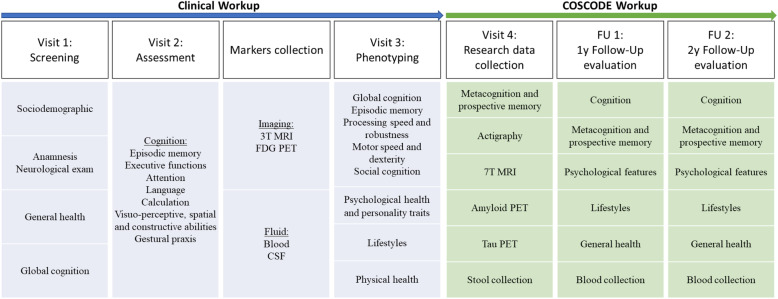
COSCODE is an observational, longitudinal (4 years), prospective clinical cohort study involving 120 SCD, and 80 control study participants (40 individuals with no cognitive impairment, and 40 living with mild cognitive impairment - MCI, or dementia due to AD), all of which will undergo diffusion magnetic resonance imaging (MRI) and functional magnetic resonance imaging (fMRI) as well as behavioral and biomarker assessments at baseline and after 1 and 2 years. Both hypothesis-driven and data-driven cluster analysis approaches will be used to identify SCD sub-types based on metacognition, connectivity, behavioral, and biomarker features.
COSCODE will allow defining and interpreting the constellation of signs and symptoms associated with different etiologies of SCD, paving the way to the development of cost-effective risk assessment and prevention protocols.
主观认知下降(SCD)是指在没有客观证据的情况下,个体对记忆和/或其他认知功能下降的主观感知。然而,一些 SCD 个体可能患有非常早期的神经退行性疾病(如阿尔茨海默病,AD)、轻度精神疾病、神经和/或躯体合并症。即使已经建立了理论框架,SCD 的病因仍然远未阐明。临床观察最近提出了一个假设,即患有初期 AD 的个体可能高估了对自己认知表现的元认知判断,而患有精神疾病的个体通常表现出低估的元认知判断。此外,已知脑连接变化是 AD 和精神疾病的相关因素,并且可以用作生物标志物来区分不同病因的 SCD 个体。COSCODE 研究的目的是确定与 SCD 不同病因相关的元认知、连接、行为和生物标志物特征。本文介绍了其基本原理和研究设计。
COSCODE 是一项观察性、纵向(4 年)、前瞻性临床队列研究,涉及 120 名 SCD 和 80 名对照研究参与者(40 名无认知障碍个体和 40 名患有轻度认知障碍-MCI 或 AD 导致的痴呆),所有参与者都将在基线以及 1 年和 2 年后接受扩散磁共振成像(MRI)和功能磁共振成像(fMRI)以及行为和生物标志物评估。将使用假设驱动和数据驱动的聚类分析方法,根据元认知、连接、行为和生物标志物特征,识别 SCD 亚型。
COSCODE 将有助于定义和解释与 SCD 不同病因相关的症状和体征组合,为开发具有成本效益的风险评估和预防方案铺平道路。