Neurochemistry Laboratory, Department of Laboratory Medicine, Amsterdam UMC, Vrije Universiteit Amsterdam, Amsterdam Neuroscience, Amsterdam, The Netherlands.
Translational Artificial Intelligence Laboratory, Department of Laboratory Medicine, Amsterdam UMC, Vrije Universiteit Amsterdam, Amsterdam Public Health, Amsterdam, The Netherlands.
Alzheimers Dement. 2024 Sep;20(9):6115-6132. doi: 10.1002/alz.14088. Epub 2024 Aug 3.
We developed a multimarker blood test result interpretation tool for the clinical dementia practice, including phosphorylated (P-)tau181, amyloid-beta (Abeta)42/40, glial fibrillary acidic protein (GFAP), and neurofilament light (NfL).
We measured the plasma biomarkers with Simoa (n = 1199), applied LASSO regression for biomarker selection and receiver operating characteristics (ROC) analyses to determine diagnostic accuracy. We validated our findings in two independent cohorts and constructed a visualization approach.
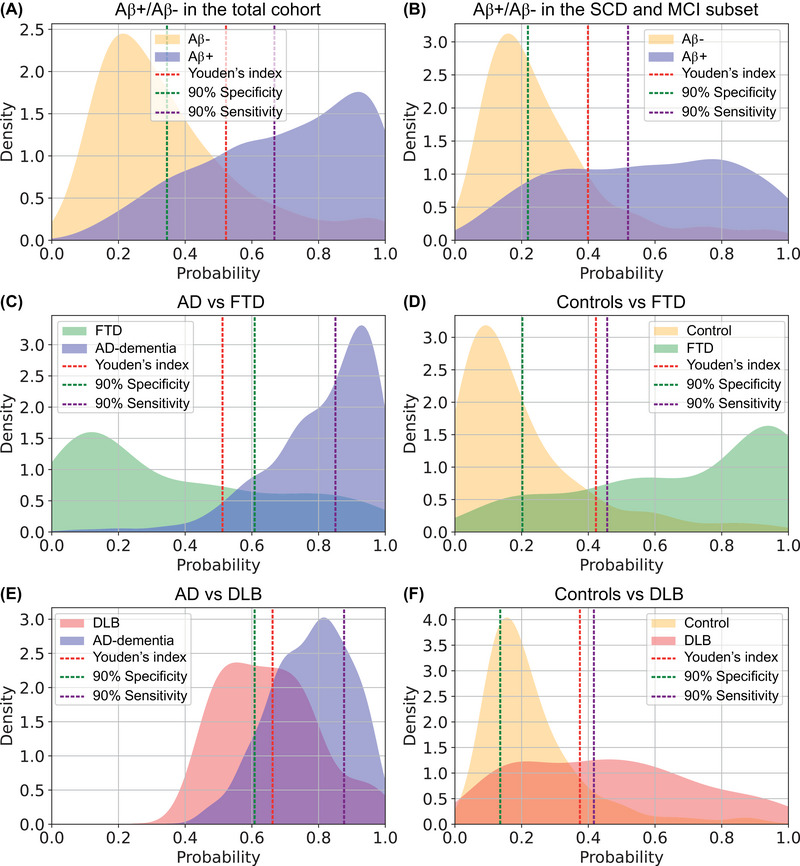
P-tau181, GFAP, and NfL were selected. This combination had area under the curve (AUC) = 83% to identify amyloid positivity in pre-dementia stages, AUC = 87%-89% to differentiate Alzheimer's or controls from frontotemporal dementia, AUC = 74%-76% to differentiate Alzheimer's or controls from dementia with Lewy bodies. Highly reproducible AUCs were obtained in independent cohorts. The resulting visualization tool includes UpSet plots to visualize the stand-alone biomarker results and density plots to visualize the biomarker results combined.
Our multimarker blood test interpretation tool is ready for testing in real-world clinical dementia settings.
We developed a multimarker blood test interpretation tool for clinical dementia practice. Our interpretation tool includes plasma biomarkers P-tau, GFAP, and NfL. Our tool is particularly useful for Alzheimer's and frontotemporal dementia diagnosis.
我们开发了一种用于临床痴呆实践的多标志物血液检测结果解读工具,包括磷酸化(P-)tau181、β淀粉样蛋白(Abeta)42/40、胶质纤维酸性蛋白(GFAP)和神经丝轻链(NfL)。
我们使用 Simoa 测量了血浆生物标志物(n=1199),应用 LASSO 回归进行生物标志物选择和接收者操作特征(ROC)分析,以确定诊断准确性。我们在两个独立队列中验证了我们的发现,并构建了一种可视化方法。
选择了 P-tau181、GFAP 和 NfL。这种组合具有 83%的曲线下面积(AUC),可用于在痴呆前阶段识别淀粉样蛋白阳性,AUC=87%-89%,用于区分阿尔茨海默病或对照与额颞叶痴呆,AUC=74%-76%,用于区分阿尔茨海默病或对照与路易体痴呆。在独立队列中获得了高度可重复的 AUC。由此产生的可视化工具包括 UpSet 图,用于可视化独立生物标志物的结果,以及密度图,用于可视化生物标志物结果的组合。
我们的多标志物血液检测解读工具已准备好在真实临床痴呆环境中进行测试。
我们开发了一种用于临床痴呆实践的多标志物血液检测解读工具。我们的解读工具包括 P-tau、GFAP 和 NfL 等血浆生物标志物。我们的工具特别适用于阿尔茨海默病和额颞叶痴呆的诊断。