Department of Internal Medicine, Radboud Expertise Center for Immunodeficiency and Autoinflammation, and Radboud Center for Infectious Disease (RCI), Radboud University Medical Center, Nijmegen, the Netherlands.
Department of Human Genetics, Radboud University Medical Center, Nijmegen, the Netherlands.
Genome Med. 2021 May 25;13(1):94. doi: 10.1186/s13073-021-00907-w.
The interleukin (IL)-1 pathway is primarily associated with innate immunological defense and plays a major role in the induction and regulation of inflammation. Both common and rare genetic variation in this pathway underlies various inflammation-mediated diseases, but the role of rare variants relative to common variants in immune response variability in healthy individuals remains unclear.
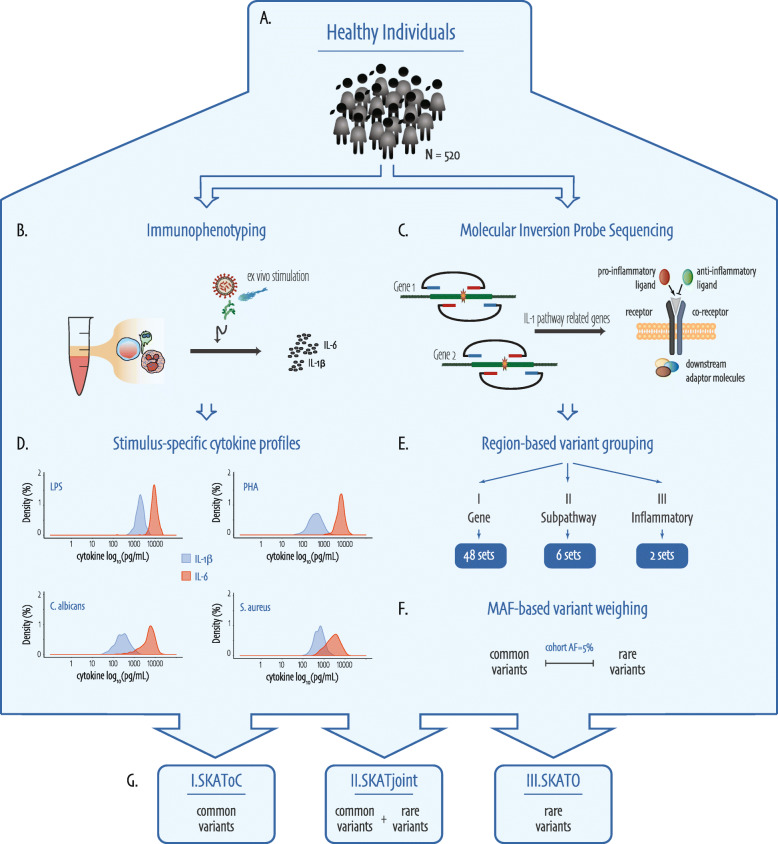
We performed molecular inversion probe sequencing on 48 IL-1 pathway-related genes in 463 healthy individuals from the Human Functional Genomics Project. We functionally grouped common and rare variants, over gene, subpathway, and inflammatory levels and performed the Sequence Kernel Association Test to test for association with in vitro stimulation-induced cytokine responses; specifically, IL-1β and IL-6 cytokine measurements upon stimulations that represent an array of microbial infections: lipopolysaccharide (LPS), phytohaemagglutinin (PHA), Candida albicans (C. albicans), and Staphylococcus aureus (S. aureus).
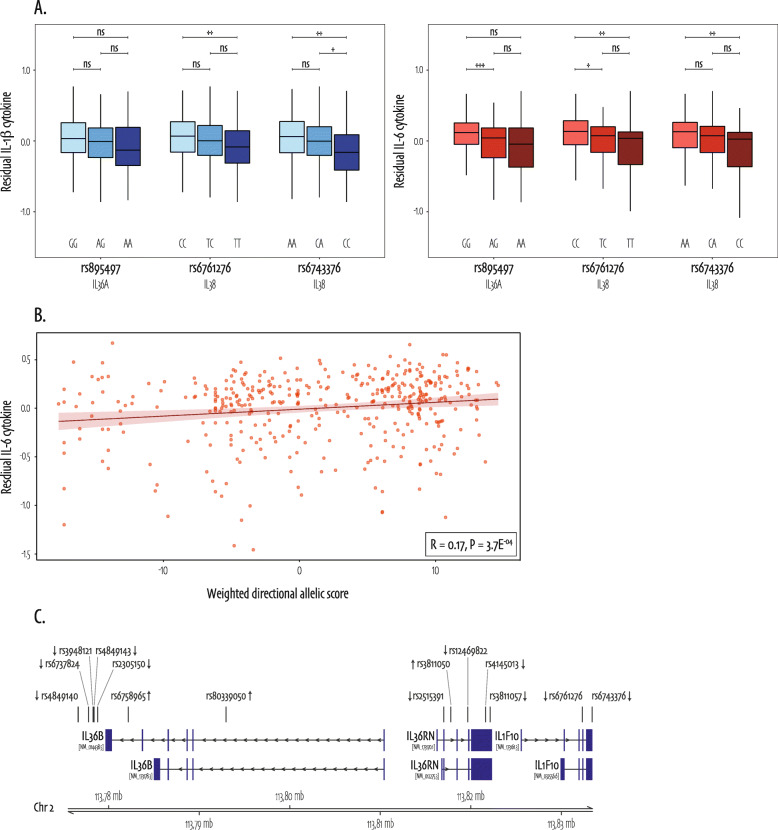
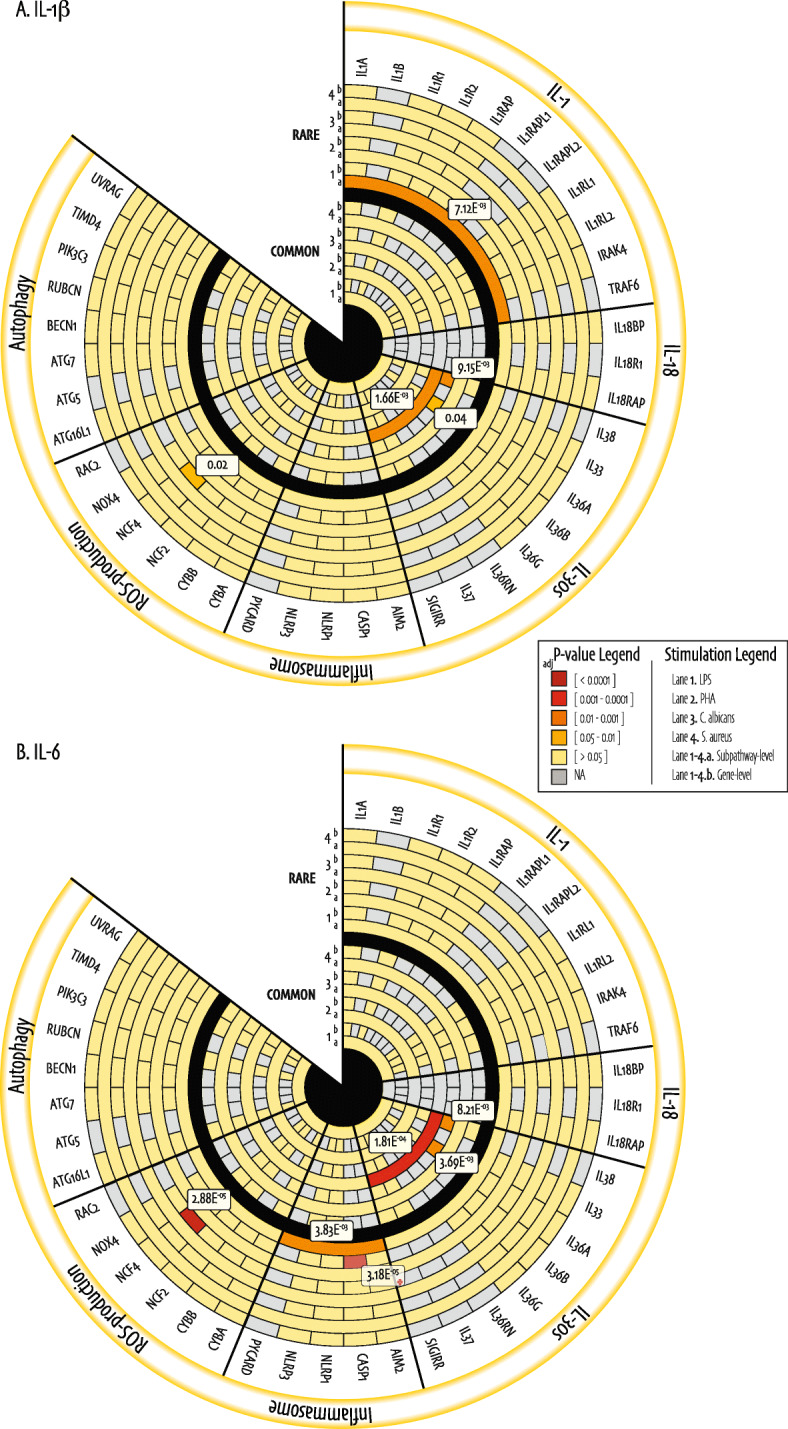
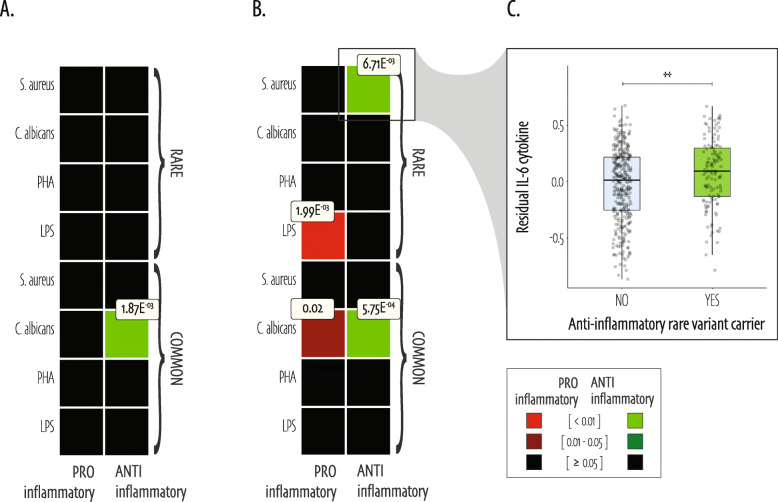
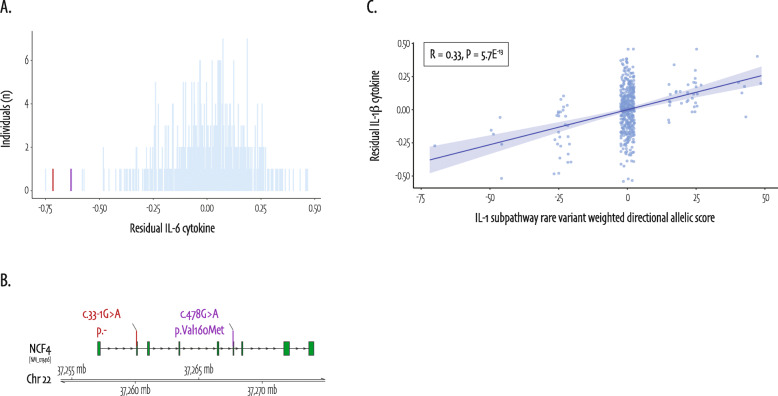
We identified a burden of NCF4 rare variants with PHA-induced IL-6 cytokine and showed that the respective carriers are in the 1% lowest IL-6 producers. Collapsing rare variants in IL-1 subpathway genes produces a bidirectional association with LPS-induced IL-1β cytokine levels, which is reflected by a significant Spearman correlation. On the inflammatory level, we identified a burden of rare variants in genes encoding for proteins with an anti-inflammatory function with S. aureus-induced IL-6 cytokine. In contrast to these rare variant findings which were based on different types of stimuli, common variant associations were exclusively identified with C. albicans-induced cytokine over various levels of grouping, from the gene, to subpathway, to inflammatory level.
In conclusion, this study shows that functionally grouping common and rare genetic variants enables the elucidation IL-1-mediated biological mechanisms, specifically, for IL-1β and IL-6 cytokine responses induced by various stimuli. The framework used in this study may allow for the analysis of rare and common genetic variants in a wider variety of (non-immune) complex phenotypes and therefore has the potential to contribute to better understanding of unresolved, complex traits and diseases.
白细胞介素(IL)-1 途径主要与先天免疫防御有关,在炎症的诱导和调节中起着重要作用。该途径中的常见和罕见遗传变异是各种炎症介导疾病的基础,但在健康个体的免疫反应变异性中,罕见变异相对于常见变异的作用仍不清楚。
我们对来自人类功能基因组学计划的 463 名健康个体的 48 个 IL-1 途径相关基因进行了分子倒置探针测序。我们按基因、子途径和炎症水平对常见和罕见变异进行了功能分组,并进行了序列核关联测试,以测试与体外刺激诱导的细胞因子反应的关联;具体而言,对代表一系列微生物感染的刺激物进行了 LPS、PHA、白念珠菌(C.albicans)和金黄色葡萄球菌(S.aureus)的刺激后,测量了 IL-1β 和 IL-6 细胞因子。
我们鉴定出 NCF4 罕见变异的负担与 PHA 诱导的 IL-6 细胞因子有关,并表明各自的载体处于 IL-6 产生量最低的 1%。IL-1 子途径基因中的罕见变异的合并产生了与 LPS 诱导的 IL-1β 细胞因子水平的双向关联,这反映在显著的 Spearman 相关性中。在炎症水平上,我们鉴定出与金黄色葡萄球菌诱导的 IL-6 细胞因子相关的抗炎功能蛋白编码基因的罕见变异负担。与这些基于不同刺激物的罕见变异发现相反,仅在各种分组水平(从基因、子途径到炎症水平)上,对 C. albicans 诱导的细胞因子的常见变异关联进行了鉴定。
总之,这项研究表明,对常见和罕见遗传变异进行功能分组可以阐明 IL-1 介导的生物学机制,特别是各种刺激物诱导的 IL-1β 和 IL-6 细胞因子反应。本研究中使用的框架可用于分析更广泛的(非免疫)复杂表型中的罕见和常见遗传变异,因此有可能有助于更好地理解未解决的复杂特征和疾病。