Direction Des Laboratoires de Santé, Ministère de La Santé, Kinshasa, Democratic Republic of the Congo.
Institut National de Recherche Biomédicale (INRB), Laboratoire de Virologie Clinique, Kinshasa, Democratic Republic of the Congo.
Infect Dis Poverty. 2021 May 25;10(1):77. doi: 10.1186/s40249-021-00860-1.
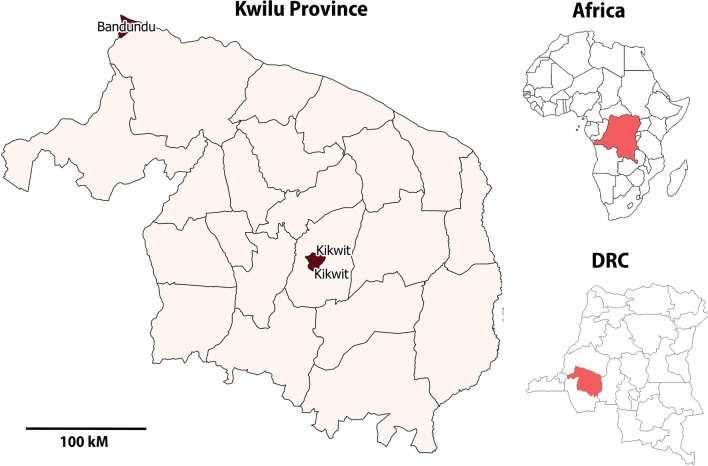
Malaria rapid diagnostic tests have become a primary and critical tool for malaria diagnosis in malaria-endemic countries where Plasmodium falciparum Histidine Rich Protein 2-based rapid diagnostic tests (PfHRP2-based RDTs) are widely used. However, in the last decade, the accuracy of PfHRP2-based RDTs has been challenged by the emergence of P. falciparum strains harbouring deletions of the P. falciparum histidine rich protein 2 (pfhrp2) gene, resulting in false-negative results. In the Democratic Republic of Congo (D.R. Congo), little is known about the prevalence of the pfhrp2 gene deletion among P. falciparum isolates infecting symptomatic patients, especially in low to moderate transmission areas where pfhrp2 deletion parasites are assumed to emerge and spread. Here we determine the local prevalence and factors associated with pfhrp2 gene deletions among symptomatic malaria patients in the Kwilu Province of the D.R. Congo.
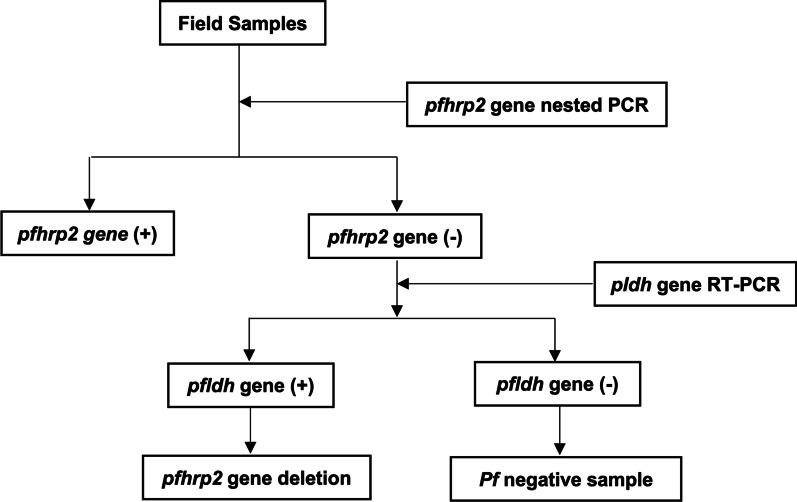
We used secondary data from a prospective health facility-based cross-sectional study conducted in 2018. Blood was collected for microscopy, PfHRP2-RDT, and spotted onto Whatman filter paper for downstream genetic analysis. Genomic DNA was extracted and used to perform PCR assays for the detection and confirmation of pfhrp2 gene deletions. Fischer's exact and the Kruskal-Wallis tests were applied to look for associations between potential explanatory variables and the pfhrp2 gene deletion with a level of statistical significance set at P < 0.05.
Of the 684 enrolled symptomatic patients, 391 (57.7%) were female. The majority (87.7%) reported the presence of mosquito breeding sites within the household's compound, and fever was the most reported symptom (81.6%). The overall prevalence of the pfhrp2 gene deletion was 9.2% (95% CI: 6.7%-12.1%). The deletion of the pfhrp2 gene was associated with health zone of origin (P = 0.012) and age (P = 0.019). Among false-negative PfHRP2-RDT results, only 9.9% were due to pfhrp2 gene deletion.
P. falciparum isolates with pfhrp2 gene deletions are relatively common among symptomatic patients in Kwilu province. Further investigations are needed to provide enough evidence for policy change. Meanwhile, the use of RDTs targeting PfHRP2 and parasite lactate dehydrogenase (pLDH) antigens could limit the spread of deleted isolates.
疟疾快速诊断检测已成为疟疾流行国家疟疾诊断的主要和关键工具,在这些国家中,广泛使用基于恶性疟原虫环子氨酸蛋白 2(PfHRP2)的快速诊断检测(PfHRP2-RDT)。然而,在过去十年中,PfHRP2-RDT 的准确性受到携带恶性疟原虫环子氨酸蛋白 2(pfhrp2)基因缺失的恶性疟原虫株的出现所挑战,导致假阴性结果。在刚果民主共和国(刚果(金)),对于感染有症状患者的恶性疟原虫分离株中 pfhrp2 基因缺失的流行率知之甚少,特别是在低至中度传播地区,假设 pfhrp2 缺失寄生虫会出现并传播。在这里,我们确定了在刚果(金)奎卢省有症状疟疾患者中 pfhrp2 基因缺失的当地流行率和相关因素。
我们使用了 2018 年进行的一项基于前瞻性卫生机构的横断面研究的二级数据。采集血液进行显微镜检查、PfHRP2-RDT,并点样到沃特曼滤纸上进行下游基因分析。提取基因组 DNA,并用于进行 PCR 检测以检测和确认 pfhrp2 基因缺失。应用 Fisher 精确检验和 Kruskal-Wallis 检验来寻找潜在解释变量与 pfhrp2 基因缺失之间的关联,统计显著性水平设为 P<0.05。
在纳入的 684 名有症状患者中,有 391 名(57.7%)为女性。大多数患者(87.7%)报告其家庭院内有蚊子滋生地,发热是最常见的症状(81.6%)。pfhrp2 基因缺失的总体流行率为 9.2%(95%CI:6.7%-12.1%)。pfhrp2 基因缺失与来源卫生区(P=0.012)和年龄(P=0.019)有关。在 PfHRP2-RDT 的假阴性结果中,仅有 9.9%是由于 pfhrp2 基因缺失。
在奎卢省有症状患者中,携带 pfhrp2 基因缺失的恶性疟原虫分离株相对常见。需要进一步调查,以提供足够的证据来改变政策。同时,使用针对 PfHRP2 和寄生虫乳酸脱氢酶(pLDH)抗原的 RDT 可以限制缺失分离株的传播。