Park Hyung Bin, Gwark Ji-Yong, Im Jin-Hyung, Na Jae-Boem
Department of Orthopaedic Surgery, Gyeongsang National University School of Medicine and Gyeongsang National University Changwon Hospital, Changwon, Republic of Korea.
Gyeongsang Institute of Health Sciences, Gyeongsang National University, Jinju, Republic of Korea.
Orthop J Sports Med. 2021 May 13;9(5):23259671211007734. doi: 10.1177/23259671211007734. eCollection 2021 May.
Metabolic factors have been linked to tendinopathies, yet few studies have investigated the association between metabolic factors and lateral epicondylitis.
To evaluate risk factors for lateral epicondylitis, including several metabolic factors.
Case-control study; Level of evidence, 3.
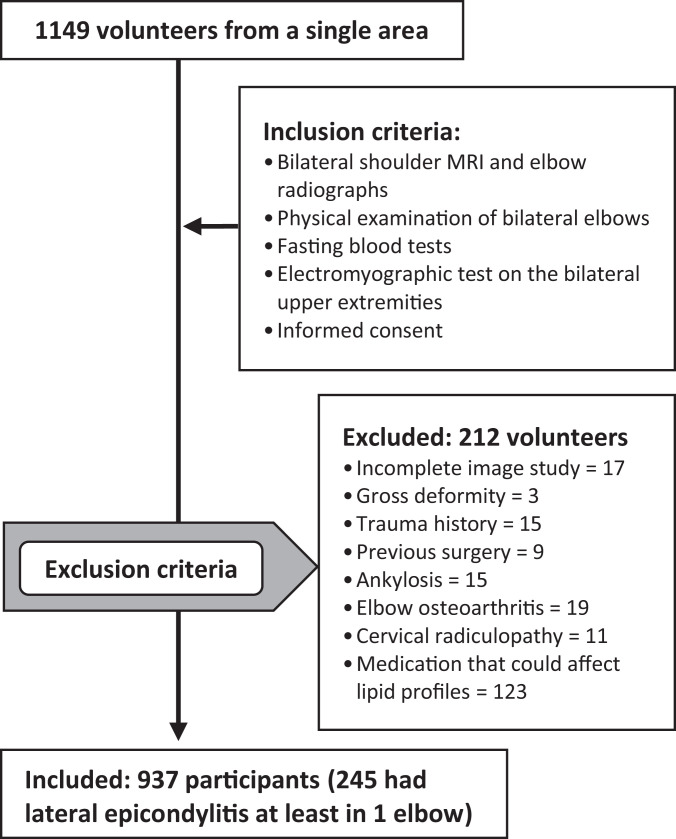
We evaluated 1 elbow in each of 937 volunteers from a rural region that employs many agricultural laborers. Each participant received a questionnaire, physical examinations, blood tests, simple radiographic evaluations of both elbows, magnetic resonance imaging of bilateral shoulders, and an electrophysiological study of bilateral upper extremities. Lateral epicondylitis was diagnosed using 3 criteria: (1) pain at the lateral aspect of the elbow, (2) point tenderness over the lateral epicondyle, and (3) pain during resistive wrist dorsiflexion with the elbow in full extension. Multivariable logistic regression analysis was used to calculate the odds ratios (ORs) and 95% CIs for various demographic, physical, and social factors, including age, sex, waist circumference, dominant-side involvement, smoking habit, alcohol intake, and participation in manual labor; the comorbidities of diabetes, hypertension, thyroid dysfunction, metabolic syndrome, ipsilateral biceps tendon injury, ipsilateral rotator cuff tear, and ipsilateral carpal tunnel syndrome; and the serologic parameters of serum lipid profile, glycosylated hemoglobin A1c, level of thyroid hormone, and high-sensitivity C-reactive protein.
The prevalence of lateral epicondylitis was 26.1% (245/937 participants). According to the multivariable logistic regression analysis, female sex (OR, 2.47; 95% CI, 1.78-3.43), dominant-side involvement (OR, 3.21; 95% CI, 2.24-4.60), manual labor (OR, 2.25; 95% CI, 1.48-3.43), and ipsilateral rotator cuff tear (OR, 2.77; 95% CI, 1.96-3.91) were significantly associated with lateral epicondylitis ( < .001 for all). No metabolic factors were significantly associated with lateral epicondylitis.
Female sex, dominant-side involvement, manual labor, and ipsilateral rotator cuff tear were found to be risk factors for lateral epicondylitis. The study results suggest that overuse activity is more strongly associated with lateral epicondylitis than are metabolic factors.
代谢因素与肌腱病有关,但很少有研究调查代谢因素与外侧上髁炎之间的关联。
评估外侧上髁炎的危险因素,包括几种代谢因素。
病例对照研究;证据等级,3级。
我们对来自一个雇佣了许多农业劳动者的农村地区的937名志愿者的每只肘部进行了评估。每位参与者都接受了问卷调查、体格检查、血液检测、双肘的简单X线评估、双侧肩部的磁共振成像以及双侧上肢的电生理研究。外侧上髁炎采用以下3条标准进行诊断:(1)肘部外侧疼痛;(2)外侧上髁处有压痛点;(3)在肘关节完全伸展时进行抗阻腕背伸时疼痛。多变量逻辑回归分析用于计算各种人口统计学、体格和社会因素的比值比(OR)及95%可信区间(CI),这些因素包括年龄、性别、腰围、优势侧受累情况、吸烟习惯、饮酒量以及体力劳动参与情况;糖尿病、高血压、甲状腺功能障碍、代谢综合征、同侧肱二头肌腱损伤、同侧肩袖撕裂和同侧腕管综合征的合并症;以及血脂谱、糖化血红蛋白A1c、甲状腺激素水平和高敏C反应蛋白的血清学参数。
外侧上髁炎的患病率为26.1%(245/937名参与者)。根据多变量逻辑回归分析,女性(OR,2.47;95%CI,1.78 - 3.43)、优势侧受累(OR,3.21;95%CI,2.24 - 4.60)、体力劳动(OR,2.25;95%CI,1.48 - 3.43)和同侧肩袖撕裂(OR,2.77;95%CI,1.96 - 3.91)与外侧上髁炎显著相关(所有P均<0.001)。没有代谢因素与外侧上髁炎显著相关。
女性、优势侧受累、体力劳动和同侧肩袖撕裂被发现是外侧上髁炎的危险因素。研究结果表明,与代谢因素相比,过度使用活动与外侧上髁炎的关联更强。