Joshi Tanvi V, Bruce Shaina F, Grim Rod, Buchanan Tommy, Chatterjee-Paer Sudeshna, Burton Elizabeth R, Sorosky Joel I, Shahin Mark S, Edelson Mitchell I
Department of Obstetrics and Gynecology, Abington Hospital-Jefferson Health, 1200 Old York Road, Price 109, Abington, PA 19001, United States.
Hanjani Institute for Gynecologic Oncology, Asplundh Cancer Pavilion, Abington Hospital-Jefferson Health, 3941 Commerce Avenue, Willow Grove, PA 19090, United States.
Gynecol Oncol Rep. 2021 Apr 30;36:100771. doi: 10.1016/j.gore.2021.100771. eCollection 2021 May.
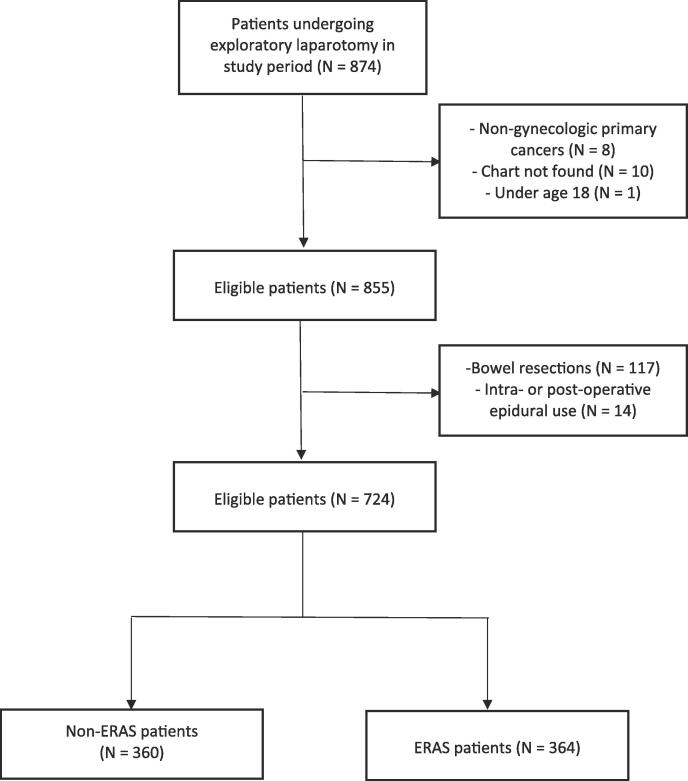
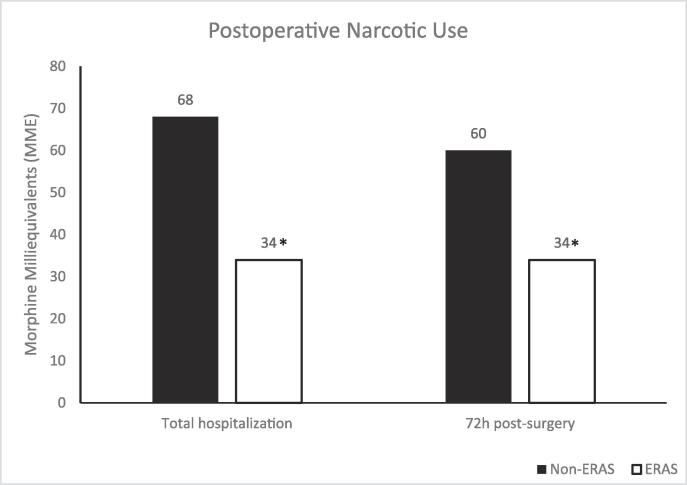
Enhanced Recovery after Surgery (ERAS) is an evidence-based approach that aims to reduce narcotic use and maintain anabolic balance to enable full functional recovery. Our primary aim was to determine the effect of ERAS on narcotic usage among patients who underwent exploratory laparotomy by gynecologic oncologists. We characterized its effect on length of stay, intraoperative blood transfusions, bowel function, 30-day readmissions, and postoperative complications. A retrospective cohort study was performed at Abington Hospital-Jefferson Health in gynecologic oncology. Women who underwent an exploratory laparotomy from 2011 to 2016 for both benign and malignant etiologies were included before and after implementation of our ERAS protocol. Patients who underwent a bowel resection were excluded. A total of 724 patients were included: 360 in the non-ERAS and 364 in the ERAS cohort. An overall reduction in narcotic usage, measured as oral morphine milliequivalents (MMEs) was observed in the ERAS relative to the non-ERAS group, during the entire hospital stay (MME 34 versus 68, p < 0.001 and within 72 h postoperatively (MME 34 versus 60, p < 0.005). A shorter length of stay and earlier return of bowel function were also observed in the ERAS group. No differences in 30-day readmissions (p = 0.967) or postoperative complications (p = 0.328) were observed. This study demonstrated the benefits of ERAS in Gynecologic Oncology. A significant reduction of postoperative narcotic use, earlier return of bowel function and a shorter postoperative hospital stay was seen in the ERAS compared to traditional perioperative care.
术后加速康复(ERAS)是一种基于证据的方法,旨在减少麻醉药物使用并维持合成代谢平衡,以实现完全功能康复。我们的主要目的是确定ERAS对妇科肿瘤学家进行探查性剖腹手术患者麻醉药物使用的影响。我们描述了其对住院时间、术中输血、肠道功能、30天再入院率和术后并发症的影响。在阿宾顿医院-杰斐逊健康中心的妇科肿瘤科室进行了一项回顾性队列研究。在实施我们的ERAS方案前后,纳入了2011年至2016年因良性和恶性病因接受探查性剖腹手术的女性。接受肠道切除术的患者被排除。总共纳入了724例患者:非ERAS组360例,ERAS组364例。相对于非ERAS组,在整个住院期间(口服吗啡毫克当量[MME]:34 vs 68,p<0.001)以及术后72小时内(MME:34 vs 60,p<0.005),ERAS组的麻醉药物使用总体减少。ERAS组还观察到住院时间缩短和肠道功能恢复更早。未观察到30天再入院率(p = 0.967)或术后并发症(p = 0.328)存在差异。本研究证明了ERAS在妇科肿瘤学中的益处。与传统围手术期护理相比,ERAS组术后麻醉药物使用显著减少,肠道功能恢复更早,术后住院时间更短。