Department of Rehabilitation, Dongyang People's Hospital, Yiwu, Zhejiang 322000, P.R. China.
Department of Child Rehabilitation, Yiwu Maternal and Child Health Care Hospital, Yiwu, Zhejiang 322000, P.R. China.
Mol Med Rep. 2021 Jul;24(1). doi: 10.3892/mmr.2021.12163. Epub 2021 May 26.
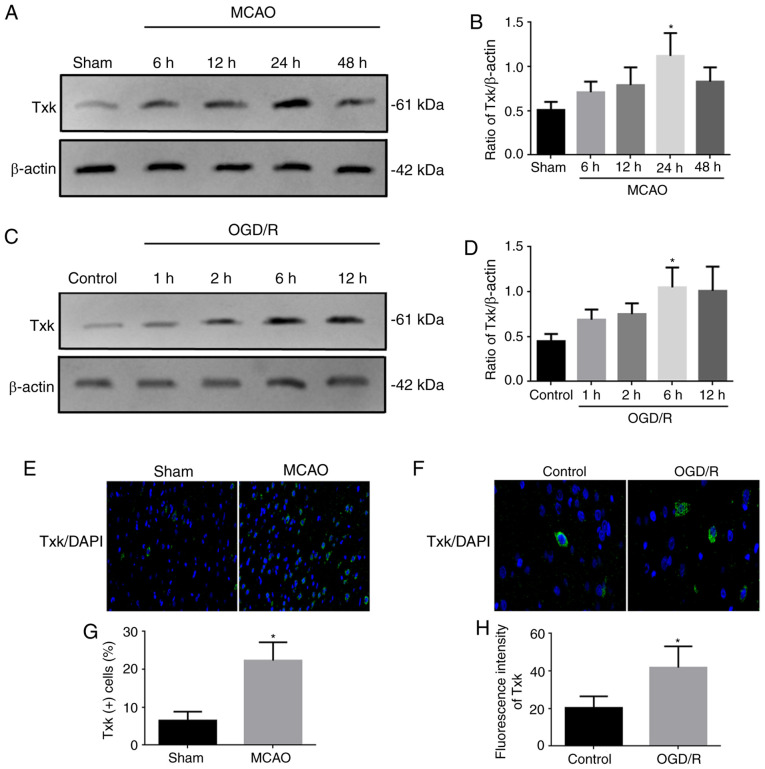
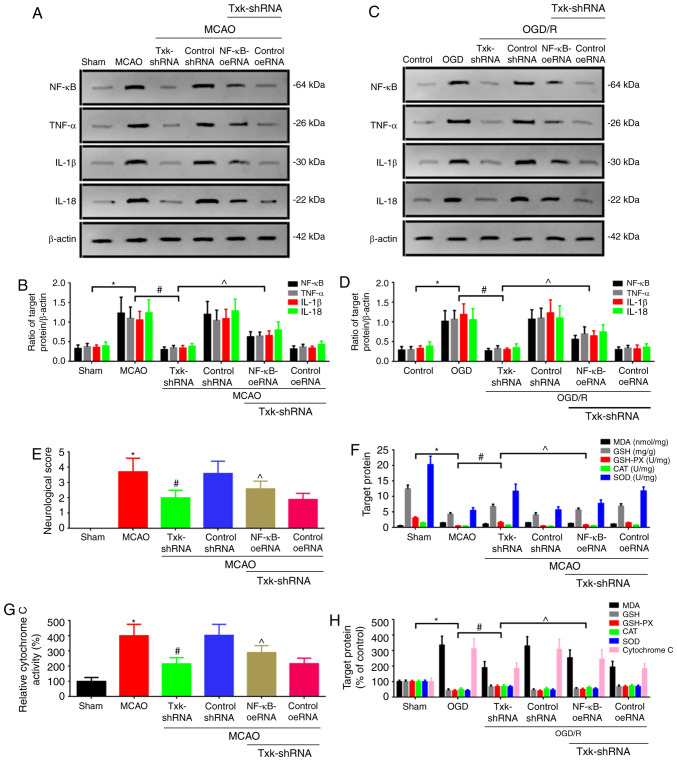
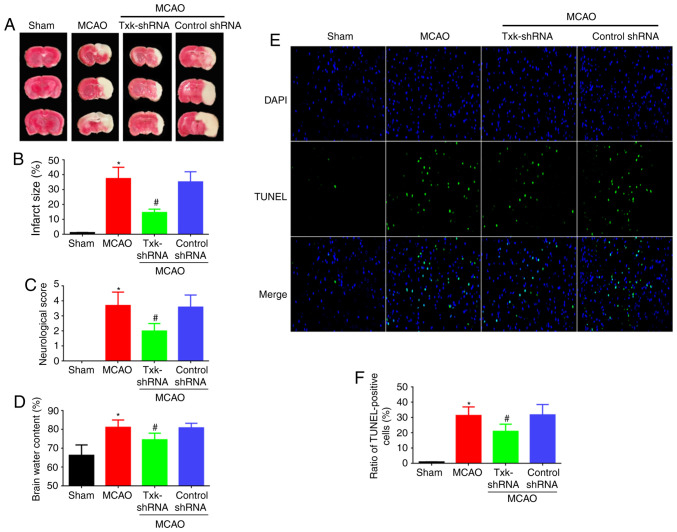
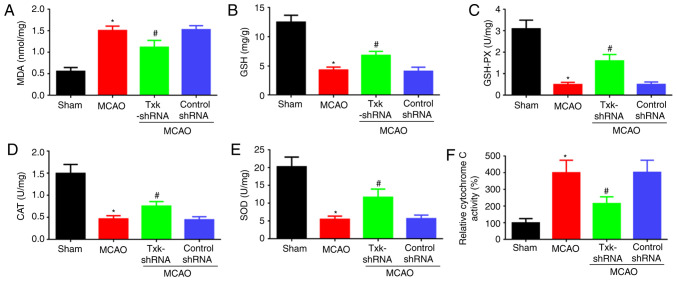
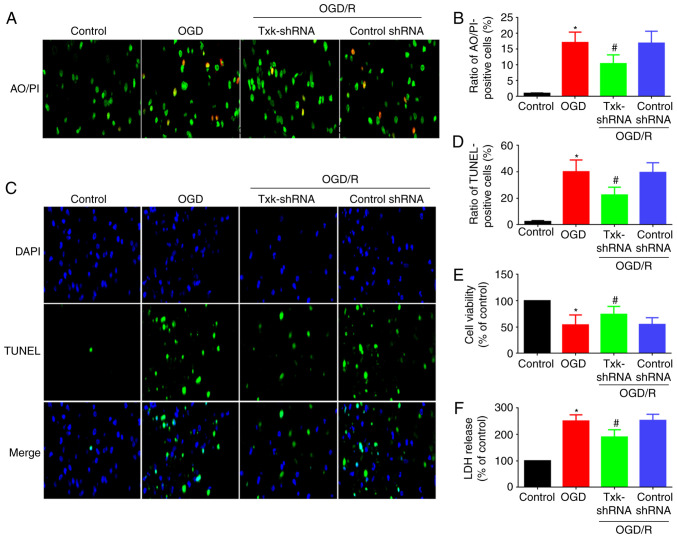
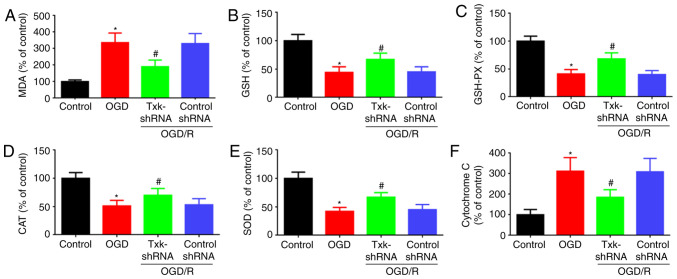
Ischemic stroke is an extremely mortal cerebrovascular disease, and neuroinflammation and oxidative stress emerge as important traits of ischemic stroke. However, as an inflammation‑associated factor, Txk tyrosine kinases (Txk) has been poorly studied in neuroscience research. The aim of the present study was to investigate the role of Txk after ischemia‑reperfusion (I/R) and , observe the association between Txk knockdown and neurological deficit and oxidative stress, and to explore whether the process was mediated by the activation of nuclear factor (NF)‑κB signaling pathway. Middle cerebral artery occlusion (MCAO), oxygen and glucose deprivation/reperfusion (OGD/R) model and western blotting have been used to simulate the I/R injury to analyze the expression, and to approximate the localization of Txk, respectively. Brain infarct volume, neurological score, brain water content, apoptosis and oxidative stress assays and apoptosis, cellular viability, the LDH release and oxidative stress assays were observed using a Txk‑knockdown lentivirus. Finally, NF‑κB overexpression lentivirus was applied to discuss whether the role of Txk following I/R was regulated by the NF‑κB signaling pathway. The results show that the Txk expression peaked at 24 h after MCAO and 6 h after OGD/R, respectively. Txk molecules gradually entered the nucleus after MCAO and OGD/R. The Txk‑knockdown lentivirus resulted in decreased brain infarct volume, neurological score, brain water content, apoptosis and oxidative stress after MCAO . Besides, Txk knockdown decreased apoptosis, LDH release, oxidative stress, and increased cellular viability, after ODG in vitro. Finally, NF‑κB overexpression reversed the process of neurological deficit and oxidative stress after Txk regulation and . Overall, the present study suggests that Txk potentially regulates apoptosis, neurological deficit, and oxidative stress after I/R, by entering the nucleus. NF‑κB maybe the downstream target factor of Txk.
缺血性脑卒中是一种极其致命的脑血管疾病,神经炎症和氧化应激是缺血性脑卒中的重要特征。然而,作为一种与炎症相关的因素,酪氨酸激酶(Txk)在神经科学研究中研究甚少。本研究旨在探讨 Txk 在缺血再灌注(I/R)后的作用,观察 Txk 敲低与神经功能缺损和氧化应激的关系,并探讨该过程是否通过核因子(NF)-κB 信号通路的激活来介导。通过使用大脑中动脉闭塞(MCAO)、氧葡萄糖剥夺/再灌注(OGD/R)模型和蛋白质印迹法分别模拟 I/R 损伤来分析 Txk 的表达和定位。通过使用 Txk 敲低慢病毒观察脑梗死体积、神经功能评分、脑水含量、凋亡和氧化应激测定以及细胞活力、乳酸脱氢酶(LDH)释放和氧化应激测定。最后,应用 NF-κB 过表达慢病毒探讨 Txk 敲低后 I/R 中 NF-κB 信号通路对 Txk 作用的调节。结果显示,Txk 表达在 MCAO 后 24 h 和 OGD/R 后 6 h 分别达到峰值。Txk 分子在 MCAO 和 OGD/R 后逐渐进入细胞核。Txk 敲低慢病毒可减少 MCAO 后的脑梗死体积、神经功能评分、脑水含量、凋亡和氧化应激。此外,Txk 敲低可减少 ODG 后的凋亡、LDH 释放、氧化应激,增加细胞活力。最后,NF-κB 过表达逆转了 Txk 调节后的神经功能缺损和氧化应激过程。综上所述,本研究表明,Txk 通过进入细胞核潜在地调节 I/R 后的细胞凋亡、神经功能缺损和氧化应激。NF-κB 可能是 Txk 的下游靶标因子。