Division of Gastroenterology & Hepatology, Mayo Clinic, Rochester, Minnesota.
Division of Pediatric Gastroenterology, Mayo Clinic, Rochester, Minnesota.
Am J Physiol Gastrointest Liver Physiol. 2021 Jul 1;321(1):G67-G74. doi: 10.1152/ajpgi.00009.2021. Epub 2021 May 26.
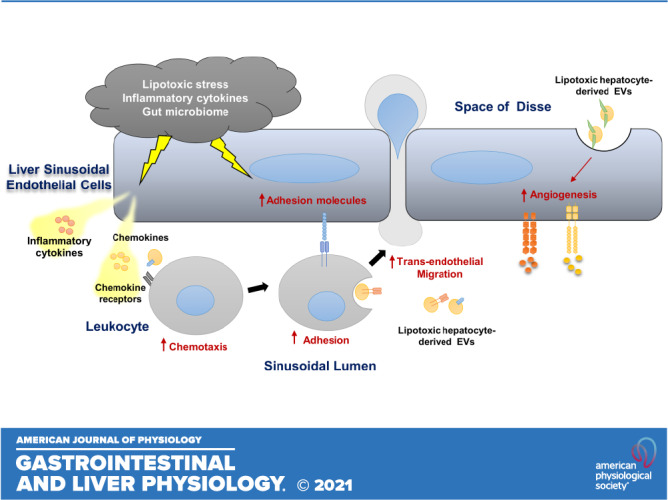
Liver sinusoidal endothelial cells (LSECs) are distinct subtypes of endothelial cells lining a low flow vascular bed at the interface of the liver parenchyma and the circulating immune cells and soluble factors. Emerging literature implicates LSEC in the pathogenesis and progression of nonalcoholic fatty liver disease (NAFLD). During the evolution of NAFLD, LSEC dysfunction ensues. LSECs undergo morphological and functional transformation known as "capillarization," as well as a pathogenic increase in surface adhesion molecules expression, referred to in this review as "endotheliopathy." LSECs govern the composition of hepatic immune cell populations in nonalcoholic steatohepatis (NASH) by mediating leukocyte subset adhesion through specific combinations of activated adhesion molecules and secreted chemokines. Moreover, extracellular vesicles released by hepatocyte under lipotoxic stress in NASH act as a catalyst for the inflammatory response and promote immune cell chemotaxis and adhesion. In the current review, we highlight leukocyte adhesion to LSEC as an initiating event in the sterile inflammatory response in NASH. We discuss preclinical studies targeting immune cells adhesion in NASH mouse models and potential therapeutic anti-inflammatory strategies for human NASH.
肝窦内皮细胞(LSEC)是衬在肝脏实质与循环免疫细胞和可溶性因子交界处的低流量血管床的独特内皮细胞亚型。新出现的文献表明 LSEC 在非酒精性脂肪性肝病(NAFLD)的发病机制和进展中起作用。在 NAFLD 的演变过程中,LSEC 功能障碍随之发生。LSEC 经历形态和功能转化,称为“毛细血管化”,以及表面黏附分子表达的致病性增加,在本综述中称为“内皮病”。LSEC 通过通过特定组合的激活黏附分子和分泌趋化因子来介导白细胞亚群黏附,从而调节非酒精性脂肪性肝炎(NASH)中肝免疫细胞群体的组成。此外,在 NASH 中,受脂肪毒性应激的肝细胞释放的细胞外囊泡作为炎症反应的催化剂,促进免疫细胞趋化和黏附。在本综述中,我们强调白细胞与 LSEC 的黏附作为 NASH 中无菌性炎症反应的起始事件。我们讨论了针对 NASH 小鼠模型中免疫细胞黏附的临床前研究和人类 NASH 的潜在治疗性抗炎策略。