B.P. Koirala Institute of Health Sciences, Dharan, Nepal.
Department of Health Services, Ministry of Health and Population, Kathmandu, Nepal.
PLoS One. 2021 May 26;16(5):e0252184. doi: 10.1371/journal.pone.0252184. eCollection 2021.
Family planning methods are used to promote safer sexual practices, reduce unintended pregnancies and unsafe abortion, and control population. Young people aged 15-24 years belong to a key reproductive age group. However, little is known about their engagement with the family planning services in Nepal. Our study aimed to identify the perceptions of and barriers to the use of family planning among youth in Nepal.
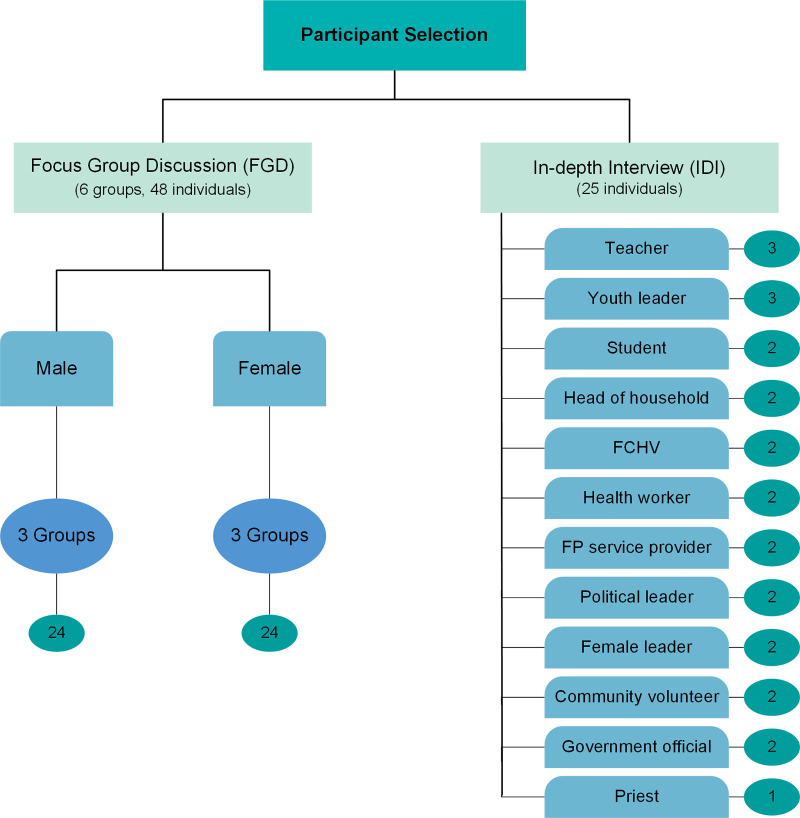
A qualitative explorative study was done among adolescents and young people aged 15-24 years from the Hattimuda village in eastern Nepal. Six focus group discussions and 25 in-depth interviews were conducted with both male and female participants in the community using a maximum variation sampling method. Data were analyzed using a thematic framework approach.
Many individuals were aware that family planning measures postpone pregnancy. However, some young participants were not fully aware of the available family planning services. Some married couples who preferred 'birth spacing' received negative judgments from their family members for not starting a family. The perceived barriers to the use of family planning included lack of knowledge about family planning use, fear of side effects of modern family planning methods, lack of access/affordability due to familial and religious beliefs/myths/misconceptions. On an individual level, some couples' timid nature also negatively influenced the uptake of family planning measures.
Women predominantly take the responsibility for using family planning measures in male-dominated decision-making societies. Moreover, young men feel that the current family planning programs have very little space for men to engage even if they were willing to participate. Communication in the community and in between the couples seem to be influenced by the presence of strong societal and cultural norms and practices. These practices seem to affect family planning related teaching at schools as well. This research shows that both young men and women are keen on getting involved with initiatives and campaigns for supporting local governments in strengthening the family planning programs in Nepal.
计划生育方法用于促进更安全的性行为,减少意外怀孕和不安全的堕胎,并控制人口。15-24 岁的年轻人属于关键生育年龄组。然而,人们对他们在尼泊尔参与计划生育服务的情况知之甚少。我们的研究旨在确定尼泊尔青年对计划生育的看法和使用障碍。
在尼泊尔东部的哈特穆达村,对 15-24 岁的青少年和年轻人进行了一项定性探索性研究。采用最大变异抽样法,对社区中的男女参与者进行了 6 次焦点小组讨论和 25 次深入访谈。使用主题框架方法分析数据。
许多人知道计划生育措施可以推迟怀孕。然而,一些年轻参与者对可用的计划生育服务并不完全了解。一些更喜欢“生育间隔”的已婚夫妇因没有开始家庭而受到家庭成员的负面评价。使用计划生育的感知障碍包括缺乏对计划生育使用的了解、对现代计划生育方法副作用的恐惧、由于家庭和宗教信仰/神话/误解而缺乏获取/负担能力。在个人层面上,一些夫妇的胆怯性格也对计划生育措施的采用产生了负面影响。
在男性主导的决策社会中,女性主要负责使用计划生育措施。此外,即使年轻男性愿意参与,他们也觉得目前的计划生育方案几乎没有给男性参与的空间。社区和夫妻之间的沟通似乎受到强大的社会和文化规范和习俗的影响。这些做法似乎也影响了学校的计划生育相关教学。这项研究表明,年轻男性和女性都热衷于参与支持地方政府加强尼泊尔计划生育方案的倡议和运动。