Department of Biochemistry, Max Planck Institute for Developmental Biology, Max-Planck-Ring 5, D-72076 Tübingen, Germany.
Nucleic Acids Res. 2021 Jun 21;49(11):6489-6510. doi: 10.1093/nar/gkab414.
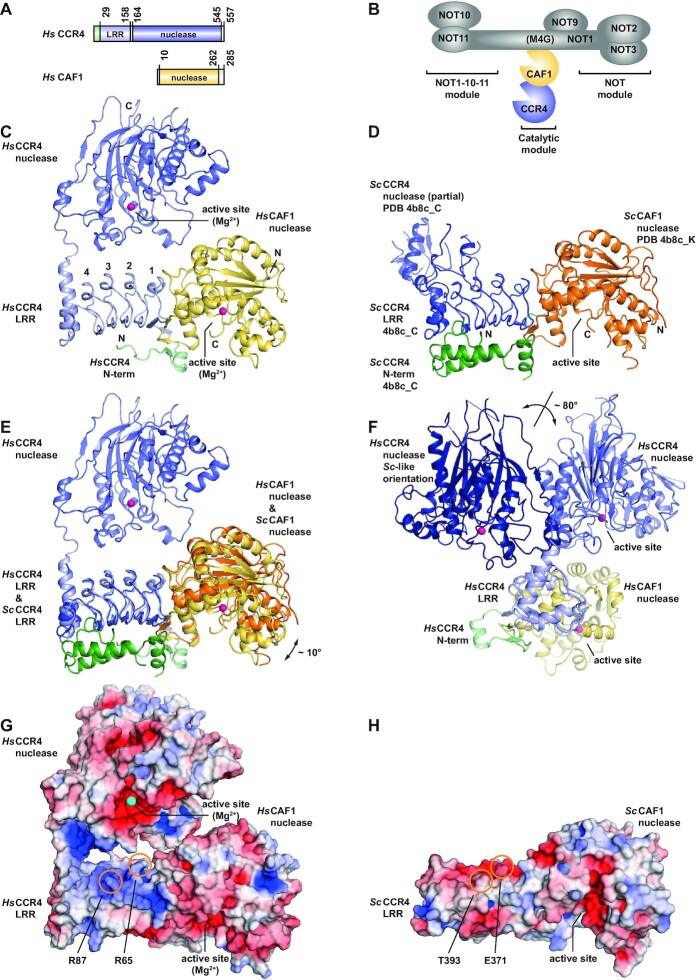
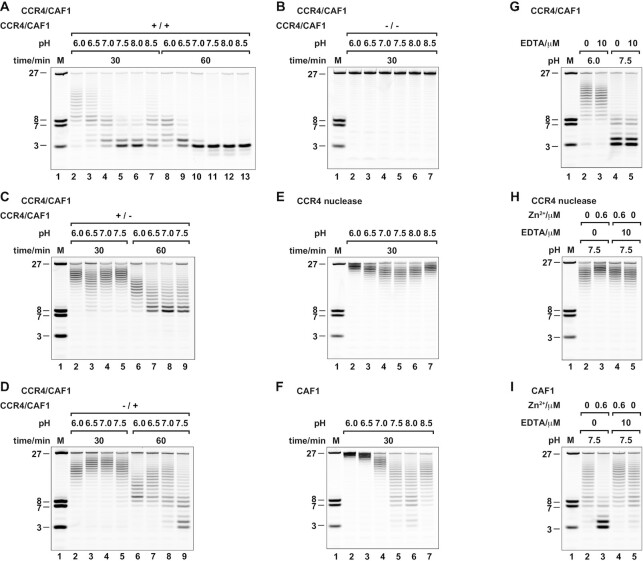
The CCR4 and CAF1 deadenylases physically interact to form the CCR4-CAF1 complex and function as the catalytic core of the larger CCR4-NOT complex. Together, they are responsible for the eventual removal of the 3'-poly(A) tail from essentially all cellular mRNAs and consequently play a central role in the posttranscriptional regulation of gene expression. The individual properties of CCR4 and CAF1, however, and their respective contributions in different organisms and cellular environments are incompletely understood. Here, we determined the crystal structure of a human CCR4-CAF1 complex and characterized its enzymatic and substrate recognition properties. The structure reveals specific molecular details affecting RNA binding and hydrolysis, and confirms the CCR4 nuclease domain to be tethered flexibly with a considerable distance between both enzyme active sites. CCR4 and CAF1 sense nucleotide identity on both sides of the 3'-terminal phosphate, efficiently differentiating between single and consecutive non-A residues. In comparison to CCR4, CAF1 emerges as a surprisingly tunable enzyme, highly sensitive to pH, magnesium and zinc ions, and possibly allowing distinct reaction geometries. Our results support a picture of CAF1 as a primordial deadenylase, which gets assisted by CCR4 for better efficiency and by the assembled NOT proteins for selective mRNA targeting and regulation.
CCR4 和 CAF1 脱腺苷酶物理相互作用形成 CCR4-CAF1 复合物,并作为更大的 CCR4-NOT 复合物的催化核心发挥作用。它们共同负责从基本上所有细胞 mRNA 中最终去除 3'-多聚(A)尾巴,因此在基因表达的转录后调控中发挥核心作用。然而,CCR4 和 CAF1 的单独特性及其在不同生物体和细胞环境中的各自贡献尚不完全清楚。在这里,我们确定了人 CCR4-CAF1 复合物的晶体结构,并表征了其酶和底物识别特性。该结构揭示了影响 RNA 结合和水解的特定分子细节,并证实 CCR4 核酸酶结构域以相当大的距离灵活地连接到两个酶活性位点之间。CCR4 和 CAF1 可以识别 3'-末端磷酸两侧的核苷酸身份,有效地区分单核苷酸和连续非 A 残基。与 CCR4 相比,CAF1 作为一种令人惊讶的可调谐酶出现,对 pH、镁离子和锌离子高度敏感,并且可能允许不同的反应几何形状。我们的结果支持了 CAF1 作为一种原始脱腺苷酶的观点,它通过 CCR4 提高效率,并通过组装的 NOT 蛋白实现对选择性 mRNA 靶向和调控。