State Key Laboratory of Plant Genomics and National Center for Plant Gene Research, Institute of Genetics and Developmental Biology, Chinese Academy of Sciences, Beijing, 100101, China.
Key Laboratory of Genetic Network Biology, Institute of Genetics and Developmental Biology, Chinese Academy of Sciences, Beijing, 100101, China.
Genome Biol. 2019 Sep 3;20(1):189. doi: 10.1186/s13059-019-1799-8.
Polyadenylation plays a key role in producing mature mRNAs in eukaryotes. It is widely believed that the poly(A)-binding proteins (PABs) uniformly bind to poly(A)-tailed mRNAs, regulating their stability and translational efficiency.
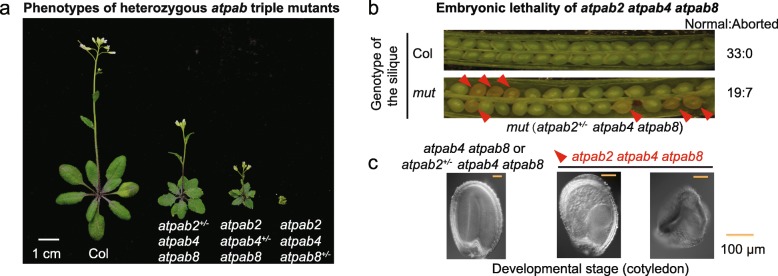
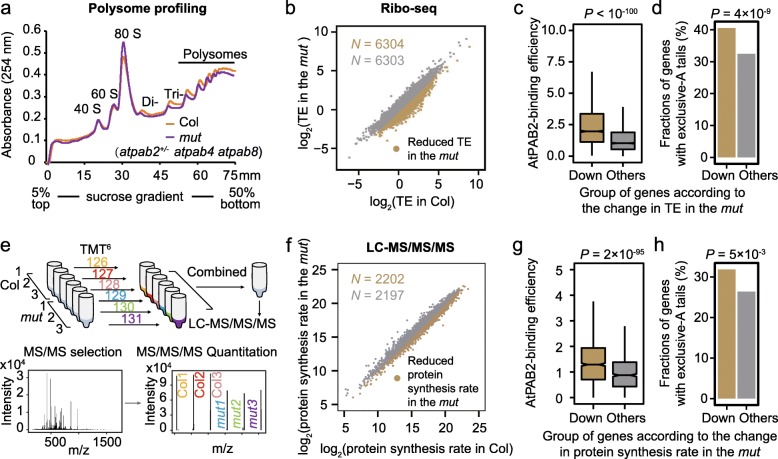
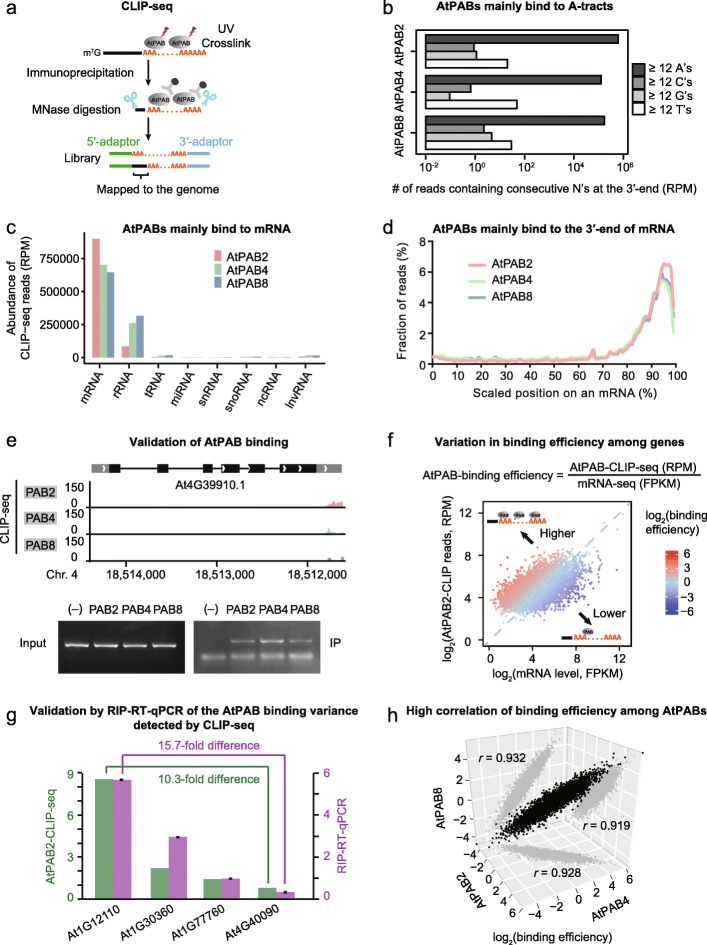
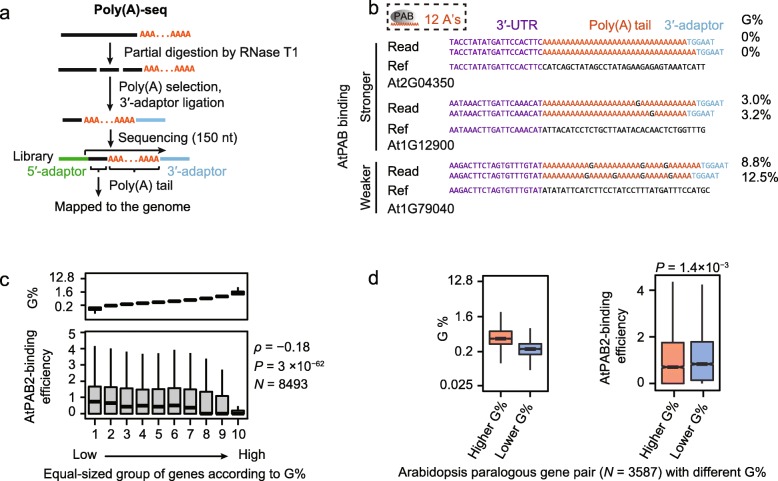
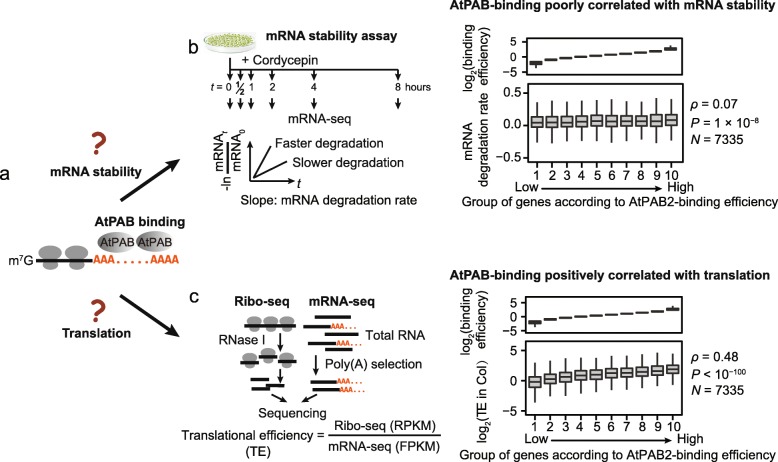
We observe that the homozygous triple mutant of broadly expressed Arabidopsis thaliana PABs, AtPAB2, AtPAB4, and AtPAB8, is embryonic lethal. To understand the molecular basis, we characterize the RNA-binding landscape of these PABs. The AtPAB-binding efficiency varies over one order of magnitude among genes. To identify the sequences accounting for the variation, we perform poly(A)-seq that directly sequences the full-length poly(A) tails. More than 10% of poly(A) tails contain at least one guanosine (G); among them, the G-content varies from 0.8 to 28%. These guanosines frequently divide poly(A) tails into interspersed A-tracts and therefore cause the variation in the AtPAB-binding efficiency among genes. Ribo-seq and genome-wide RNA stability assays show that AtPAB-binding efficiency of a gene is positively correlated with translational efficiency rather than mRNA stability. Consistently, genes with stronger AtPAB binding exhibit a greater reduction in translational efficiency when AtPAB is depleted.
Our study provides a new mechanism that translational efficiency of a gene can be regulated through the G-content-dependent PAB binding, paving the way for a better understanding of poly(A) tail-associated regulation of gene expression.
多聚腺苷酸化在真核生物产生成熟 mRNA 中起着关键作用。人们普遍认为多聚腺苷酸结合蛋白(PABs)均匀地结合到多聚腺苷酸化的 mRNAs 上,调节它们的稳定性和翻译效率。
我们观察到广泛表达的拟南芥 PAB 同源三聚体突变体 AtPAB2、AtPAB4 和 AtPAB8 的纯合突变体是胚胎致死的。为了了解其分子基础,我们对这些 PAB 的 RNA 结合图谱进行了表征。这些 PAB 的 AtPAB 结合效率在基因之间变化超过一个数量级。为了识别导致这种变化的序列,我们进行了 poly(A)-seq,直接对全长 poly(A)尾巴进行测序。超过 10%的 poly(A)尾巴至少含有一个鸟嘌呤(G);其中,G 含量从 0.8 到 28%不等。这些鸟嘌呤经常将 poly(A)尾巴分成散布的 A 链,因此导致基因之间的 AtPAB 结合效率的变化。Ribo-seq 和全基因组 RNA 稳定性测定表明,一个基因的 AtPAB 结合效率与翻译效率呈正相关,而与 mRNA 稳定性无关。一致地,当 AtPAB 耗尽时,AtPAB 结合能力更强的基因的翻译效率下降更大。
我们的研究提供了一个新的机制,即一个基因的翻译效率可以通过依赖 G 含量的 PAB 结合来调节,为更好地理解 poly(A)尾巴与基因表达相关的调控铺平了道路。