The affiliations of the members of the writing committee are as follows: the Department of Maternal, Newborn, Child, and Adolescent Health, and Ageing, World Health Organization, Geneva (S.P.N.R., S.Y., N.M., H.V.J., H.T., R.B.); Vardhman Mahavir Medical College and Safdarjung Hospital (S.A., P.M., N.C., J.S., P.A., K.N., I.S., K.C.A., H.C.) and the All India Institute of Medical Sciences (M.J.S.), New Delhi, and Translational Health Science and Technology Institute, Faridabad (N.W.) - all in India; Muhimbili University of Health and Allied Sciences (H.N., E.A., A.M.) and Muhimbili National Hospital (M.N., R.M.) - both in Dar es Salaam, Tanzania; the University of Malawi, College of Medicine, Blantyre, Malawi (K.K., L.G., A.T.M., V.S., Q.D.); Obafemi Awolowo University, Ile-Ife, Nigeria (C.H.A., O.K., B.P.K., E.A.A.); Kwame Nkrumah University of Science and Technology (S.N., R.L.-R., D.A., G.P.-R.) and Komfo Anokye Teaching Hospital (A.B.-Y., N.W.-B., I.N.), Kumasi, and the School of Public Health, University of Ghana, Accra (A.A.M.) - all in Ghana; Karolinska University Hospital (A.L.) and Karolinska Institute (N.B., A.L., B.W.), Stockholm; the Institute for Safety Governance and Criminology, University of Cape Town, Cape Town, South Africa (B.M.); and Stavanger University Hospital, Stavanger, Norway (S.R.).
N Engl J Med. 2021 May 27;384(21):2028-2038. doi: 10.1056/NEJMoa2026486.
"Kangaroo mother care," a type of newborn care involving skin-to-skin contact with the mother or other caregiver, reduces mortality in infants with low birth weight (<2.0 kg) when initiated after stabilization, but the majority of deaths occur before stabilization. The safety and efficacy of kangaroo mother care initiated soon after birth among infants with low birth weight are uncertain.
We conducted a randomized, controlled trial in five hospitals in Ghana, India, Malawi, Nigeria, and Tanzania involving infants with a birth weight between 1.0 and 1.799 kg who were assigned to receive immediate kangaroo mother care (intervention) or conventional care in an incubator or a radiant warmer until their condition stabilized and kangaroo mother care thereafter (control). The primary outcomes were death in the neonatal period (the first 28 days of life) and in the first 72 hours of life.
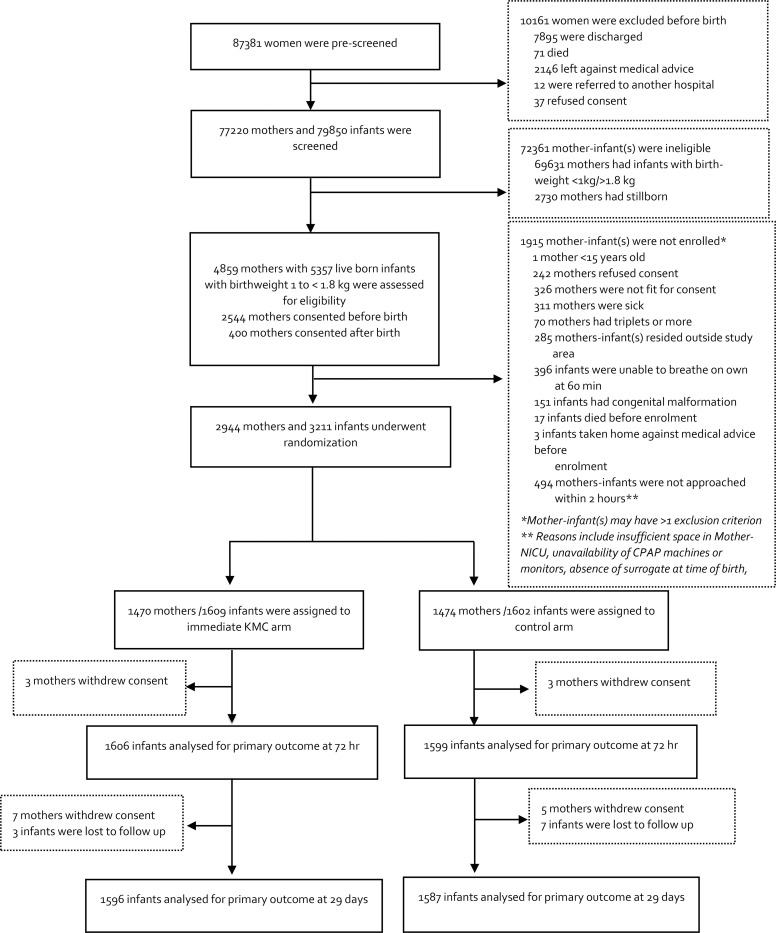
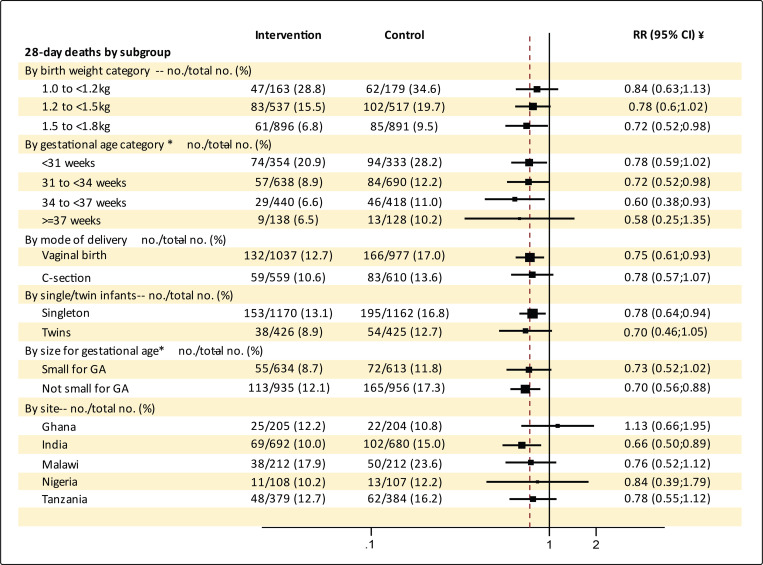
A total of 3211 infants and their mothers were randomly assigned to the intervention group (1609 infants with their mothers) or the control group (1602 infants with their mothers). The median daily duration of skin-to-skin contact in the neonatal intensive care unit was 16.9 hours (interquartile range, 13.0 to 19.7) in the intervention group and 1.5 hours (interquartile range, 0.3 to 3.3) in the control group. Neonatal death occurred in the first 28 days in 191 infants in the intervention group (12.0%) and in 249 infants in the control group (15.7%) (relative risk of death, 0.75; 95% confidence interval [CI], 0.64 to 0.89; P = 0.001); neonatal death in the first 72 hours of life occurred in 74 infants in the intervention group (4.6%) and in 92 infants in the control group (5.8%) (relative risk of death, 0.77; 95% CI, 0.58 to 1.04; P = 0.09). The trial was stopped early on the recommendation of the data and safety monitoring board owing to the finding of reduced mortality among infants receiving immediate kangaroo mother care.
Among infants with a birth weight between 1.0 and 1.799 kg, those who received immediate kangaroo mother care had lower mortality at 28 days than those who received conventional care with kangaroo mother care initiated after stabilization; the between-group difference favoring immediate kangaroo mother care at 72 hours was not significant. (Funded by the Bill and Melinda Gates Foundation; Australian New Zealand Clinical Trials Registry number, ACTRN12618001880235; Clinical Trials Registry-India number, CTRI/2018/08/015369.).
“袋鼠式护理”是一种涉及与母亲或其他照顾者进行皮肤接触的新生儿护理方式,可降低低出生体重(<2.0 千克)婴儿的死亡率,当在稳定后开始实施,但大多数死亡发生在稳定之前。在低出生体重婴儿出生后立即开始袋鼠式护理的安全性和有效性尚不确定。
我们在加纳、印度、马拉维、尼日利亚和坦桑尼亚的五家医院进行了一项随机对照试验,涉及出生体重在 1.0 至 1.799 千克之间的婴儿,他们被分配接受立即的袋鼠式护理(干预组)或在孵化器或辐射保暖器中接受常规护理,直到病情稳定,然后再接受袋鼠式护理(对照组)。主要结局是新生儿期(生命的头 28 天)和生命的头 72 小时内的死亡。
共有 3211 名婴儿及其母亲被随机分配至干预组(1609 名婴儿及其母亲)或对照组(1602 名婴儿及其母亲)。在新生儿重症监护病房,皮肤接触的每日中位持续时间为 16.9 小时(四分位间距,13.0 至 19.7),而对照组为 1.5 小时(四分位间距,0.3 至 3.3)。干预组在新生儿期第 28 天内死亡的婴儿有 191 例(12.0%),对照组有 249 例(15.7%)(死亡风险比,0.75;95%置信区间,0.64 至 0.89;P=0.001);生命的头 72 小时内死亡的婴儿在干预组有 74 例(4.6%),对照组有 92 例(5.8%)(死亡风险比,0.77;95%置信区间,0.58 至 1.04;P=0.09)。由于发现接受立即袋鼠式护理的婴儿死亡率降低,数据和安全监测委员会建议提前停止试验。
在出生体重在 1.0 至 1.799 千克之间的婴儿中,与接受稳定后开始的常规护理加袋鼠式护理的婴儿相比,立即接受袋鼠式护理的婴儿在 28 天时的死亡率较低;但在 72 小时时,组间差异无统计学意义。(由比尔及梅琳达·盖茨基金会资助;澳大利亚和新西兰临床试验注册中心编号,ACTRN12618001880235;印度临床试验注册中心编号,CTRI/2018/08/015369。)