Institute for Social Science Research, The University of Queensland, Indooroopilly, QLD, Australia.
The Australian Research Council Centre of Excellence for Children and Families over the Life Course (The Life Course Centre), The University of Queensland, Indooroopilly, QLD, Australia.
Eur J Clin Nutr. 2022 Feb;76(2):277-287. doi: 10.1038/s41430-021-00945-y. Epub 2021 May 26.
To examine trends and projections of underweight (Body Mass Index, BMI < 18.5 kg/m) and overweight (BMI ≥ 25.0 kg/m) in women of reproductive age in 55 low- and middle-income countries (LMICs).
We used data from 2,337,855 women aged 15-49 years from nationally representative Demographic and Health Survey conducted between 1990 and 2018. Bayesian linear regression analyses were performed.
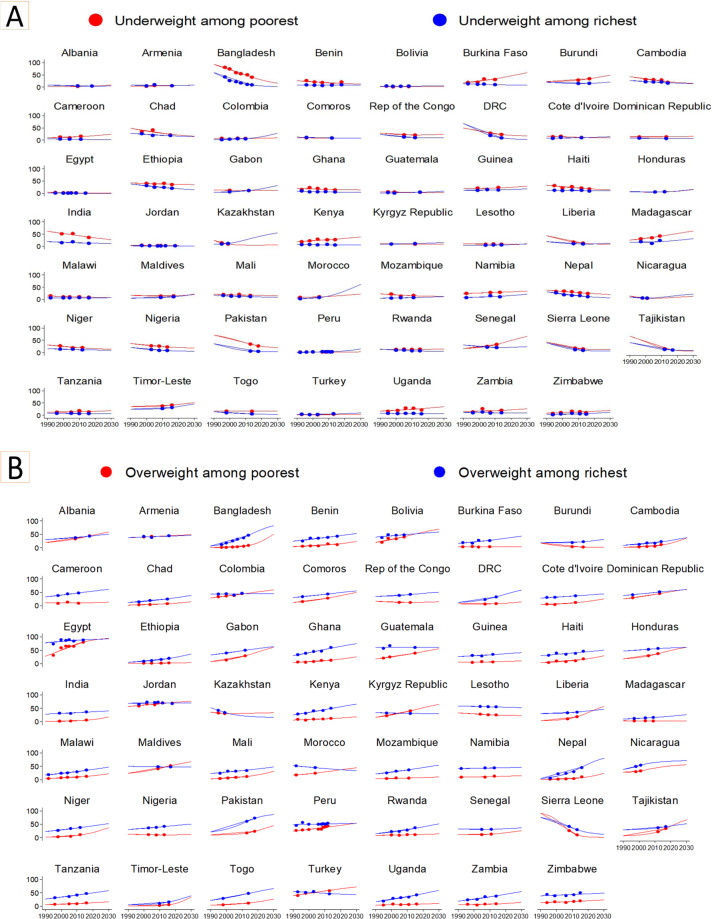
During 1990-2018, the prevalence of underweight decreased in 35 countries and overweight increased in 50 countries. The highest underweight increase was in Morocco (5.5%) and overweight in Nepal (12.4%). In 2030, >20% of women in eight LMICs will be underweight, with Madagascar (36.8%), Senegal (32.2%), and Burundi (29.2%) projected to experience the highest burden of underweight. Whereas >50% of women in 22 LMICs are projected to be overweight, with Egypt (94.7%), Jordan (75.0%), and Pakistan (74.1%) projected to have the highest burden of overweight. 24 LMICs are projected to experience the double burden of malnutrition (both underweight and overweight >20%) in 2030. Noticeable variations in underweight and overweight were observed across wealth, residence, education, and age of women, with a higher rate of overweight in high-income, high-education, and urban women. These inequalities have widened in many countries and are projected to continue. The probability of eradicating overweight and underweight is nearly 0% for all countries by 2030, except Egypt is on track to eradicate underweight.
Although the prevalence of underweight declined, this decline has been superseded by the dramatic increase of overweight. None of the 55 LMICs is likely to eradicate malnutrition in women by 2030.
研究 55 个中低收入国家(LMICs)育龄妇女中体重过轻(BMI<18.5kg/m)和超重(BMI≥25.0kg/m)的趋势和预测。
我们使用了 1990 年至 2018 年期间进行的 2337855 名 15-49 岁年龄的妇女的国家代表性人口与健康调查数据。进行了贝叶斯线性回归分析。
1990-2018 年期间,35 个国家的体重过轻患病率下降,50 个国家的超重患病率上升。体重过轻增加最多的是摩洛哥(5.5%),超重增加最多的是尼泊尔(12.4%)。到 2030 年,8 个 LMICs 中超过 20%的妇女体重过轻,其中马达加斯加(36.8%)、塞内加尔(32.2%)和布隆迪(29.2%)预计将面临最重的体重过轻负担。而 22 个 LMICs 中超过 50%的妇女预计超重,其中埃及(94.7%)、约旦(75.0%)和巴基斯坦(74.1%)预计将面临最重的超重负担。到 2030 年,24 个 LMICs 将面临营养不良的双重负担(体重过轻和超重均超过 20%)。在妇女的财富、居住地、教育和年龄方面,体重过轻和超重存在明显差异,高收入、高教育和城市妇女的超重率更高。在许多国家,这些不平等现象有所扩大,并预计将继续扩大。到 2030 年,除埃及有望消除体重过轻外,所有国家消除超重和体重不足的可能性几乎为 0%。
尽管体重过轻的患病率有所下降,但这一趋势被超重的急剧增加所取代。到 2030 年,55 个 LMICs 中没有一个国家可能消除妇女营养不良。