Kumar Abhishek, Sethi Vani, Murira Zivai, Prakash Atma, Shrestha Anita, Joe William
Department of Economics, FLAME University, Pune, Maharashtra, India.
UNICEF Regional Office for South Asia, Kathmandu, Nepal.
Front Nutr. 2024 Nov 18;11:1445314. doi: 10.3389/fnut.2024.1445314. eCollection 2024.
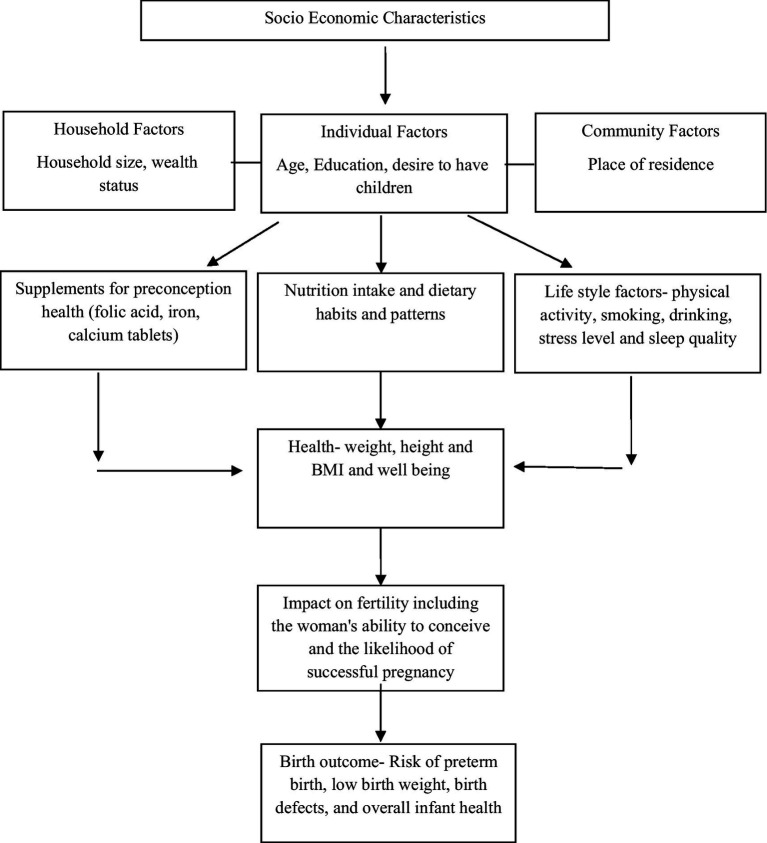
Preconception nutrition, the nutritional status of women before pregnancy, is crucial for maternal and child health. Interventions focusing on preconception nutrition can help break the intergenerational cycle of malnutrition by improving the health and nutritional status of women before pregnancy. This study investigated the recent trends and patterns in the nutritional status of nulliparous adolescents and young women across six countries in South Asia: Bangladesh, India, Maldives, Nepal, Pakistan, and Sri Lanka.
This study utilized the cross-sectional data from the Demographic and Health Survey (DHS) conducted between 2010 and 2022 for six South Asian countries. A total sample of 20,024 nulliparous married women aged 15-24 years was analyzed to estimate the pooled prevalence for various anthropometric outcomes. Annual changes in the prevalence of the outcome indicators were presented for each country. Predictors of thinness and overweight were analyzed using logistic regression models.
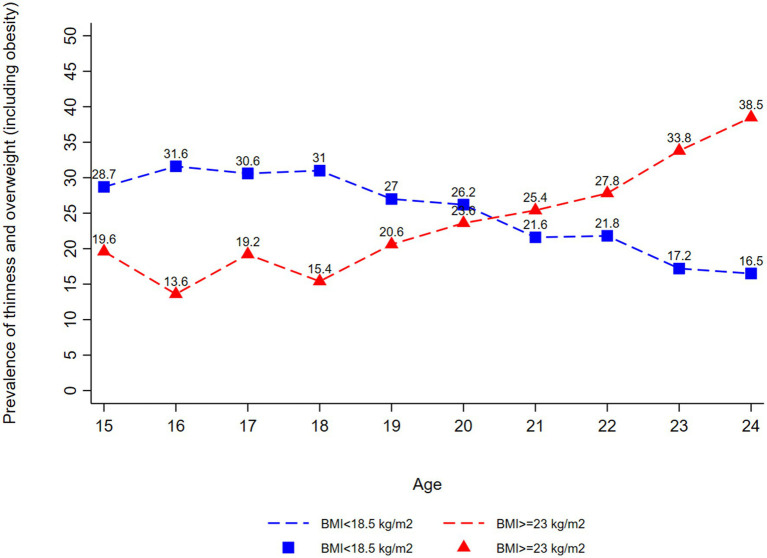
Based on the latest rounds of DHS for respective countries, the pooled weighted prevalence of thinness was 24.4%, overweight was 24.8%, and short height was 11.3%. The prevalence of underweight ranged from 14.6% in Pakistan (DHS 2018) to 25.9% in India (DHS 2021). The least reduction in the prevalence of underweight was observed in India at 2.8% and Nepal at 0.7%. Based on the latest surveys, the mean BMI among women aged 15-24 years was the highest in Maldives (24.1, 95% CI: 23.4, 24.8) and Pakistan (22.9, 95% CI: 22.2, 23.5) and the lowest in India (20.9, 95% CI: 20.9, 21.0) and Nepal (20.8, 95% CI: 20.4, 21.2). The pooled prevalence of thinness and short height was high in rural areas (26.2 and 11.8%), among less educated (28.1 and 14.5%), and bottom 40% wealth quintile groups (29.8 and 15.8%). Compared to young women (20-24 years), adolescent girls were 39% more likely to be underweight (OR: 1.39; 95% CI: 1.25, 1.54).
The findings highlight the need to broaden the scope of policies and programs designed for pregnant and lactating women so that nulliparous married women can be screened frequently for their anthropometric progress. Given the uneven distribution of the burden, it is recommended to implement comprehensive nutrition packages to reach all population subgroups across the regions.
孕前营养,即女性怀孕前的营养状况,对母婴健康至关重要。关注孕前营养的干预措施有助于通过改善女性怀孕前的健康和营养状况,打破营养不良的代际循环。本研究调查了南亚六个国家(孟加拉国、印度、马尔代夫、尼泊尔、巴基斯坦和斯里兰卡)未生育青少年和年轻女性营养状况的最新趋势和模式。
本研究利用了2010年至2022年期间对六个南亚国家进行的人口与健康调查(DHS)的横断面数据。对总共20,024名年龄在15 - 24岁的未生育已婚女性样本进行分析,以估计各种人体测量结果的合并患病率。列出了每个国家结果指标患病率的年度变化情况。使用逻辑回归模型分析消瘦和超重的预测因素。
根据各国最新一轮的人口与健康调查,消瘦的合并加权患病率为24.4%,超重为24.8%,身高过矮为11.3%。体重不足的患病率从巴基斯坦(2018年人口与健康调查)的14.6%到印度(2021年人口与健康调查)的25.9%不等。体重不足患病率下降最少的是印度,为2.8%,尼泊尔为0.7%。根据最新调查,15 - 24岁女性的平均体重指数在马尔代夫(24.1,95%置信区间:23.4,24.8)和巴基斯坦(22.9,95%置信区间:22.2,23.5)最高,在印度(20.9,95%置信区间:20.9,21.0)和尼泊尔(20.8,95%置信区间:20.4,21.2)最低。消瘦和身高过矮的合并患病率在农村地区较高(分别为26.2%和11.8%),在受教育程度较低的人群中(分别为28.1%和14.5%)以及财富五分位数最低的40%人群中(分别为29.8%和15.8%)较高。与年轻女性(20 - 24岁)相比,青春期女孩体重不足可能性高39%(比值比:1.39;95%置信区间:1.25,1.54)。
研究结果凸显了有必要扩大为孕妇和哺乳期妇女设计的政策和项目范围,以便能经常对未生育已婚妇女的人体测量进展情况进行筛查。鉴于负担分布不均,建议实施全面的营养套餐,覆盖各地区所有人群亚组。