Section of Gastroenterology, Hepatology and Nutrition, Department of Medicine, University of Chicago, Chicago, IL 60637, United States.
World J Gastroenterol. 2021 May 21;27(19):2312-2324. doi: 10.3748/wjg.v27.i19.2312.
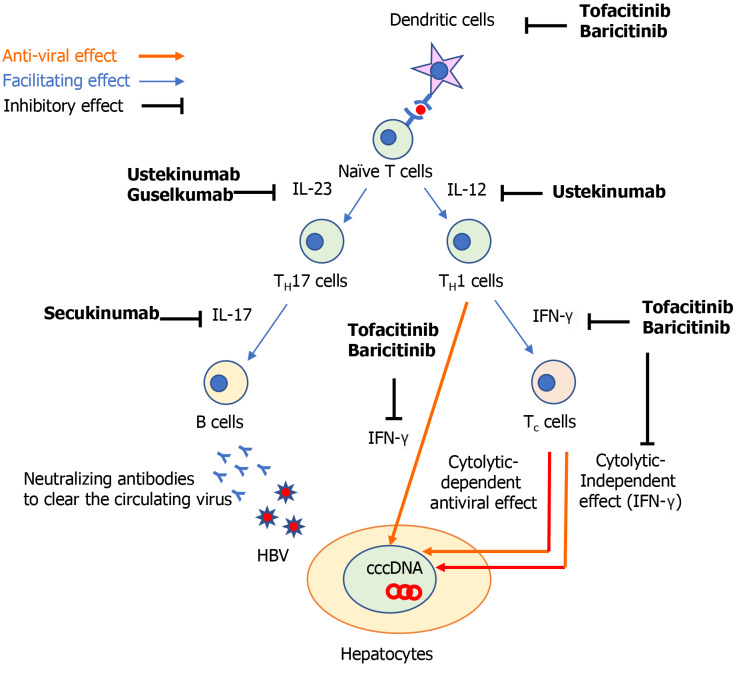
Hepatitis B virus reactivation (HBVr) can occur in patients treated with immunosuppressive medications. Risk stratification for HBVr based on hepatitis B virus (HBV) serology and viral load is an important strategy to determine appropriate HBV monitoring and antiviral prophylaxis use. Recent advances in the understanding of pathophysiology of autoimmune diseases have led the development of cytokine-targeted therapies. Tumor necrosis factor (TNF)-α inhibitors have been widely used for patients with inflammatory bowel disease, psoriasis, and rheumatic diseases. Further, the clinical benefits of interleukin (IL)-12/23, IL-17, or Janus kinases inhibitors have been demonstrated in these patients. It is well known that TNF-α inhibitor use can lead to HBVr, however, the risk of HBVr in patients undergoing non-TNF-targeted biologics have not been fully understood. In this review, we discuss the risk of HBVr in patients treated with non-TNF-targeted biologics, and immunological mechanisms of these medications causing HBVr.
乙型肝炎病毒再激活(HBVr)可发生在接受免疫抑制药物治疗的患者中。基于乙型肝炎病毒(HBV)血清学和病毒载量对 HBVr 进行风险分层是确定适当的 HBV 监测和抗病毒预防使用的重要策略。对自身免疫性疾病病理生理学的理解的最新进展导致了细胞因子靶向治疗的发展。肿瘤坏死因子(TNF)-α抑制剂已广泛用于炎症性肠病、银屑病和风湿性疾病患者。此外,在这些患者中已经证明了白细胞介素(IL)-12/23、IL-17 或 Janus 激酶抑制剂的临床益处。众所周知,TNF-α 抑制剂的使用会导致 HBVr,然而,接受非 TNF 靶向生物制剂治疗的患者发生 HBVr 的风险尚未完全了解。在这篇综述中,我们讨论了接受非 TNF 靶向生物制剂治疗的患者发生 HBVr 的风险,以及这些药物导致 HBVr 的免疫机制。