Section of Endocrinology and Investigative Medicine, Imperial College London, London, United Kingdom.
Section of Cell Biology and Functional Genomics, Imperial College London, London, United Kingdom.
Front Endocrinol (Lausanne). 2021 May 10;12:678055. doi: 10.3389/fendo.2021.678055. eCollection 2021.
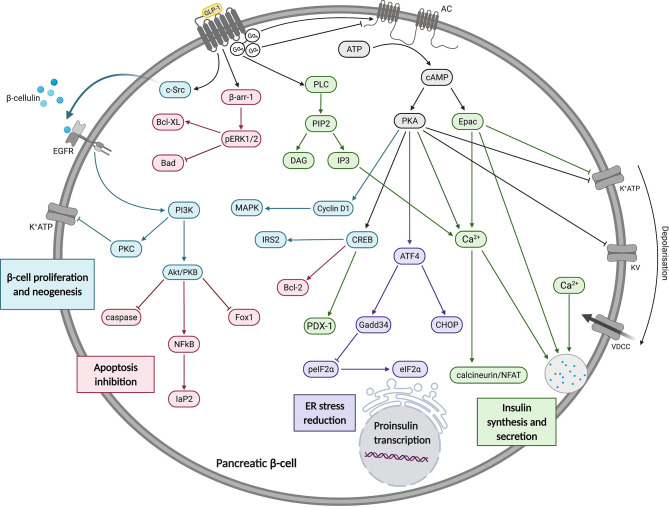
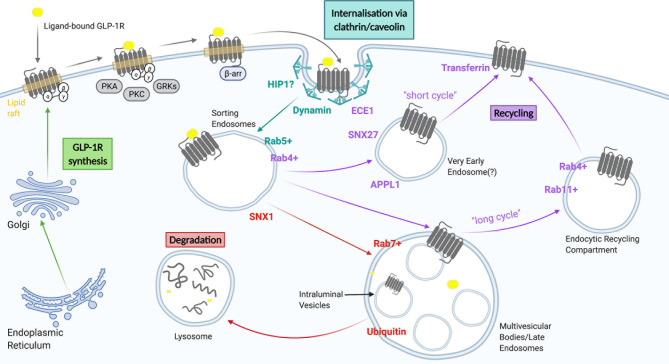
The glucagon-like peptide 1 receptor (GLP-1R) is a class B G protein-coupled receptor (GPCR) which mediates the effects of GLP-1, an incretin hormone secreted primarily from L-cells in the intestine and within the central nervous system. The GLP-1R, upon activation, exerts several metabolic effects including the release of insulin and suppression of appetite, and has, accordingly, become an important target for the treatment for type 2 diabetes (T2D). Recently, there has been heightened interest in how the activated GLP-1R is trafficked between different endomembrane compartments, controlling the spatial origin and duration of intracellular signals. The discovery of "biased" GLP-1R agonists that show altered trafficking profiles and selective engagement with different intracellular effectors has added to the tools available to study the mechanisms and physiological importance of these processes. In this review we survey early and recent work that has shed light on the interplay between GLP-1R signalling and trafficking, and how it might be therapeutically tractable for T2D and related diseases.
胰高血糖素样肽 1 受体 (GLP-1R) 是一种 B 类 G 蛋白偶联受体 (GPCR),主要介导肠 L 细胞和中枢神经系统分泌的肠促胰岛素激素 GLP-1 的作用。GLP-1R 激活后可发挥多种代谢作用,包括胰岛素分泌和食欲抑制,因此成为治疗 2 型糖尿病 (T2D) 的重要靶点。最近,人们越来越关注激活的 GLP-1R 如何在不同的内膜隔室之间运输,从而控制细胞内信号的空间起源和持续时间。“偏向”GLP-1R 激动剂的发现改变了其运输特征,并选择性地与不同的细胞内效应器结合,这为研究这些过程的机制和生理重要性提供了更多的工具。在这篇综述中,我们调查了早期和最近的工作,这些工作阐明了 GLP-1R 信号转导和运输之间的相互作用,以及它如何在治疗 T2D 和相关疾病方面具有潜在的治疗意义。