Kim Myojeong, You Euna, Park Seongjin, Hong Sungwoo
Department of Chemistry, Korea Advanced Institute of Science and Technology (KAIST) Daejeon 34141 Korea
Center for Catalytic Hydrocarbon Functionalizations, Institute for Basic Science (IBS) Daejeon 34141 Korea.
Chem Sci. 2021 Mar 31;12(19):6629-6637. doi: 10.1039/d1sc00776a.
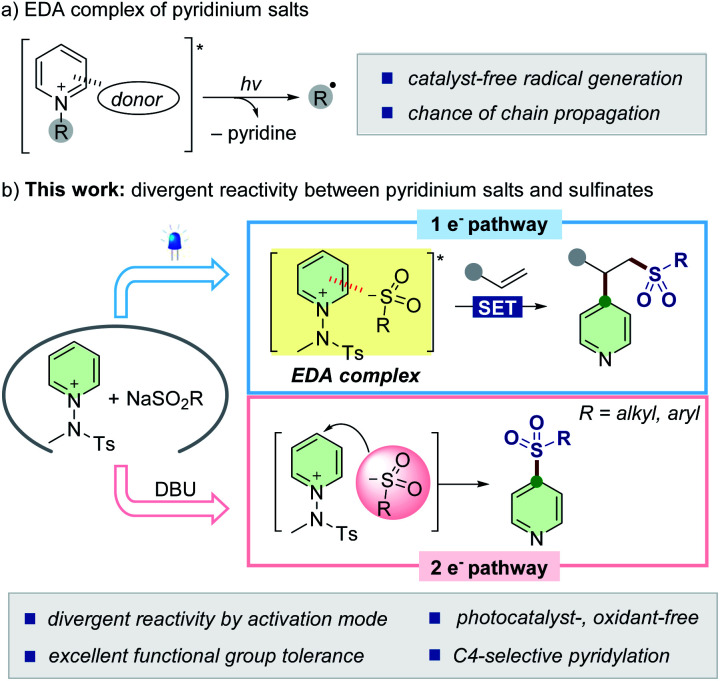
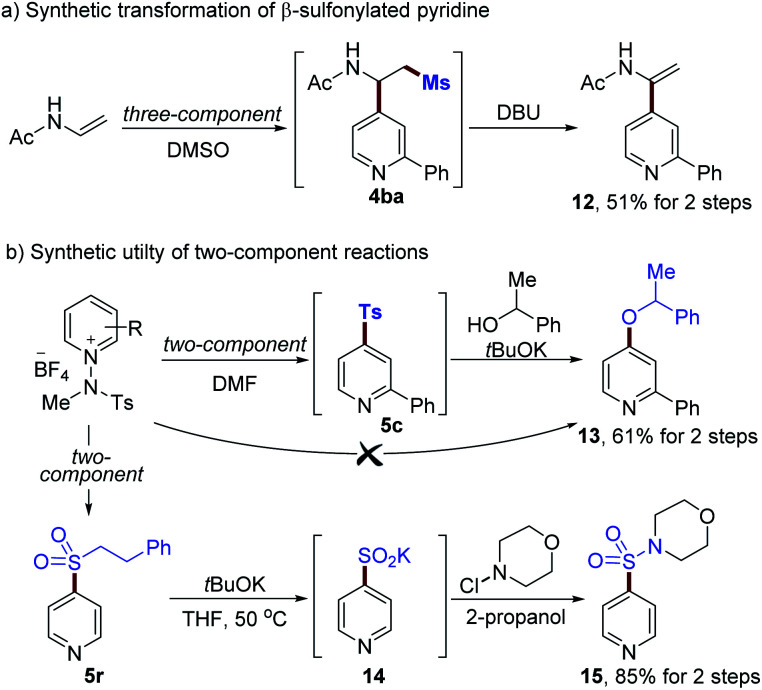
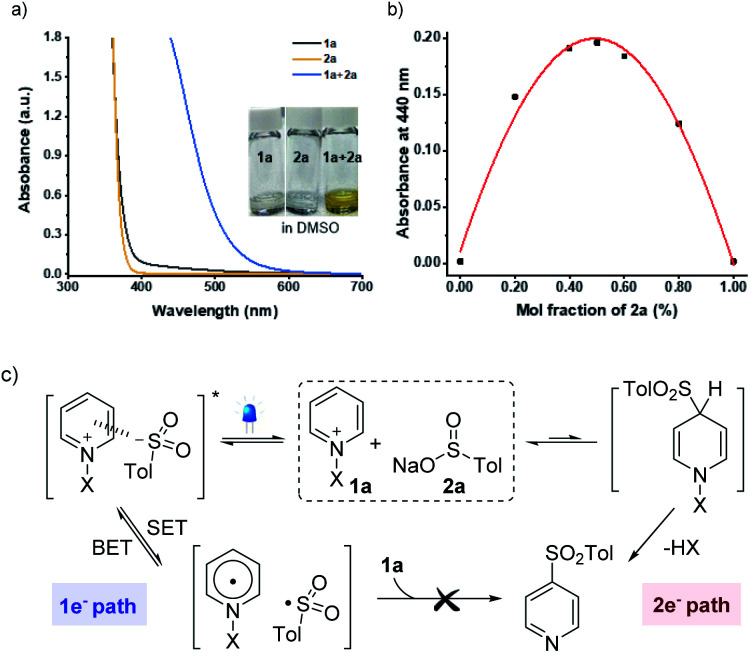
One of the main goals of modern synthesis is to develop distinct reaction pathways from identical starting materials for the efficient synthesis of diverse compounds. Herein, we disclose the unique divergent reactivity of the combination sets of pyridinium salts and sulfinates to achieve sulfonative pyridylation of alkenes and direct C4-sulfonylation of pyridines by controlling the one- two-electron reaction manifolds for the selective formation of each product. Base-catalyzed cross-coupling between sulfinates and -amidopyridinium salts led to the direct introduction of a sulfonyl group into the C4 position of pyridines. Remarkably, the reactivity of this set of compounds is completely altered upon exposure to visible light: electron donor-acceptor complexes of -amidopyridinium salts and sulfinates are formed to enable access to sulfonyl radicals. In this catalyst-free radical pathway, both sulfonyl and pyridyl groups could be incorporated into alkenes a three-component reaction, which provides facile access to a variety of β-pyridyl alkyl sulfones. These two reactions are orthogonal and complementary, achieving a broad substrate scope in a late-stage fashion under mild reaction conditions.
现代合成的主要目标之一是从相同的起始原料开发出不同的反应途径,以高效合成各种化合物。在此,我们揭示了吡啶盐和亚磺酸盐组合集独特的发散反应性,通过控制单电子和双电子反应流形来实现烯烃的磺酰化吡啶化以及吡啶的直接C4-磺酰化,从而选择性地形成每种产物。碱催化的亚磺酸盐与α-酰胺基吡啶盐之间的交叉偶联导致将磺酰基直接引入吡啶的C4位。值得注意的是,这组化合物在可见光照射下反应性会完全改变:形成α-酰胺基吡啶盐和亚磺酸盐的电子供体-受体复合物,从而能够生成磺酰基自由基。在这种无催化剂的自由基途径中,磺酰基和吡啶基都可以通过一个三组分反应引入到烯烃中,这为各种β-吡啶基烷基砜的合成提供了便利。这两个反应相互正交且互补,在温和的反应条件下以后期方式实现了广泛的底物范围。