Nellis Marianne E, Vasovic Ljiljana V, Goel Ruchika, Karam Oliver
Department of Pediatrics, New York Presbyterian Hospital - Weill Cornell Medicine, New York, NY, United States.
Department of Pathology and Laboratory Medicine, Weill Cornell Medicine, New York, NY, United States.
Front Pediatr. 2021 May 10;9:673613. doi: 10.3389/fped.2021.673613. eCollection 2021.
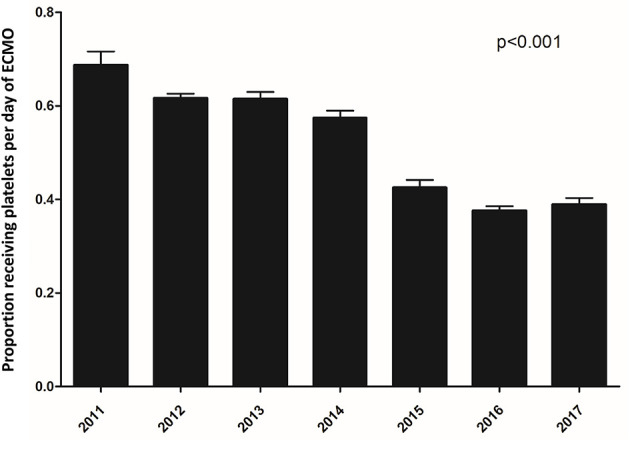
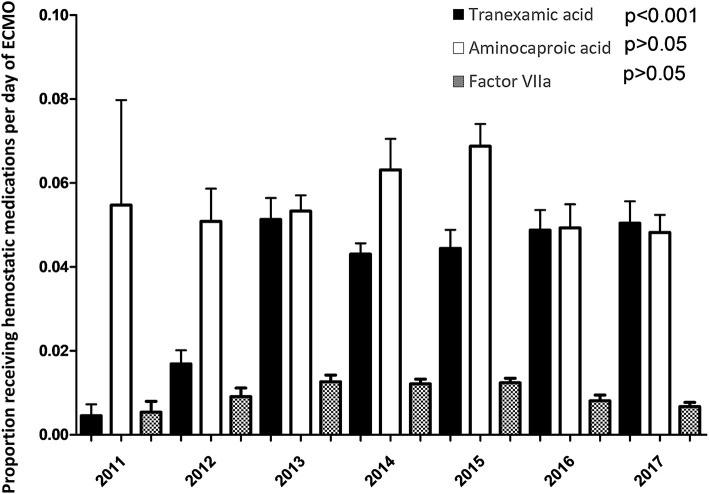
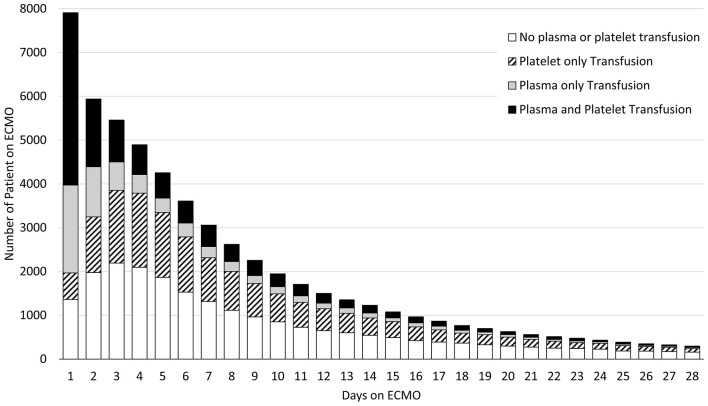
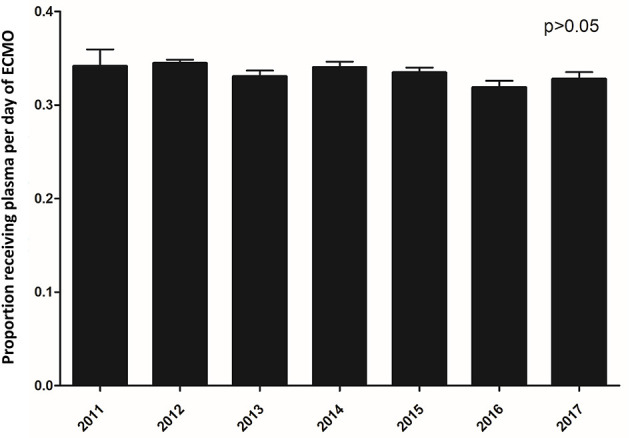
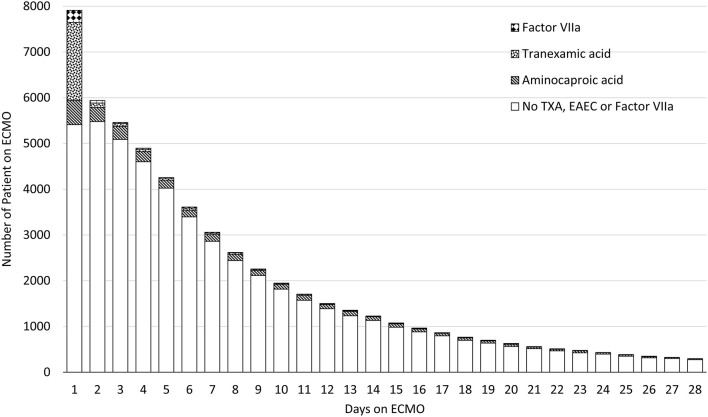
Children supported by extracorporeal membrane oxygenation (ECMO) are at high risk of bleeding. Though practitioners often prescribe blood components and/or medications to prevent or treat bleeding, the utilization of these hemostatic measures in children is not well-understood. We sought to evaluate the use of hemostatic blood products (platelet, plasma and cryoprecipitate transfusions) and medications [aminocaproic acid, tranexamic acid (TXA) and Factor VIIa] in children supported by ECMO. Retrospective observational study using the Pediatric Health Information System (PHIS) database from 2011-2017. Fifty-one U.S. children's hospitals. Children (aged 0-18 years) supported by ECMO. None. ECMO was employed in the care of 7,910 children for a total of 56,079 ECMO days. Fifty-five percent of the patients were male with a median (IQR) age of 0 (0-2) years. The median (IQR) length of ECMO was 5 (2-9) days with a hospital mortality rate of 34%. Platelets were transfused on 49% of ECMO days, plasma on 33% of ECMO days and cryoprecipitate on 17% of ECMO days. Twenty-two percent of children received TXA with the majority receiving it on the first day of ECMO and the use of TXA increased during the 6-year period studied ( < 0.001). Seven percent of children received aminocaproic acid and 3% received Factor VIIa. Children supported by ECMO are exposed to a significant number of hemostatic blood products. Antifibrinolytics, in particular TXA, are being used more frequently. Given the known morbidity and mortality associated with hemostatic blood products, studies are warranted to evaluate the effectiveness of hemostatic strategies.
接受体外膜肺氧合(ECMO)支持的儿童出血风险很高。尽管从业者经常开具血液成分和/或药物来预防或治疗出血,但这些止血措施在儿童中的应用情况尚未得到充分了解。我们试图评估在接受ECMO支持的儿童中使用止血血液制品(血小板、血浆和冷沉淀输血)和药物[氨基己酸、氨甲环酸(TXA)和凝血因子VIIa]的情况。使用2011 - 2017年儿科健康信息系统(PHIS)数据库进行回顾性观察研究。美国51家儿童医院。接受ECMO支持的儿童(0 - 18岁)。无。ECMO用于7910名儿童的治疗,ECMO总天数达56079天。55%的患者为男性,中位(四分位间距)年龄为0(0 - 2)岁。ECMO的中位(四分位间距)时长为5(2 - 9)天,医院死亡率为34%。49%的ECMO日输注了血小板,33%的ECMO日输注了血浆,17%的ECMO日输注了冷沉淀。22%的儿童接受了TXA,大多数在ECMO治疗的第一天接受,且在研究的6年期间TXA的使用有所增加(P<0.001)。7%的儿童接受了氨基己酸,3%的儿童接受了凝血因子VIIa。接受ECMO支持的儿童接触了大量的止血血液制品。抗纤溶药物,尤其是TXA,使用更为频繁。鉴于已知止血血液制品会带来发病率和死亡率,有必要开展研究以评估止血策略的有效性。