Kim Chohee, Cho Hwan-Ho, Choi Joon Young, Franks Teri J, Han Joungho, Choi Yeonu, Lee Se-Hoon, Park Hyunjin, Lee Kyung Soo
Department of Radiology, Samsung Medical Center, Sungkyunkwan University School of Medicine (SKKU-SOM), Seoul, South Korea.
Department of Electronic and Computer Engineering, Sungkyunkwan University, Suwon, South Korea.
Eur J Radiol Open. 2021 May 18;8:100351. doi: 10.1016/j.ejro.2021.100351. eCollection 2021.
To demonstrate semantic, radiomics, and the combined risk models related to the prognoses of pulmonary pleomorphic carcinomas (PCs).
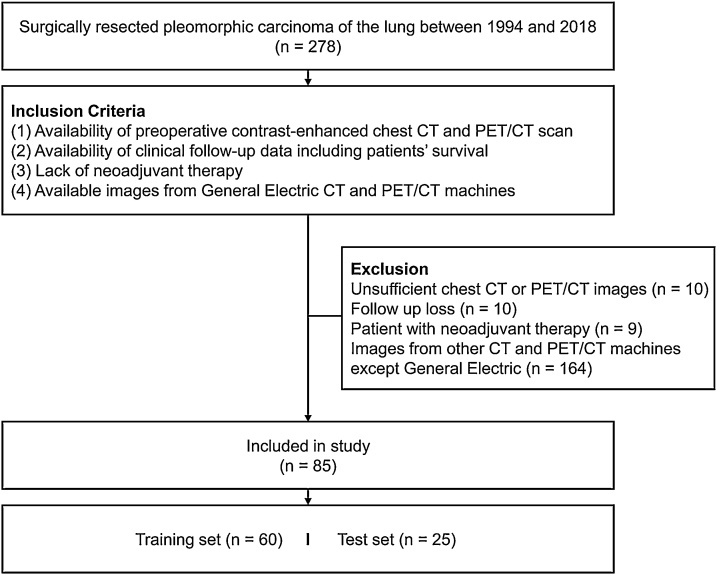
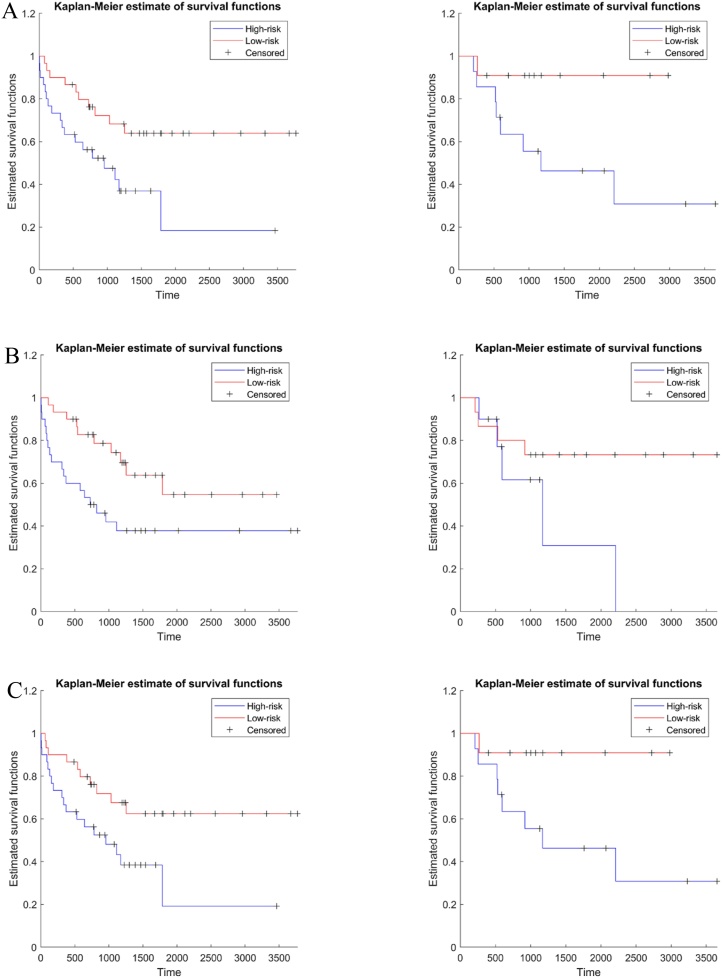
We included 85 patients (M:F = 71:14; age, 35-88 [mean, 63 years]) whose imaging features were divided into training (n = 60) and test (n = 25) sets. Nineteen semantic and 142 radiomics features related to tumors were computed. Semantic risk score (SRS) model was built using the Cox-least absolute shrinkage and selection operator (LASSO) approach. Radiomics risk score (RRS) from CT and PET features and combined risk score (CRS) adopting both semantic and radiomics features were also constructed. Risk groups were stratified by the median of the risk scores of the training set. Survival analysis was conducted with the Kaplan-Meier plots.
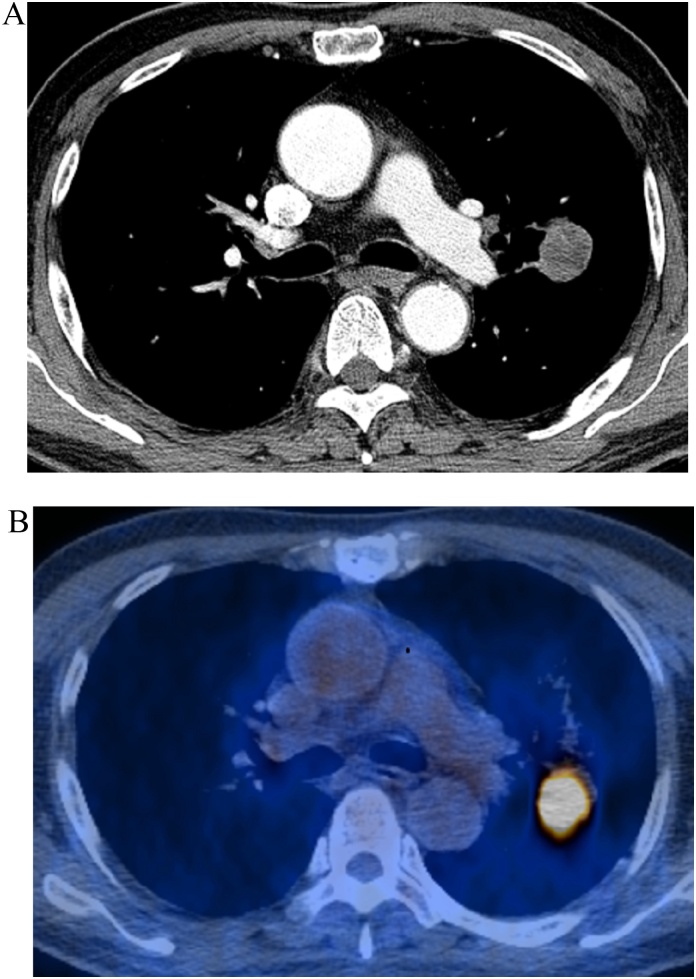
Of 85 PCs, adenocarcinoma was the most common epithelial component found in 63 (73 %) tumors. In SRS model, four features were stratified into high- and low-risk groups (HR, 4.119; concordance index ([C-index], 0.664) in the test set. In RRS model, five features helped improve the stratification (HR, 3.716; C-index, 0.591) and in CRS model, three features helped perform the best stratification (HR, 4.795; C-index, 0.617). The two significant features of CRS models were the SUVmax and the histogram feature of energy ([CT Firstorder Energy]).
In PCs of the lungs, the combined model leveraging semantic and radiomics features provides a better prognosis compared to using semantic and radiomics features separately. The high SUVmax of solid portion (CT Firstorder Energy) of tumors is associated with poor prognosis in lung PCs.
阐述与肺多形性癌(PC)预后相关的语义、影像组学及联合风险模型。
我们纳入了85例患者(男:女 = 71:14;年龄35 - 88岁[平均63岁]),其影像特征被分为训练集(n = 60)和测试集(n = 25)。计算了19个与肿瘤相关的语义特征和142个影像组学特征。使用Cox最小绝对收缩和选择算子(LASSO)方法构建语义风险评分(SRS)模型。还构建了基于CT和PET特征的影像组学风险评分(RRS)以及采用语义和影像组学特征的联合风险评分(CRS)。根据训练集风险评分的中位数对风险组进行分层。采用Kaplan - Meier图进行生存分析。
在85例PC中,腺癌是最常见的上皮成分,在63例(73%)肿瘤中被发现。在SRS模型中,4个特征被分层为高风险组和低风险组(风险比[HR],4.119;测试集中一致性指数[C指数],0.664)。在RRS模型中,5个特征有助于改善分层(HR,3.716;C指数,0.591),在CRS模型中,3个特征有助于实现最佳分层(HR,4.795;C指数,0.617)。CRS模型的两个显著特征是SUVmax和能量直方图特征([CT一阶能量])。
在肺PC中,与单独使用语义和影像组学特征相比,利用语义和影像组学特征的联合模型能提供更好的预后。肿瘤实性部分的高SUVmax(CT一阶能量)与肺PC的预后不良相关。