University of Groningen, University Medical Center Groningen, Groningen, The Netherlands.
UMCG Research BV, University Medical Center Groningen, Groningen, The Netherlands.
Biopreserv Biobank. 2021 Jun;19(3):228-240. doi: 10.1089/bio.2021.0011. Epub 2021 May 27.
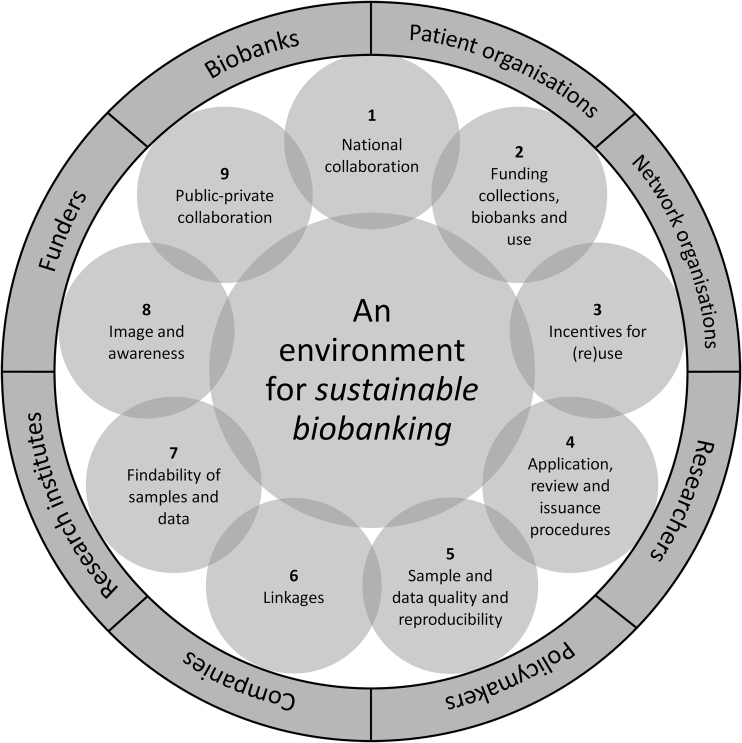
Biobanks and their collections are considered essential for contemporary biomedical research and a critical resource toward personalized medicine. However, they need to operate in a sustainable manner to prevent research waste and maximize impact. Sustainability is the capacity of a biobank to remain operative, effective, and competitive over its expected lifetime. This remains a challenge given a biobank's position at the interplay of ethical, societal, scientific, and commercial values and the difficulties in finding continuous funding. In the end, biobanks are responsible for their own sustainability. Still, biobanks also depend on their surrounding environment, which contains overarching legislative, policy, financial, and other factors that can either impede or promote sustainability. The Biobanking and Biomolecular Research Infrastructure for The Netherlands (BBMRI.nl) has worked on improving the national environment for sustainable biobanking. In this article, we present the final outcomes of this BBMRI.nl project. First, we summarize the current overarching challenges of the Dutch biobanking landscape. These challenges were gathered during workshops and focus groups with Dutch biobanks and their users, for which the full results are described in separate reports. The main overarching challenges relate to sample and data quality, funding, use and reuse, findability and accessibility, and the general image of biobanks. Second, we propose a package of recommendations-across nine themes-toward creating overarching conditions that stimulate and enable sustainable biobanking. These recommendations serve as a guideline for the Dutch biobanking community and their stakeholders to jointly work toward practical implementation and a better biobanking environment. There are undoubtedly parallels between the Dutch situation and the challenges found in other countries. We hope that sharing our project's approach, outcomes, and recommendations will support other countries in their efforts toward sustainable biobanking.
生物银行及其样本集被认为是当代生物医学研究的基础,也是迈向个体化医疗的关键资源。然而,它们需要以可持续的方式运作,以防止研究浪费并最大限度地发挥其影响。生物银行的可持续性是指其在预期寿命内保持运行、有效和有竞争力的能力。考虑到生物银行在伦理、社会、科学和商业价值的相互作用中的地位,以及寻找持续资金的困难,这仍然是一个挑战。最终,生物银行需要对自身的可持续性负责。然而,生物银行也依赖于其周围的环境,其中包含总体立法、政策、财务和其他因素,这些因素可能会阻碍或促进可持续性。荷兰生物银行和生物分子研究基础设施(BBMRI.nl)致力于改善国家可持续生物银行的环境。在本文中,我们介绍了该 BBMRI.nl 项目的最终成果。首先,我们总结了荷兰生物银行领域当前面临的主要挑战。这些挑战是在与荷兰生物银行及其用户举行的研讨会和重点小组讨论中收集的,其完整结果在单独的报告中描述。主要的总体挑战与样本和数据质量、资金、使用和再利用、可发现性和可及性以及生物银行的总体形象有关。其次,我们提出了一整套建议——跨越九个主题——创造总体条件,以刺激和促进可持续的生物银行。这些建议为荷兰生物银行界及其利益相关者提供了一个指导方针,以共同努力实现实际实施和更好的生物银行环境。荷兰的情况与其他国家发现的挑战之间无疑存在相似之处。我们希望分享我们项目的方法、成果和建议,以支持其他国家在可持续生物银行方面的努力。