Department of Acute and Critical Care Nursing, School of Nursing, Sapporo City University, Sapporo, Hokkaido, Japan.
Department of Adult Health Nursing, College of Nursing, Ibaraki Christian University, Hitachi, Ibaraki, Japan.
PLoS One. 2021 May 27;16(5):e0252167. doi: 10.1371/journal.pone.0252167. eCollection 2021.
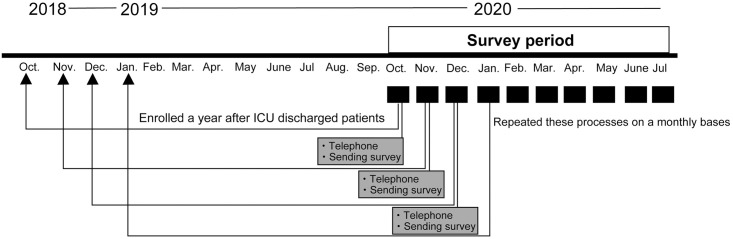
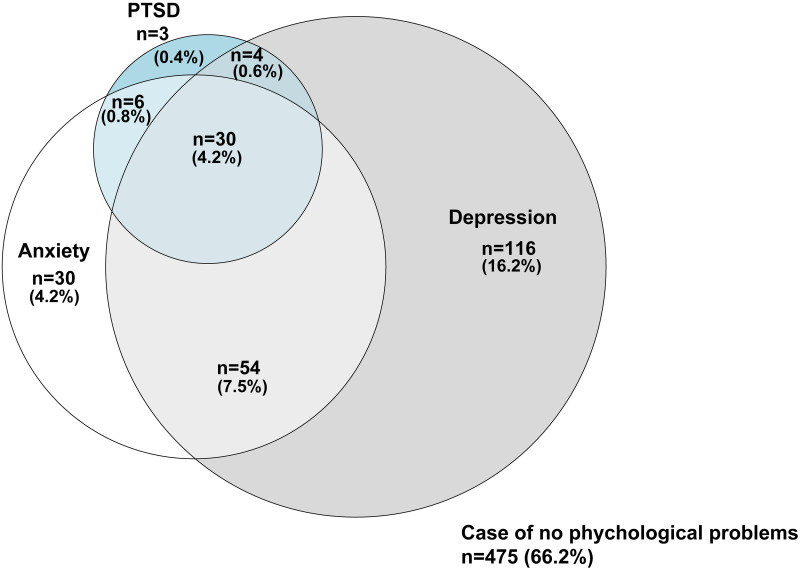
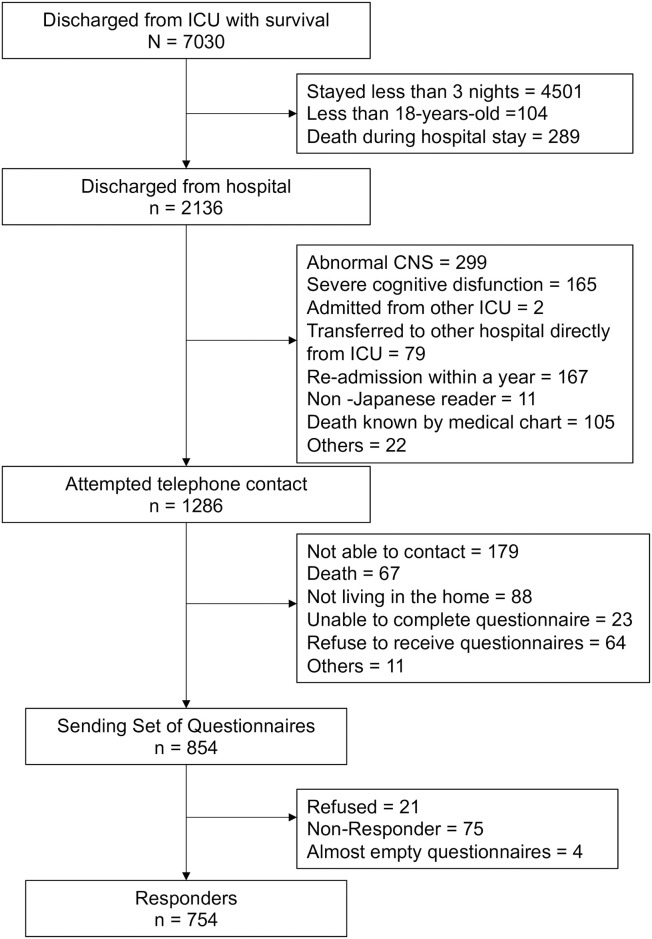
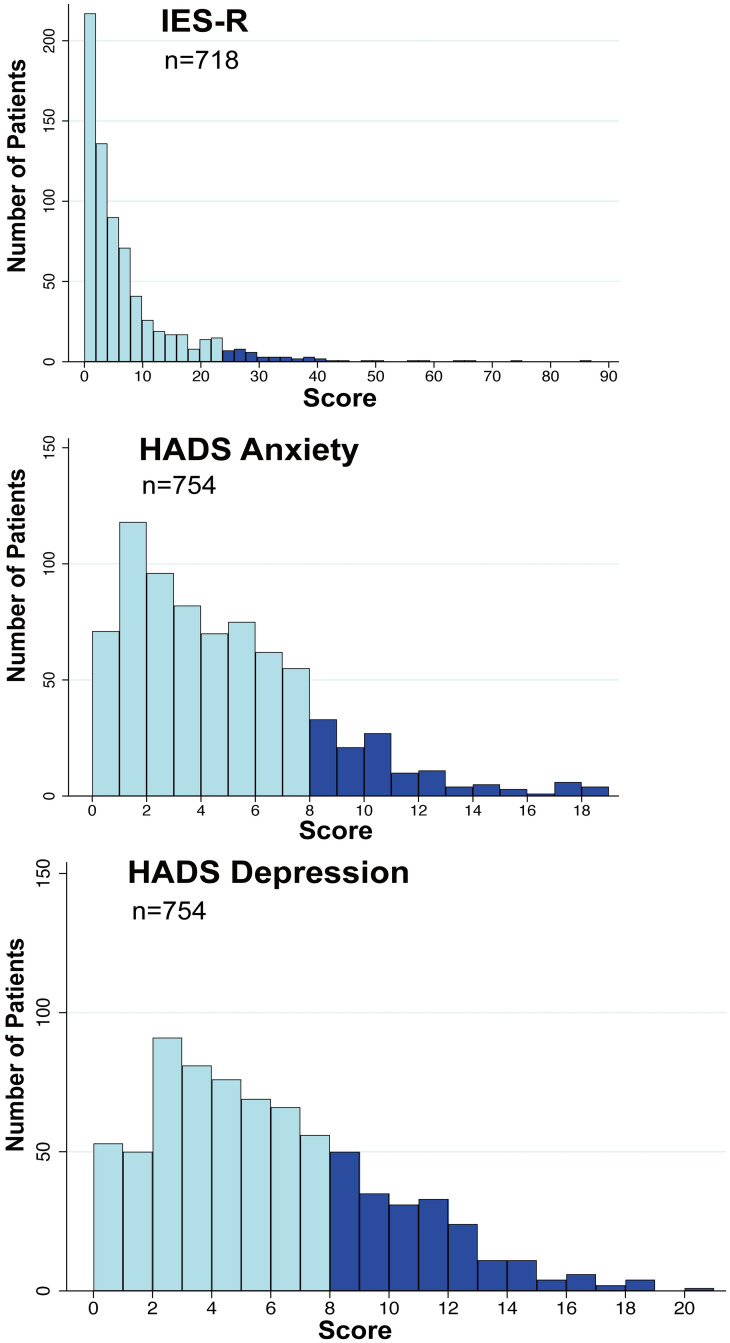
Few studies have examined the epidemiology of post-intensive care syndrome in Japan. This study investigated the mental health and quality of life of patients living at home in Japan after intensive care unit (ICU) discharge. Additionally, we examined whether unplanned admission to the ICU was associated with more severe post-traumatic stress disorder (PTSD), anxiety, and depressive symptoms. An ambidirectional cohort study was conducted at 12 ICUs in Japan. Patients who stayed in the ICU for > 3 nights and were living at home for 1 year afterward were included. One year after ICU discharge, we retrospectively screened patients and performed a mail survey on a monthly basis, including the Impact of Event Scale-Revised (IER-S), the Hospital Anxiety Depression Scale (HADS), and the EuroQOL-5 Dimension (EQ-5D-L) questionnaires. Patients' characteristics, delirium and coma status, drugs used, and ICU and hospital length of stay were assessed from medical records. Descriptive statistics and multilevel linear regression modeling were used to examine our hypothesis. Among 7,030 discharged patients, 854 patients were surveyed by mail. Of these, 778 patients responded (response rate = 91.1%). The data from 754 patients were analyzed. The median IES-R score was 3 (interquartile range [IQR] = 1‒9), and the prevalence of suspected PTSD was 6.0%. The median HADS anxiety score was 4.00 (IQR = 1.17‒6.00), and the prevalence of anxiety was 16.6%. The median HADS depression score was 5 (IQR = 2‒8), and the prevalence of depression was 28.1%. EQ-5D-L scores were lower in our participants than in the sex- and age-matched Japanese population. Unplanned admission was an independent risk factor for more severe PTSD, anxiety, and depressive symptoms. Approximately one-third of patients in the general ICU population experienced mental health issues one year after ICU discharge. Unplanned admission was an independent predictor for more severe PTSD symptoms.
鲜有研究调查日本重症监护病房(ICU)后综合征的流行病学。本研究调查了日本 ICU 出院后在家中生活的患者的心理健康和生活质量。此外,我们还研究了 ICU 非计划性再入院是否与更严重的创伤后应激障碍(PTSD)、焦虑和抑郁症状相关。这是一项在日本 12 家 ICU 开展的双向队列研究。纳入 ICU 住院时间超过 3 晚且 ICU 出院后 1 年仍在家居住的患者。在 ICU 出院 1 年后,我们通过回顾性筛选患者并进行每月邮件调查,包括创伤后应激障碍影响量表修订版(IES-R)、医院焦虑抑郁量表(HADS)和欧洲五维健康量表(EQ-5D-L)问卷。从病历中评估患者特征、谵妄和昏迷状态、使用的药物以及 ICU 和住院时间。采用描述性统计和多水平线性回归模型检验假设。在 7030 名出院患者中,有 854 名通过邮件接受调查。其中,778 名患者做出回应(回应率=91.1%)。对 754 名患者的数据进行了分析。IES-R 评分中位数为 3(四分位距[IQR]=1-9),疑似 PTSD 患病率为 6.0%。HADS 焦虑评分中位数为 4.00(IQR=1.17-6.00),焦虑患病率为 16.6%。HADS 抑郁评分中位数为 5(IQR=2-8),抑郁患病率为 28.1%。与日本同性别和同年龄匹配的一般人群相比,我们的参与者的 EQ-5D-L 评分较低。非计划性再入院是 PTSD、焦虑和抑郁症状更严重的独立危险因素。大约三分之一的普通 ICU 患者在 ICU 出院后 1 年内出现心理健康问题。非计划性再入院是 PTSD 症状更严重的独立预测因素。