Department of Neurosciences, Rehabilitation, Ophthalmology, Genetics, Maternal and Child Health (DINOGMI), University of Genoa, Genoa, Italy.
Department of Neurosciences, Rehabilitation, Ophthalmology, Genetics, Maternal and Child Health (DINOGMI), University of Genoa, Genoa, Italy; Laboratory of Experimental Neurosciences, Ospedale Policlinico San Martino IRCCS, Genoa, Italy.
J Neurol Sci. 2021 Aug 15;427:117501. doi: 10.1016/j.jns.2021.117501. Epub 2021 May 20.
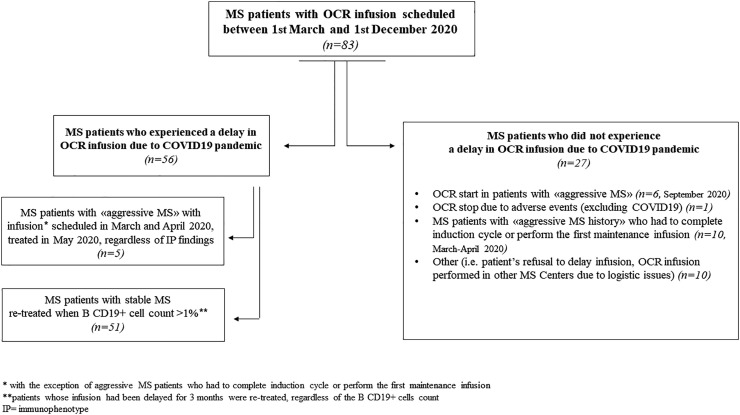
During SARS-CoV-2 pandemic, we adopted a personalized delayed protocol for ocrelizumab infusions in Relapsing Remitting Multiple Sclerosis (RRMS) patients according to the national recommendations. Out of the 83 RRMS patients whose infusion was scheduled between March and December 2020, 56 patients experienced a delay in treatment based on MS severity and SARS-CoV2 infection risk profile. In most cases, the immunophenotype was performed monthly to guide re-infusions. Specifically, B CD19 + cells repopulation rate was monitored. Mean infusion delay was 103,1 [SD 40,6] days, and none of the patients presented relapses or active disease at MRI at the end of the observation period. Treatment naïve status and the interval between immunophenotyping and the last ocrelizumab infusion were predictors of earlier B CD19 + cells repopulation. Two patients contracted SARS-CoV2 with complete recovery. Definitive data about Sars-Cov2 vaccine efficacy in patients treated with ocrelizumab are still lacking. Our findings suggest that a personalized treatment with a delayed infusion schedule does not compromise ocrelizumab short-term efficacy and may help to lengthen the therapeutic window for an effective response to SARS-CoV2 vaccine.
在 SARS-CoV-2 大流行期间,我们根据国家建议为复发缓解型多发性硬化症 (RRMS) 患者采用了奥瑞珠单抗输注的个体化延迟方案。在 2020 年 3 月至 12 月期间安排输注的 83 名 RRMS 患者中,根据 MS 严重程度和 SARS-CoV2 感染风险概况,有 56 名患者延迟了治疗。在大多数情况下,每月进行免疫表型分析以指导再输注。具体而言,监测 B CD19+细胞再增殖率。平均输注延迟 103.1 [SD 40.6] 天,在观察期末,没有患者出现复发或 MRI 上的活动疾病。治疗初治状态和免疫表型与最后一次奥瑞珠单抗输注之间的间隔是 B CD19+细胞更早再增殖的预测因素。有 2 名患者感染了 SARS-CoV2 并完全康复。关于接受奥瑞珠单抗治疗的患者中 SARS-CoV2 疫苗疗效的明确数据仍然缺乏。我们的研究结果表明,个体化的延迟输注方案不会影响奥瑞珠单抗的短期疗效,并可能有助于延长对 SARS-CoV2 疫苗有效反应的治疗窗口。