UOC Neurology, Sant'Elia Hospital, Caltanissetta, Italy.
Department of Medical and Surgical Sciences, University of Foggia, Foggia, Italy.
Neurotherapeutics. 2022 Sep;19(5):1535-1545. doi: 10.1007/s13311-022-01289-6. Epub 2022 Aug 29.
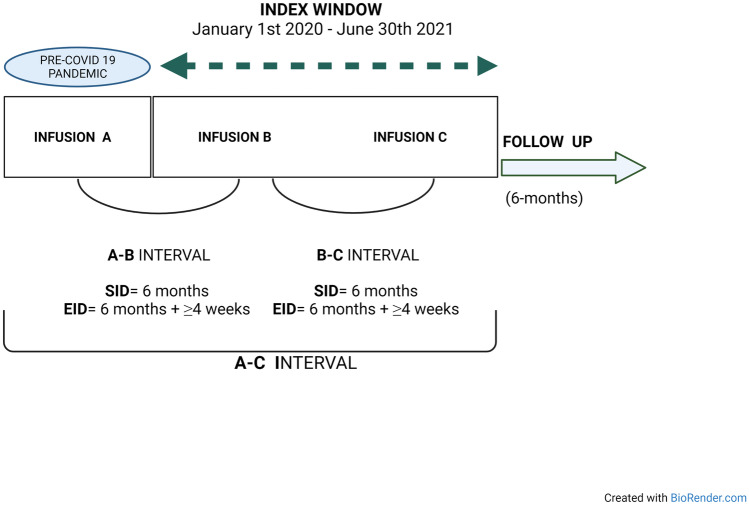
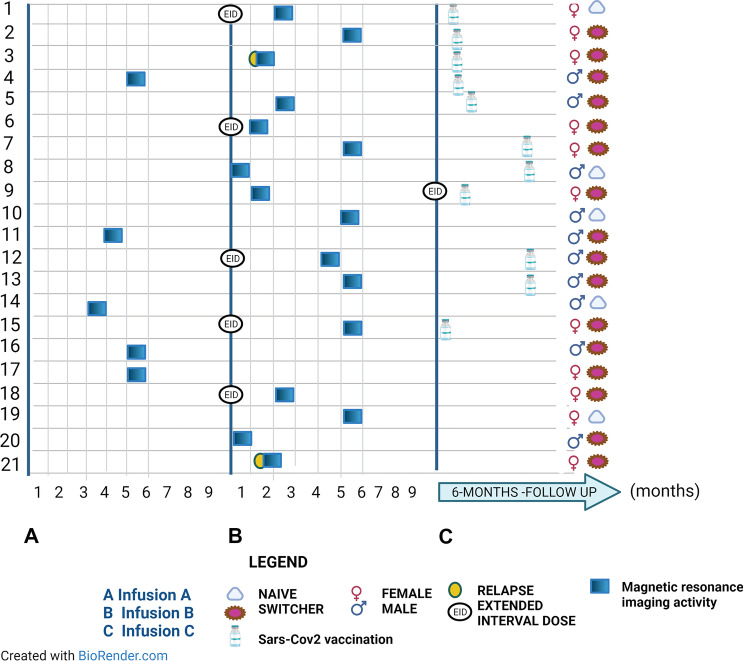
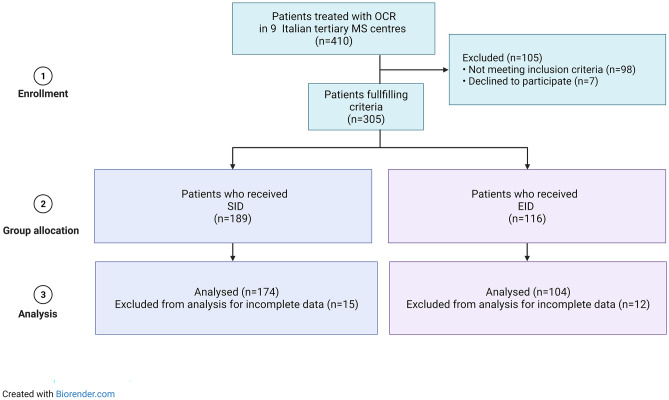
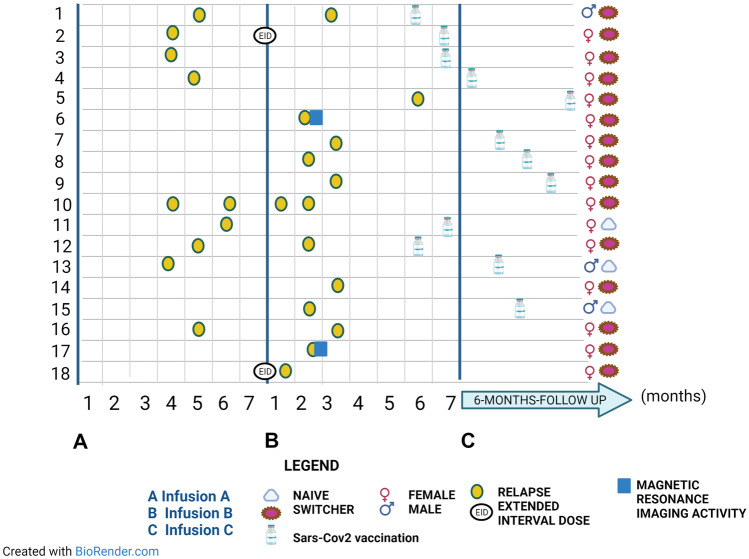
In the COVID-19 pandemic era, safety concerns have been raised regarding the risk of severe infection following administration of ocrelizumab (OCR), a B-cell-depleting therapy. We enrolled all relapsing remitting multiple sclerosis (RRMS) patients who received maintenance doses of OCR from January 2020 to June 2021. Data were extracted in December 2021. Standard interval dosing (SID) was defined as a regular maintenance interval of OCR infusion every 6 months, whereas extended interval dosing (EID) was defined as an OCR infusion delay of at least 4 weeks. Three infusions were considered in defining SID vs. EID (infusions A, B, and C). Infusion A was the last infusion before January 2020. The primary study outcome was a comparison of disease activity during the A-C interval, which was defined as either clinical (new relapses) or radiological (new lesions on T1-gadolinium or T2-weighted magnetic resonance imaging (MRI) sequences). Second, we aimed to assess confirmed disability progression (CDP). A total cohort of 278 patients (174 on SID and 104 on EID) was enrolled. Patients who received OCR on EID had a longer disease duration and a higher rate of vaccination against severe acute respiratory syndrome-coronavirus 2 (p < 0.05). EID was associated with an increased risk of MRI activity during the A-C interval (OR 5.373, 95% CI 1.203-24.001, p = 0.028). Being on SID or EID did not influence CDP (V-Cramer 0.47, p = 0.342). EID seemed to be associated with a higher risk of MRI activity in our cohort. EID needs to be carefully considered for OCR-treated patients.
在 COVID-19 大流行期间,人们对奥瑞珠单抗(OCR)治疗后严重感染的风险提出了安全担忧,奥瑞珠单抗是一种 B 细胞耗竭疗法。我们招募了所有在 2020 年 1 月至 2021 年 6 月期间接受 OCR 维持剂量治疗的复发缓解型多发性硬化症(RRMS)患者。数据于 2021 年 12 月提取。标准间隔剂量(SID)定义为每 6 个月进行一次 OCR 输注的常规维持间隔,而延长间隔剂量(EID)定义为 OCR 输注至少延迟 4 周。SID 与 EID (输注 A、B 和 C)的定义中考虑了 3 次输注。输注 A 是 2020 年 1 月之前的最后一次输注。主要研究结果是比较 A-C 间隔期间的疾病活动,定义为临床(新复发)或放射学(T1-钆增强或 T2 加权磁共振成像(MRI)序列上新病变)。其次,我们旨在评估确诊的残疾进展(CDP)。共纳入 278 例患者(SID 组 174 例,EID 组 104 例)。接受 EID 治疗的患者疾病持续时间更长,且严重急性呼吸综合征冠状病毒 2 (SARS-CoV-2)疫苗接种率更高(p < 0.05)。EID 与 A-C 间隔期间 MRI 活动的风险增加相关(OR 5.373,95%CI 1.203-24.001,p = 0.028)。接受 SID 或 EID 治疗并不影响 CDP(V-Cramer 0.47,p = 0.342)。在我们的队列中,EID 似乎与更高的 MRI 活动风险相关。对于接受 OCR 治疗的患者,EID 需要谨慎考虑。