Department of Obstetrics and Gynecology, Severance Hospital, Yonsei University College of Medicine, Seoul, South Korea.
Institute of Women's Life Medical Science, Yonsei University College of Medicine, Seoul, South Korea.
BMC Surg. 2021 May 27;21(1):264. doi: 10.1186/s12893-021-01245-9.
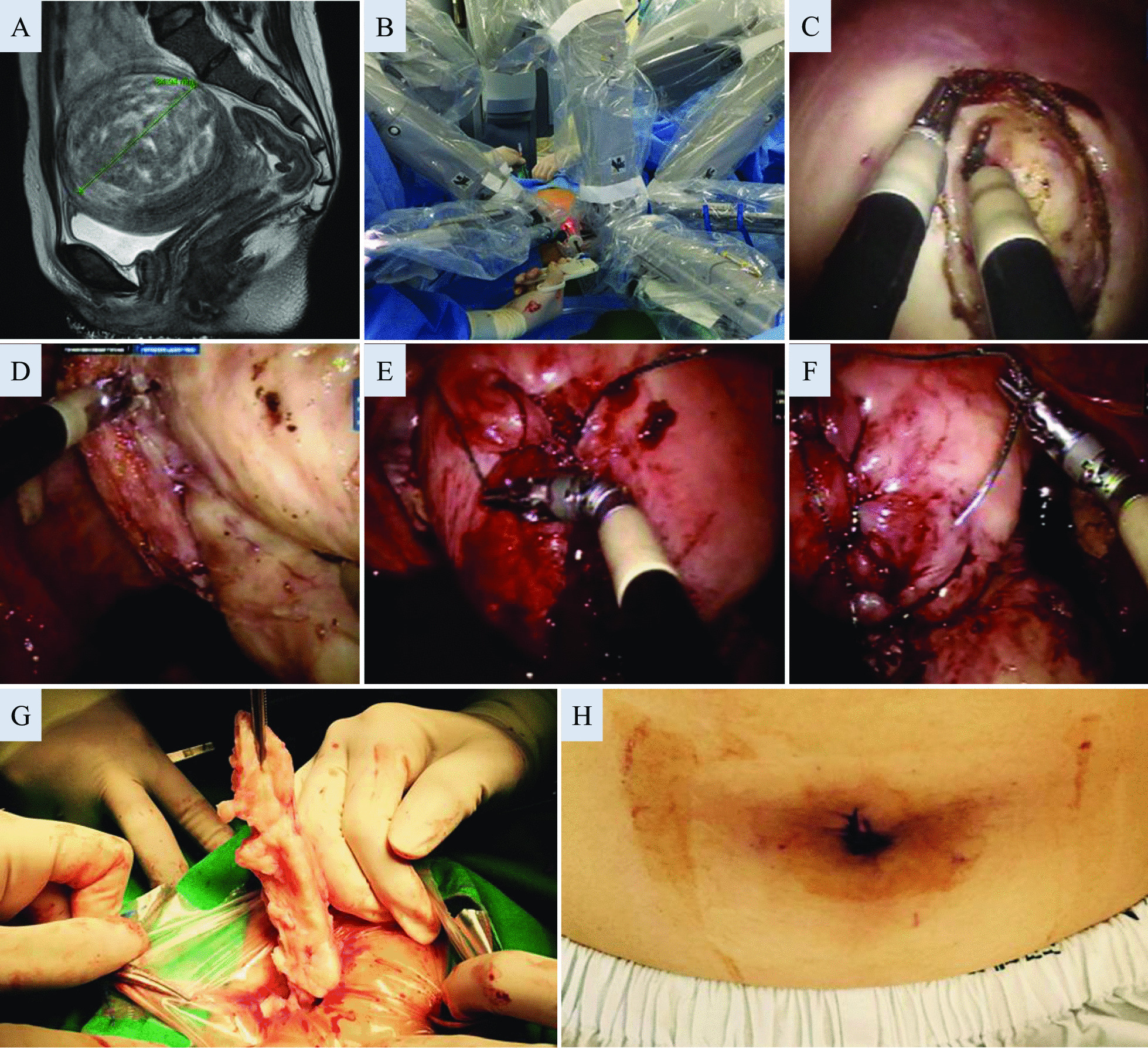
This study aimed to evaluate the compatibility of robotic single-site (RSS) myomectomy in comparison with the conventional robotic multi-port (RMP) myomectomy to achieve successful surgical outcomes with reliability and reproducibility.
This retrospective case-control study was performed on 236 robotic myomectomies at a university medical center. After 1:1 propensity score matching for the total myoma number, total myoma diameter, and patient age, 90 patients in each group (RSS: n = 90; RMP: n = 90) were evaluated. Patient demographics, preoperative parameters, intraoperative characteristics, and postoperative outcome measures were analyzed.
The body mass index, parity, preoperative hemoglobin levels, mean maximal myoma diameter, and anatomical type of myoma showed no mean differences between RSS and RMP myomectomies. The RSS group was younger, had lesser number of myomas removed, and had a smaller sum of the maximal diameter of total myomas removed than the RMP group. After propensity score matching, the total operative time (RSS: 150.9 ± 57.1 min vs. RMP: 170 ± 74.5 min, p = 0.0296) was significantly shorter in the RSS group. The RSS group tended to have a longer docking time (RSS: 9.8 ± 6.5 min vs. RMP: 8 ± 6.2 min, p = 0.0527), shorter console time (RSS: 111.1 ± 52.3 min vs. RMP: 125.8 ± 65.1 min, p = 0.0665), and shorter time required for in-bag morcellation (RSS: 30.1 ± 17.2 min vs. RMP: 36.2 ± 25.7 min, p = 0.0684). The visual analog scale pain score 1 day postoperatively was significantly lower in the RSS group (RSS: 2.4 ± 0.8 days vs. RMP: 2.7 ± 0.8 days, p = 0.0149), with similar consumption of analgesic drugs. The rate of transfusion, estimated blood loss during the operation, and length of hospital stay were not different between the two modalities. No other noticeable complications were observed in either group.
Da Vinci RSS myomectomy is a compatible option with regard to reproducibility and safety, without significantly compromising the number and sum of the maximal diameter of myomas removed. The advantage of shorter total operative time and less pain with the same amount of analgesic drugs in RSS myomectomy will contribute to improving patient satisfaction.
本研究旨在评估机器人单部位(RSS)子宫肌瘤剔除术与传统机器人多孔(RMP)子宫肌瘤剔除术的兼容性,以实现可靠且可重复的手术结果。
本回顾性病例对照研究在一所大学医学中心进行,对 236 例机器人子宫肌瘤剔除术进行了研究。在对总肌瘤数、总肌瘤直径和患者年龄进行 1:1 倾向评分匹配后,每组(RSS:n=90;RMP:n=90)评估 90 例患者。分析患者的人口统计学、术前参数、术中特征和术后结果。
RSS 和 RMP 子宫肌瘤剔除术的体重指数、产次、术前血红蛋白水平、最大肌瘤平均直径和肌瘤的解剖类型无差异。RSS 组年龄较小,剔除的肌瘤数量较少,剔除的总肌瘤最大直径之和也小于 RMP 组。经过倾向评分匹配后,RSS 组的总手术时间(RSS:150.9±57.1 min 比 RMP:170±74.5 min,p=0.0296)明显缩短。RSS 组的对接时间(RSS:9.8±6.5 min 比 RMP:8±6.2 min,p=0.0527)较长,控制台时间(RSS:111.1±52.3 min 比 RMP:125.8±65.1 min,p=0.0665)较短,袋内切碎时间(RSS:30.1±17.2 min 比 RMP:36.2±25.7 min,p=0.0684)较短。RSS 组术后 1 天的视觉模拟评分(VAS)明显较低(RSS:2.4±0.8 天比 RMP:2.7±0.8 天,p=0.0149),镇痛药的消耗量相似。两种方式的输血率、术中估计失血量和住院时间无差异。两组均未出现其他明显并发症。
达芬奇 RSS 子宫肌瘤剔除术在可重复性和安全性方面是一种可行的选择,不会显著影响剔除肌瘤的数量和最大直径之和。RSS 子宫肌瘤剔除术的总手术时间更短,疼痛程度更低,而镇痛药的用量相同,这将有助于提高患者的满意度。