From the Cogito Center for Applied Neurocognition and Neuropsychological Research (S.J.B., M.F., A.R., N.S., I.-K.P.); Department of Neurology (M.D., M.G., M.W., K.L., J.G., N.G., H.-P.H., O.A., S.M., P.A., I.-K.P.), Medical Faculty, Heinrich Heine University, Düsseldorf, Germany; Brain and Mind Centre (H.-P.H.), Department of Neurology, University of Sydney; and Department of Neurology (H.-P.H.), Medical University of Vienna, Austria.
Neurol Neuroimmunol Neuroinflamm. 2021 May 27;8(4). doi: 10.1212/NXI.0000000000001018. Print 2021 Jul.
Retinal layer thickness (RLT) measured by optical coherence tomography (OCT) is considered a noninvasive, cost-efficient marker of neurodegeneration in multiple sclerosis (MS). We aimed to investigate associations of RLT with cognitive performance and its potential as indicator of cognitive status in patients with MS by performing generalized estimating equation (GEE) analyses.
In this cross-sectional study, patients with at least mild signs of cognitive impairment were examined by OCT as well as by the Brief International Cognitive Assessment for MS and tests assessing attention and executive functions (Trail Making Test [TMT] A and B). Associations of these factors were investigated using GEE models controlling for demographic and disease-related factors and correcting for multiple testing.
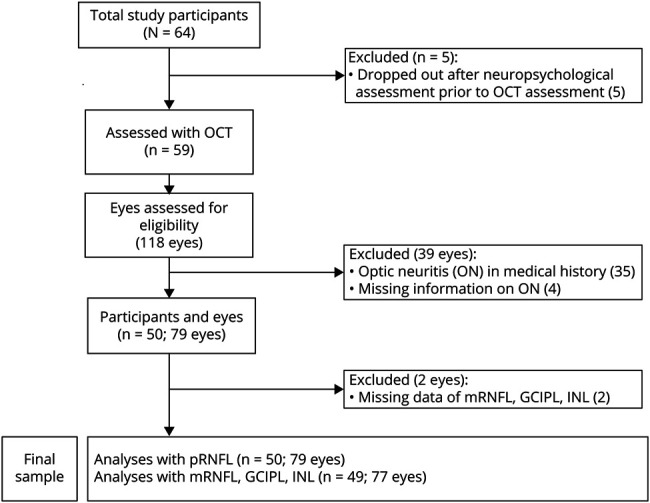
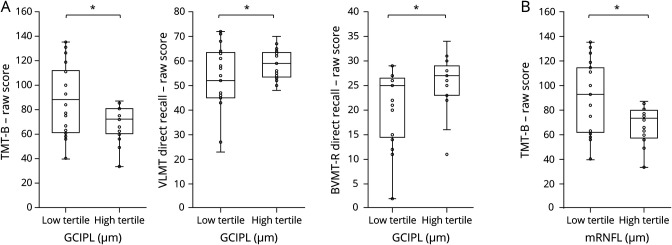
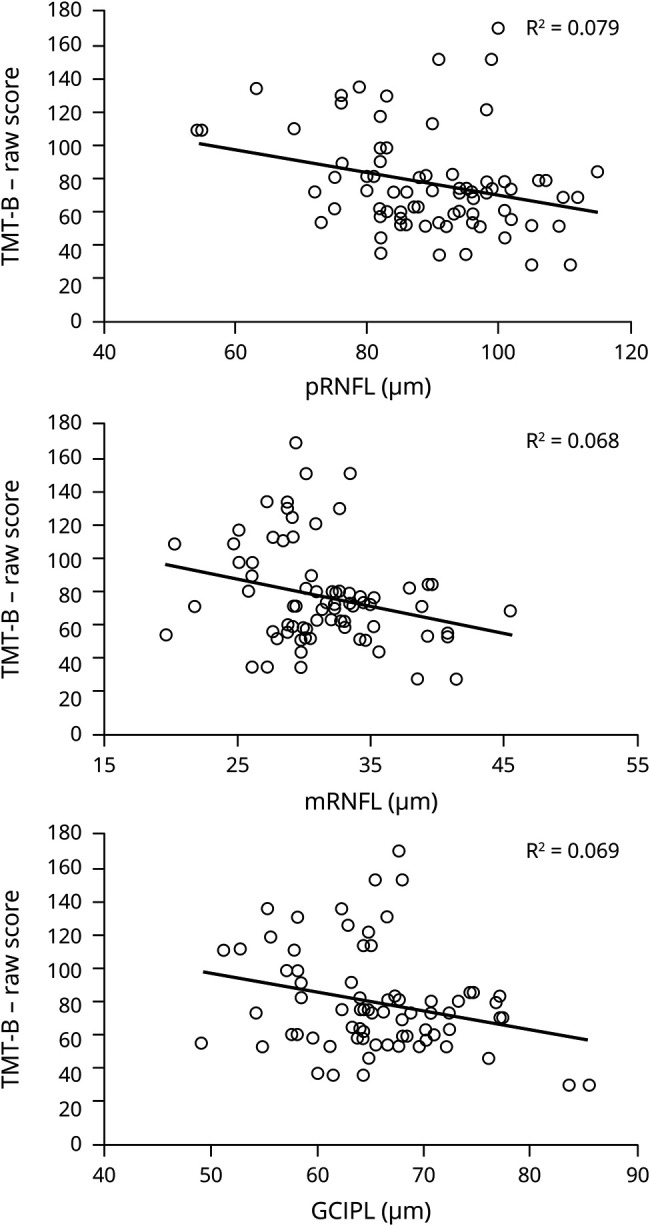
A total of 64 patients entered the study. In the final sample (n = 50 [n = 14 excluded due to missing data or drop-outs]; n = 44 relapsing-remitting MS and n = 6 secondary progressive MS, mean Expanded Disability Status Scale score = 2.59 [SD = 1.17], disease duration [median] = 7.34 [interquartile range = 12.1]), 36.0% were cognitively impaired. RLT of the macular retinal nerve fiber layer was associated with performance in TMT-B (β = -0.259). Analyses focusing on the upper and lower tertile of RLT additionally revealed associations between macular ganglion cell-inner plexiform layer and TMT-B and verbal short-term memory and learning, respectively.
In patients with MS, at less advanced disease stages, RLT was especially associated with cognitive flexibility promoting OCT as a potential marker advocating further extensive neuropsychological examination.
光学相干断层扫描(OCT)测量的视网膜层厚度(RLT)被认为是多发性硬化症(MS)中神经退行性变的一种非侵入性、具有成本效益的标志物。我们旨在通过广义估计方程(GEE)分析,研究 RLT 与认知表现的相关性及其作为 MS 患者认知状态指标的潜力。
在这项横断面研究中,对至少有轻度认知障碍迹象的患者进行 OCT 检查,以及进行简短国际认知评估用于 MS 和评估注意力和执行功能的测试(TMT 测试 A 和 B)。使用 GEE 模型,控制人口统计学和疾病相关因素,并进行多次测试校正,来研究这些因素之间的关联。
共有 64 名患者入组了该研究。在最终样本中(n=50 [n=14 因数据缺失或退出而被排除];n=44 例复发缓解型 MS 和 n=6 例继发进展型 MS,平均扩展残疾状况量表评分=2.59 [SD=1.17],疾病病程[中位数]=7.34 [四分位距=12.1]),36.0%的患者存在认知障碍。黄斑视网膜神经纤维层的 RLT 与 TMT-B 的表现相关(β=-0.259)。针对 RLT 的上、下三分位的分析还揭示了黄斑神经节细胞-内丛状层与 TMT-B 以及言语短期记忆和学习之间的相关性。
在 MS 患者中,在疾病进展程度较低的阶段,RLT 与认知灵活性的相关性更强,因此提倡将 OCT 作为一种潜在的标志物,进一步进行广泛的神经心理学检查。