Institute for Alpine Environment, Eurac Research, Drususallee 1, 39100, Bozen/Bolzano, Italy.
Department of Statistics, Faculty of Economics and Statistics, Universität Innsbruck, Universitätsstrasse 15, 6020, Innsbruck, Austria.
Sci Rep. 2021 May 27;11(1):11246. doi: 10.1038/s41598-021-90652-2.
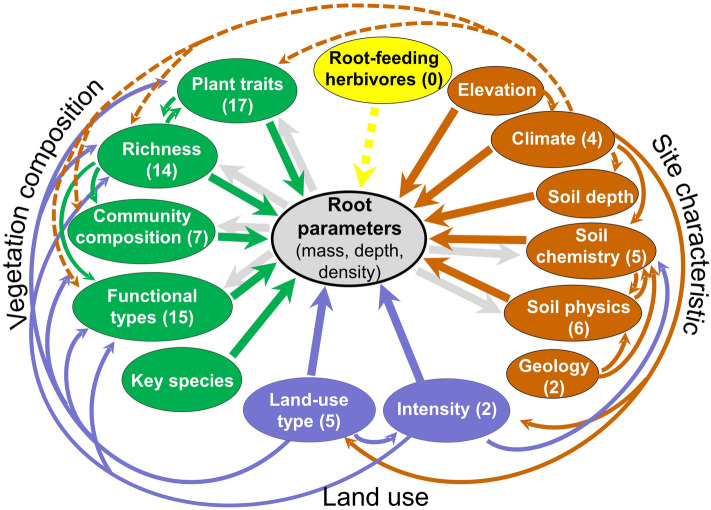
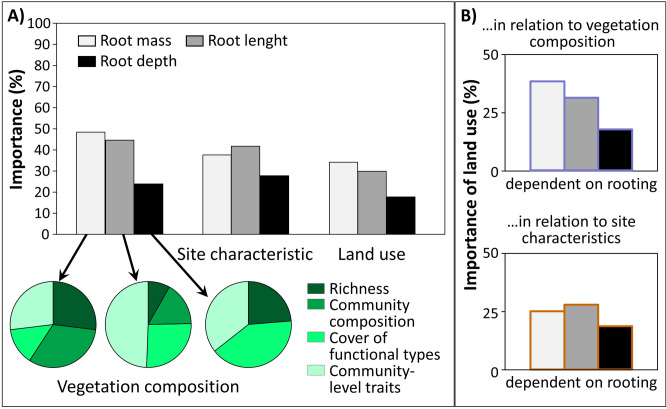
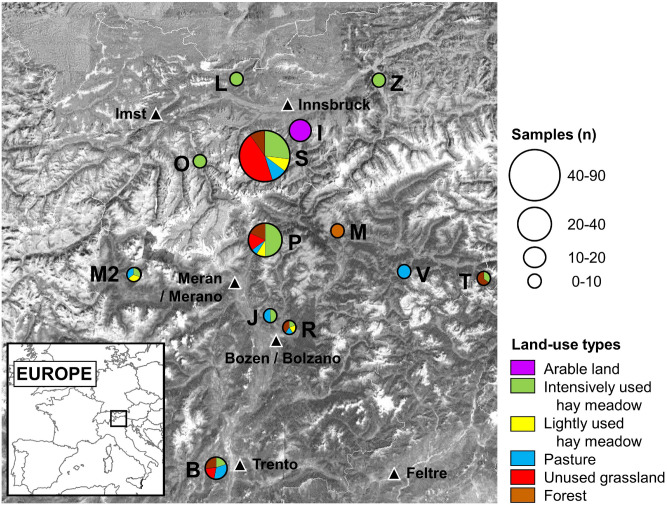
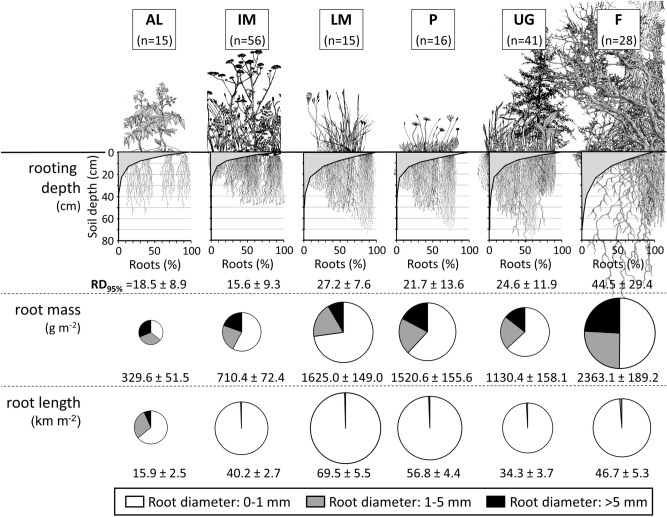
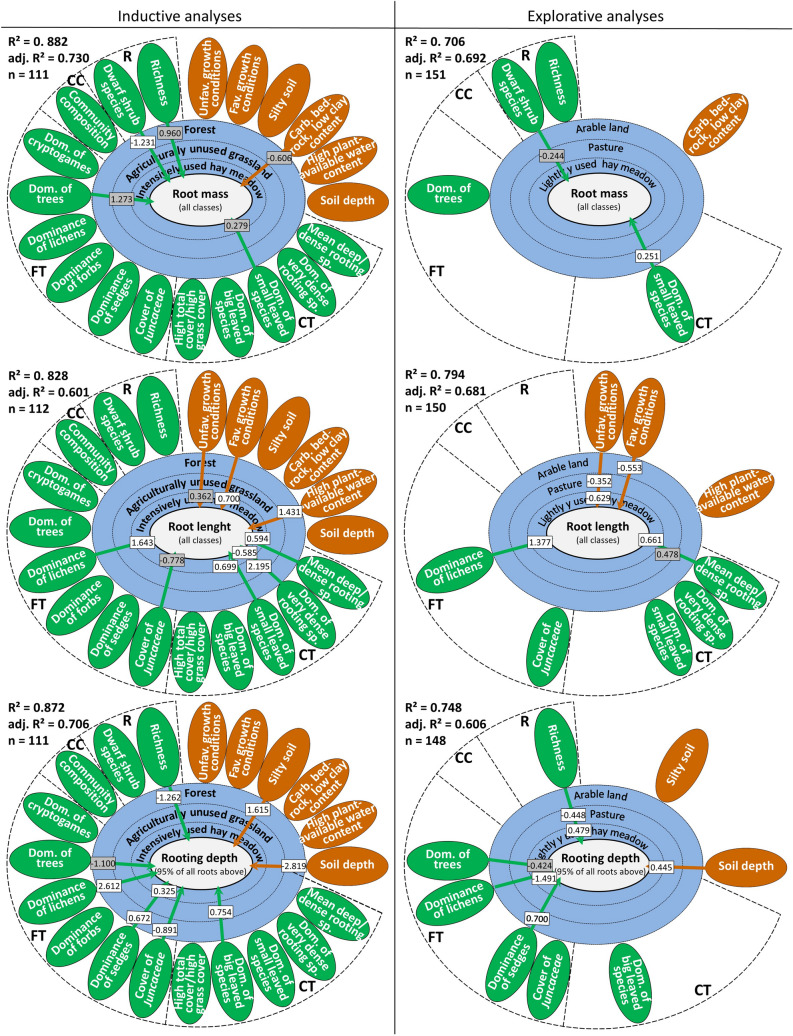
Plant rooting strongly affects most hydrological, biogeochemical and ecological processes in terrestrial ecosystems, as it presents the main pathway for carbon, water and nutrient transfer from soil to the atmosphere and is a key factor in stabilizing the soil layer. Few studies have actually investigated the link between phytosociological and structural vegetation composition and diversity in soil rooting parameters. Our study provides a comprehensive evaluation of plant cover and diversity effects on rooting parameters dependent on different land-use types along a north-south transect in the Eastern Alps. We conducted field studies of root biomass, rooting density and rooting depth for the six main land-use types: intensively and lightly used hay meadows, pastures, arable land, agriculturally unused grasslands and forests. The variation in rooting parameters was explained by different aspects of species and functional richness, species and functional composition, functional traits, abundance of key species and site variables depending on the land-use types. Our results showed that different characteristics of biodiversity explained the variance in root parameters (mass, density and depth) to a high degree (determination coefficient R values varied between 0.621 and 0.891). All rooting parameters increased with increasing plant species richness, as well as with a higher diversity of plant functional traits. The inclusion of site parameters significantly increased the explained variance, while we could not find evidence for key species and their abundance to provide additional explanatory power. Allowing the effects to vary depending on land-use types turned out to be a necessity supporting the importance of considering land-use types for rooting. The findings indicate that vegetation composition has a clear relationship with rooting parameters across different habitats in the European Alps. As the effect of plant composition differs with respect to the land-use type, rooting can be monitored by land management to achieve the desired benefits. For example, intensified rooting through extensive management decreases erosion risk and increases carbon uptake.
植物根系强烈影响陆地生态系统中的大多数水文、生物地球化学和生态过程,因为它是碳、水和养分从土壤转移到大气的主要途径,也是稳定土壤层的关键因素。很少有研究实际上调查了植物社会学和结构植被组成与土壤根系参数之间的联系。我们的研究提供了对植物覆盖和多样性对依赖于阿尔卑斯山东部南北向样带不同土地利用类型的根系参数的影响的综合评估。我们对六种主要土地利用类型(集约和轻度使用的干草草地、牧场、耕地、农业未使用的草地和森林)的根生物量、根系密度和根系深度进行了实地研究。根据土地利用类型,根系参数的变化由物种和功能丰富度、物种和功能组成、功能特征、关键物种的丰度和站点变量的不同方面来解释。我们的结果表明,不同的生物多样性特征在很大程度上解释了根系参数(质量、密度和深度)的变化(决定系数 R 值在 0.621 到 0.891 之间变化)。所有根系参数都随着植物物种丰富度的增加而增加,同时植物功能特征的多样性也增加。纳入站点参数显著增加了可解释的方差,而我们没有发现关键物种及其丰度的证据来提供额外的解释力。允许根据土地利用类型来改变效应,这被证明是支持考虑土地利用类型对根系的重要性的必要性。研究结果表明,植被组成与欧洲阿尔卑斯山不同生境中的根系参数之间存在明显的关系。由于植物组成的影响因土地利用类型而异,因此可以通过土地管理来监测根系,以实现预期的效益。例如,通过广泛的管理来加强根系可以降低侵蚀风险并增加碳吸收。