Redelstein Regine, Dinter Thomas, Hertel Dietrich, Leuschner Christoph
Plant Ecology and Ecosystems Research, University of Goettingen, Goettingen, Germany.
Soil Science of Temperate Ecosystems, University of Goettingen, Goettingen, Germany.
Front Plant Sci. 2018 Feb 6;9:98. doi: 10.3389/fpls.2018.00098. eCollection 2018.
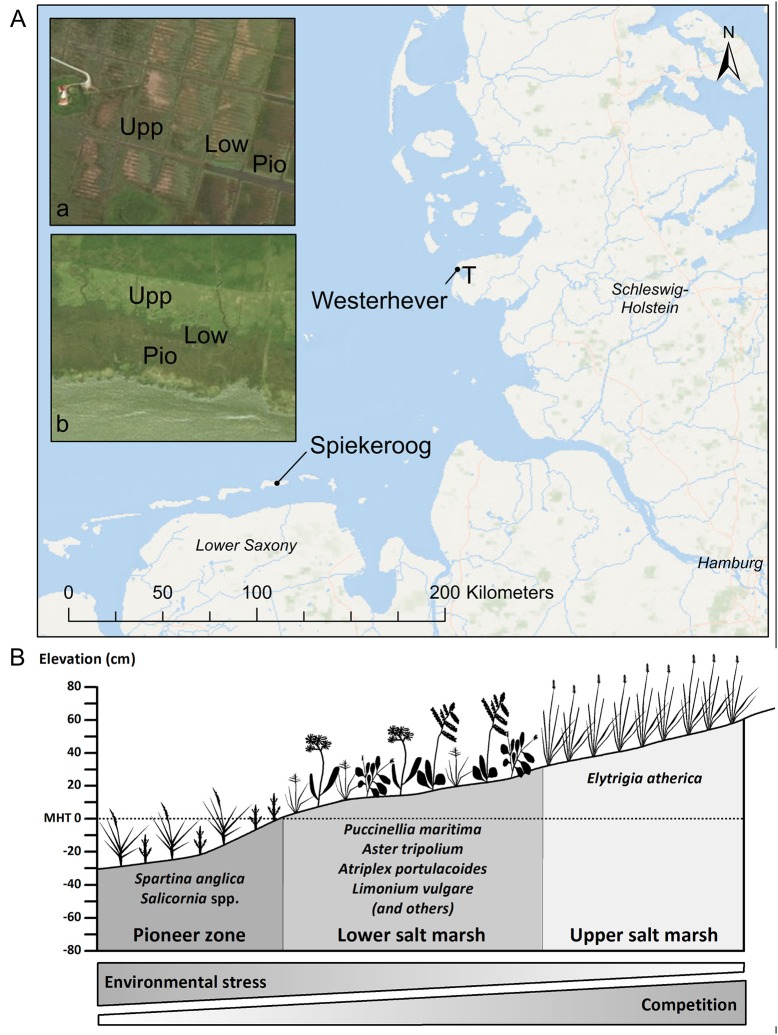
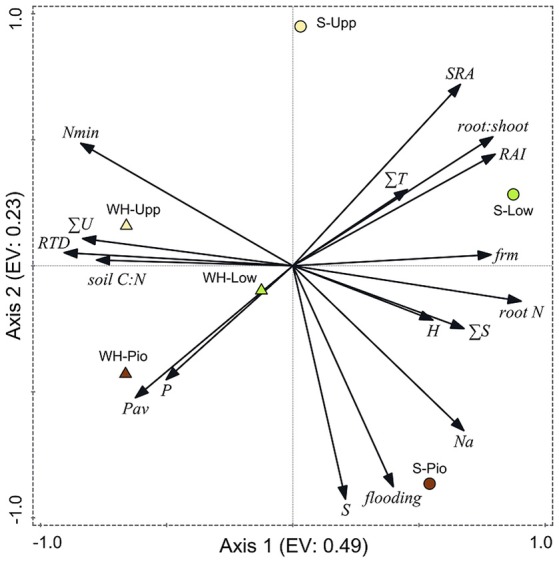
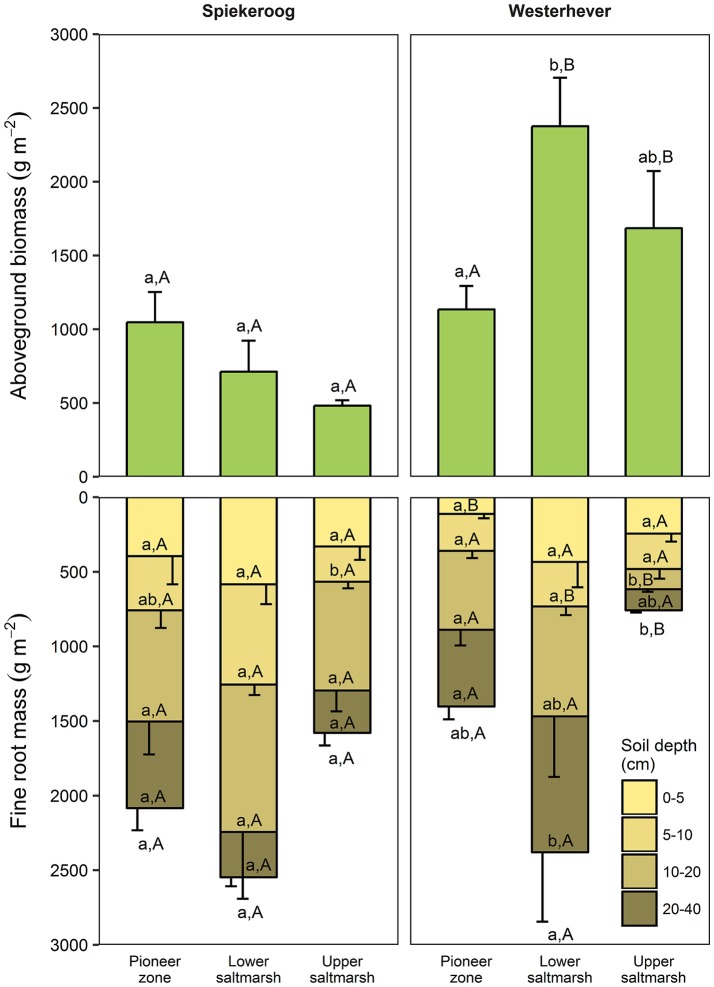
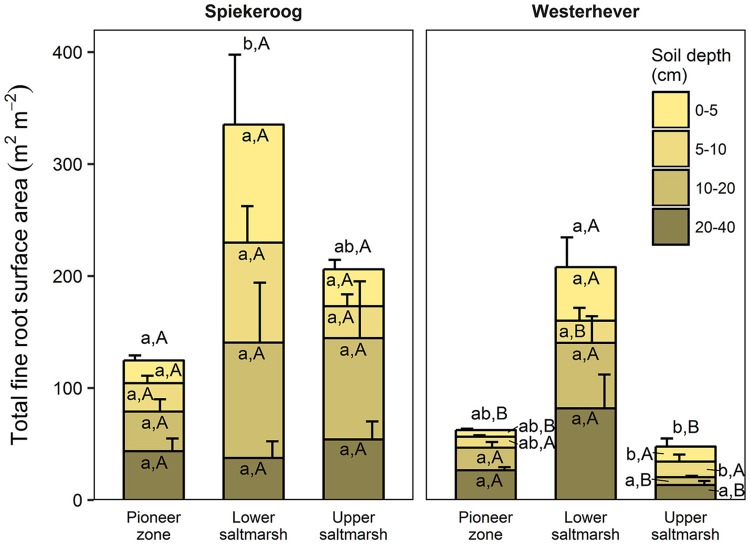
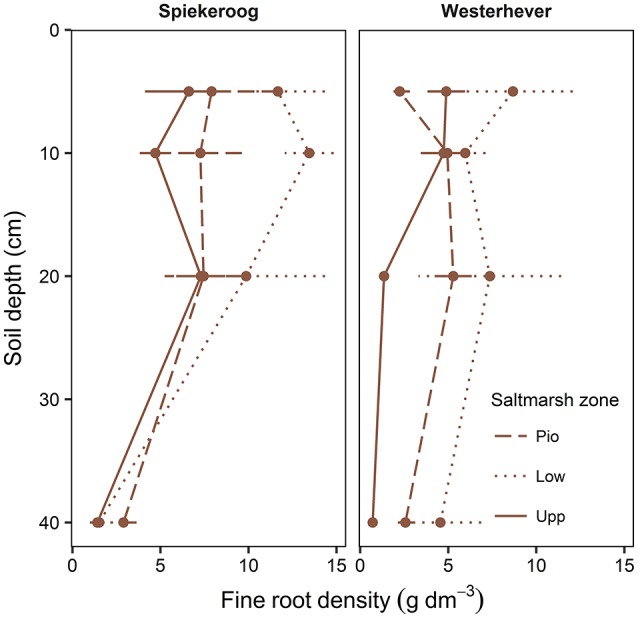
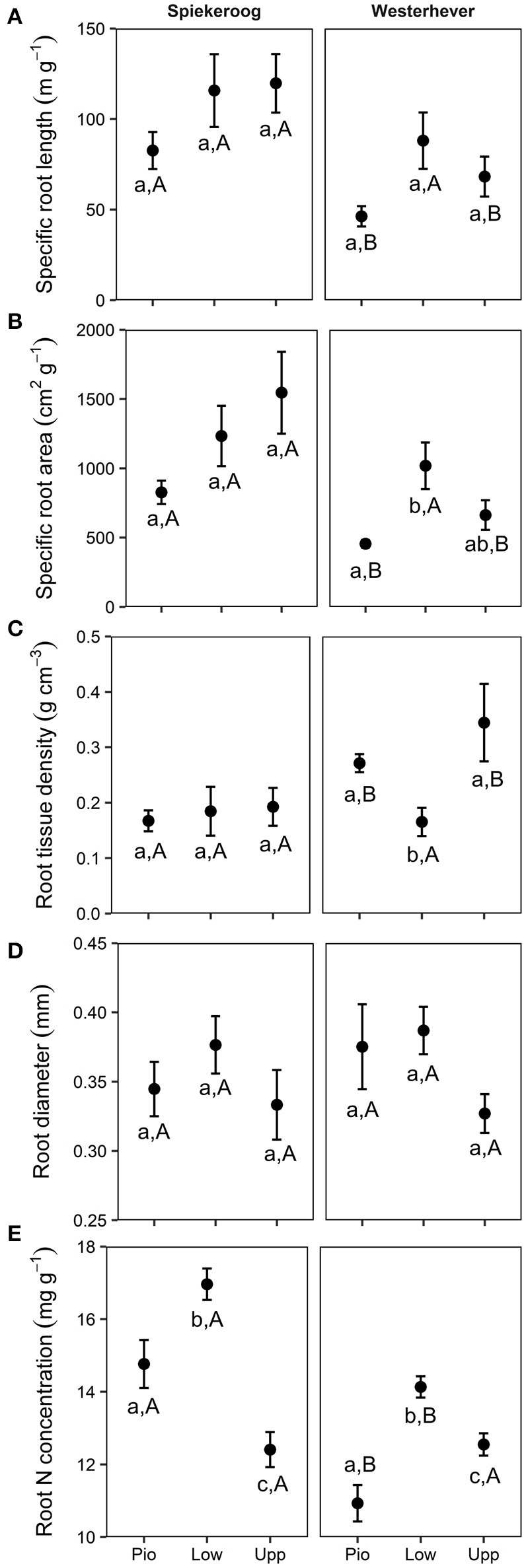
Saltmarsh plants are exposed to multiple stresses including tidal inundation, salinity, wave action and sediment anoxia, which require specific root system adaptations to secure sufficient resource capture and firm anchorage in a temporary toxic environment. It is well known that many saltmarsh species develop large below-ground biomass (roots and rhizomes) but relations between fine roots, in particular, and the abiotic conditions in salt marshes are widely unknown. We studied fine root mass (<2 mm in diameter), fine root depth distribution and fine root morphology in three typical communities (-dominated pioneer zone, -dominated lower marsh, -dominated upper marsh) across elevational gradients in two tidal salt marshes of the German North Sea coast [a mostly sandy marsh on a barrier island (Spiekeroog), and a silty-clayey marsh on the mainland coast (Westerhever)]. Fine root mass in the 0-40 cm profile ranged between 750 and 2,500 g m in all plots with maxima at both sites in the lower marsh with intermediate inundation frequency and highest plant species richness indicating an effect of biodiversity on fine root mass. Fine root mass and, even more, total fine root surface area (maximum 340 m m) were high compared to terrestrial grasslands, and were greater in the nutrient-poorer Spiekeroog marsh. Fine root density showed only a slight or no decrease toward 40 cm depth. We conclude that the standing fine root mass and morphology of these salt marshes is mainly under control of species identity and nutrient availability, but species richness is especially influential. The plants of the pioneer zone and lower marsh possess well adapted fine roots and large standing root masses despite the often water-saturated sediment.
盐沼植物面临多种胁迫,包括潮汐淹没、盐分、波浪作用和沉积物缺氧,这就需要特定的根系适应性,以确保在临时有毒环境中获得足够的资源捕获和稳固的锚固。众所周知,许多盐沼物种会形成大量的地下生物量(根和根茎),但特别是细根与盐沼非生物条件之间的关系却鲜为人知。我们研究了德国北海海岸两个潮汐盐沼[一个位于屏障岛(施皮克罗格)上的主要为沙质的盐沼,以及一个位于大陆海岸(韦斯特黑弗)的粉质粘土质盐沼]中,三个典型群落(以先锋带为主、以下部盐沼为主、以上部盐沼为主)沿海拔梯度的细根质量(直径<2毫米)、细根深度分布和细根形态。在所有样地中,0-40厘米土层的细根质量在750至2500克/平方米之间,两个地点的下部盐沼均达到最大值,其淹没频率适中且植物物种丰富度最高,表明生物多样性对细根质量有影响。与陆地草原相比,细根质量,甚至更重要的是总细根表面积(最大340平方米)都很高,并且在营养较贫瘠的施皮克罗格盐沼中更大。细根密度在40厘米深度处仅略有下降或没有下降。我们得出结论,这些盐沼的现存细根质量和形态主要受物种特性和养分有效性的控制,但物种丰富度的影响尤为显著。尽管沉积物经常处于水饱和状态,但先锋带和下部盐沼的植物仍拥有适应良好的细根和大量的现存根量。