Díaz González Marta, Buberman Assaf, Morales Miguel, Ferrer Isidro, Knafo Shira
Department of Physiology and Cell Biology, Faculty of Health Sciences, The National Institute for Biotechnology in the Negev, Ben-Gurion University of the Negev, Beer-Sheva, Israel.
Instituto Biofisika (UPV/EHU, CSIC), University of the Basque Country, Leioa, Spain.
Front Synaptic Neurosci. 2021 May 11;13:683290. doi: 10.3389/fnsyn.2021.683290. eCollection 2021.
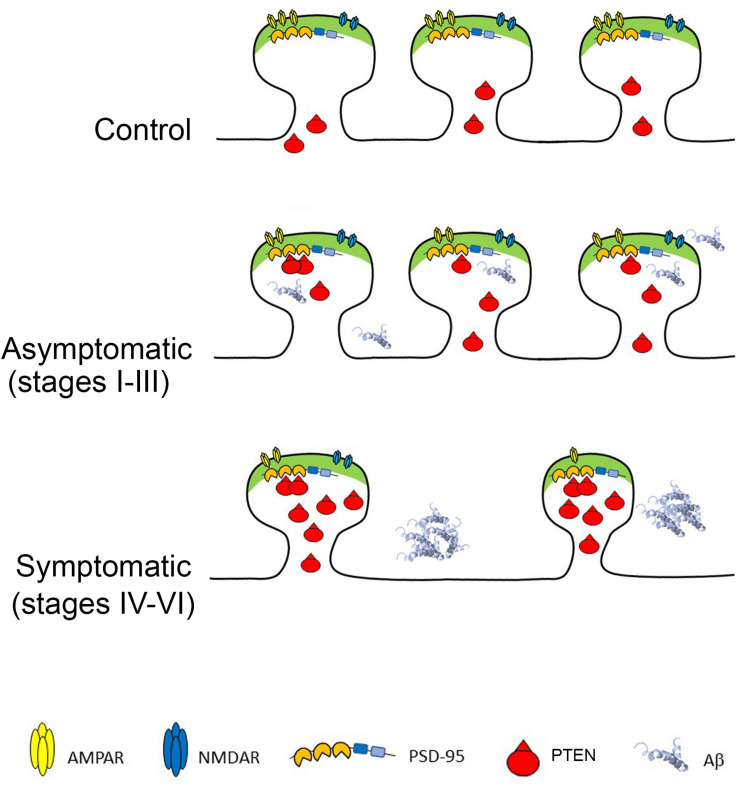
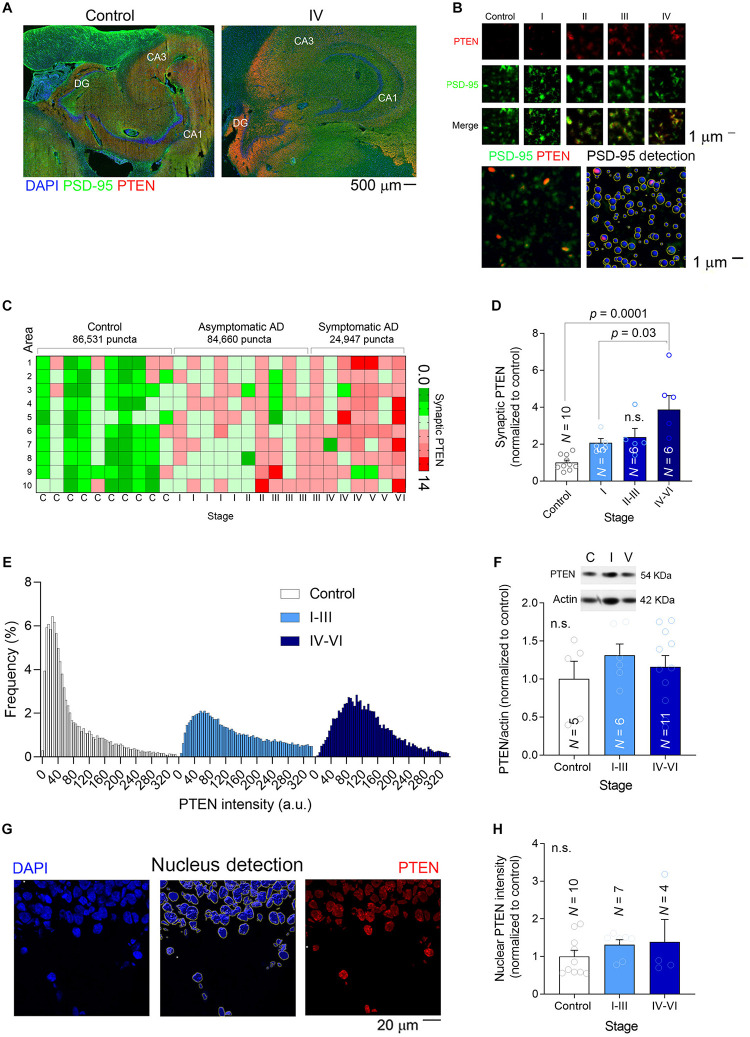
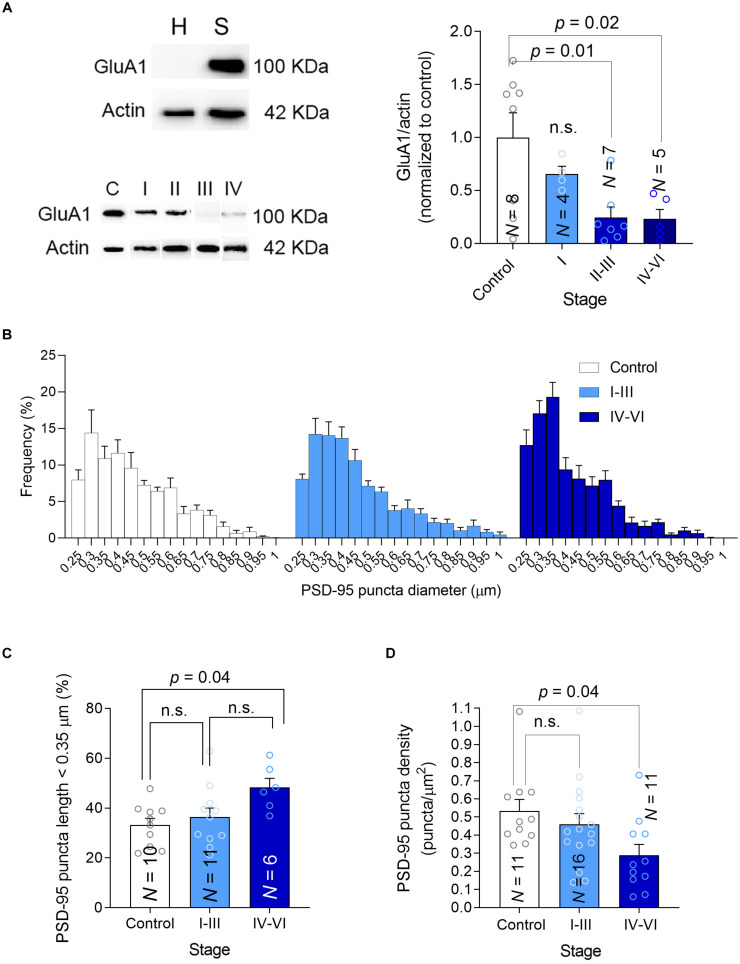
In Alzheimer's disease (AD), Amyloid β (Aβ) impairs synaptic function by inhibiting long-term potentiation (LTP), and by facilitating long-term depression (LTD). There is now evidence from AD models that Aβ provokes this shift toward synaptic depression by triggering the access to and accumulation of PTEN in the postsynaptic terminal of hippocampal neurons. Here we quantified the PTEN in 196,138 individual excitatory dentate gyrus synapses from AD patients at different stages of the disease and from controls with no neuropathological findings. We detected a gradual increase of synaptic PTEN in AD brains as the disease progresses, in conjunction with a significant decrease in synaptic density. The synapses that remain in symptomatic AD patients are more likely to be smaller and exhibit fewer AMPA receptors (AMPARs). Hence, a high Aβ load appears to strongly compromise human hippocampal synapses, as reflected by an increase in PTEN, inducing a loss of AMPARs that may eventually provoke synaptic failure and loss.
在阿尔茨海默病(AD)中,淀粉样β蛋白(Aβ)通过抑制长时程增强(LTP)和促进长时程抑制(LTD)来损害突触功能。目前来自AD模型的证据表明,Aβ通过触发海马神经元突触后终末中PTEN的进入和积累,促使这种向突触抑制的转变。在此,我们对来自不同疾病阶段的AD患者以及无神经病理学发现的对照的196,138个单个兴奋性齿状回突触中的PTEN进行了定量。我们检测到随着疾病进展,AD大脑中突触PTEN逐渐增加,同时突触密度显著降低。有症状的AD患者中残留的突触更可能较小且表现出较少的α-氨基-3-羟基-5-甲基-4-异恶唑丙酸受体(AMPARs)。因此,高Aβ负荷似乎会严重损害人类海马突触,这表现为PTEN增加,导致AMPARs丢失,最终可能引发突触功能障碍和丧失。