Musalam Kauther, Sohal Karpal S, Owibingire Sira S, Kileo Baraka
Department of Dental Services, Muhimbili National Hospital, P. O. Box 65000, Dar es Salaam, Tanzania.
Department of Oral and Maxillofacial Surgery, School of Dentistry, Muhimbili University of Health and Allied Sciences, P. O. Box 65014, Dar es Salaam, Tanzania.
Int J Dent. 2021 May 8;2021:9965204. doi: 10.1155/2021/9965204. eCollection 2021.
It is estimated that, about 40% of the population suffer from dental anxiety. Dental anxiety is considered to be complex and multifactorial with a wide range of provoking factors which may be patient, provider, or environment-related.
This study aimed to assess the magnitude and determinants of dental anxiety among adult patients attending public dental clinics in Dar es Salaam, Tanzania. . This was a descriptive cross-sectional study carried out in 4 public hospitals in Dar es Salaam, Tanzania. It included 300 adult patients who had dental caries, periodontal diseases, or dental trauma. Data were collected using a self-administered Modified Dental Anxiety Scale (MDAS) questionnaire. Data were analyzed using the SPSS computer software version 23. A one-way Analysis of Variance (ANOVA) was used to assess the association between variables, and the significance level was set at < 0.05.
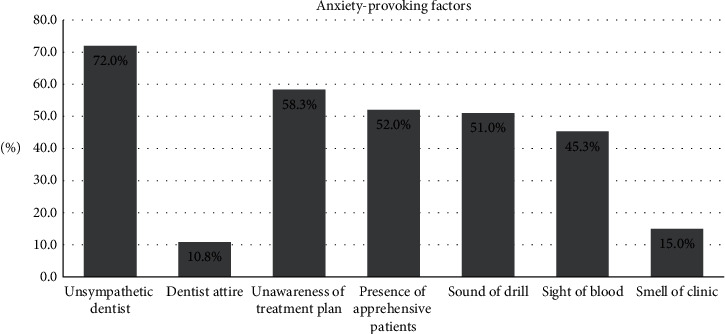
The mean age of participants was 32.18 years (±11.06 SD) with a male-to-female ratio of 1 : 1.43. The means MDAS score was 12.84 ± 4.99. Tooth extraction had the highest mean MDAS score. The majority (261, 87%) of participants had mild-to-severe anxiety. The most common (72.2%) anxiety-provoking factor was an unsympathetic dentist; others included unawareness of the procedure to be carried out (58.3%) and the presence of apprehensive patients (52.0%). The level of anxiety was found to be statistically significantly associated ( < 0.05) with young age [=0.009, AOR 3.06 (95% CI, 1.32, 7.09), female patients [ < 0.001, AOR 4.45 (95% CI, 2.05, 9.70)], and a higher education level [ < 0.05, AOR 2.32 (95% CI, 1.03, 5.25)].
The prevalence of dental anxiety was high among the participants of this study. Female gender, young age, and a higher level of education constituted determinants of dental anxiety. An unsympathetic practitioner, unawareness of the procedure, and presence of apprehensive patients were the common anxiety-provoking factors.
据估计,约40%的人口患有牙科焦虑症。牙科焦虑症被认为是复杂且多因素的,有多种诱发因素,可能与患者、医护人员或环境有关。
本研究旨在评估坦桑尼亚达累斯萨拉姆公立牙科诊所成年患者中牙科焦虑症的严重程度及其决定因素。 这是一项在坦桑尼亚达累斯萨拉姆的4家公立医院开展的描述性横断面研究。研究纳入了300名患有龋齿、牙周疾病或牙外伤的成年患者。使用自行填写的改良牙科焦虑量表(MDAS)问卷收集数据。使用SPSS 23版计算机软件对数据进行分析。采用单因素方差分析(ANOVA)评估变量之间的关联,显著性水平设定为<0.05。
参与者的平均年龄为32.18岁(标准差±11.06),男女比例为1∶1.43。MDAS平均得分为12.84±4.99。拔牙的MDAS平均得分最高。大多数(261名,87%)参与者患有轻度至重度焦虑症。最常见的(72.2%)焦虑诱发因素是冷漠的牙医;其他因素包括对即将进行的治疗不了解(58.3%)以及有焦虑的患者在场(52.0%)。研究发现,焦虑水平在统计学上与年轻[=0.009,调整后比值比(AOR)3.06(95%置信区间,1.32,7.09)]、女性患者[<0.001,AOR 4.45(95%置信区间,2.05,9.70)]以及较高教育水平[<0.05,AOR 2.32(95%置信区间,1.03,5.25)]显著相关。
本研究参与者中牙科焦虑症的患病率较高。女性、年轻以及较高的教育水平是牙科焦虑症的决定因素。冷漠的从业者、对治疗不了解以及有焦虑的患者在场是常见的焦虑诱发因素。