Guan Tianwang, Qiu Zicong, Su Miao, Yang Jinming, Tang Yongshi, Jiang Yanting, Yao Dunchen, Lai Yanxian, Li Yanfang, Liu Cheng
Department of Cardiology, Guangzhou First People's Hospital, Guangzhou Medical University, Guangzhou, China.
Department of Cardiology, Guangzhou First People's Hospital, South China University of Technology, Guangzhou, China.
Front Oncol. 2021 May 11;11:641955. doi: 10.3389/fonc.2021.641955. eCollection 2021.
To study the cardiovascular death (CVD) risk in primary central nervous system lymphoma (PCNSL) patients with chemotherapy.
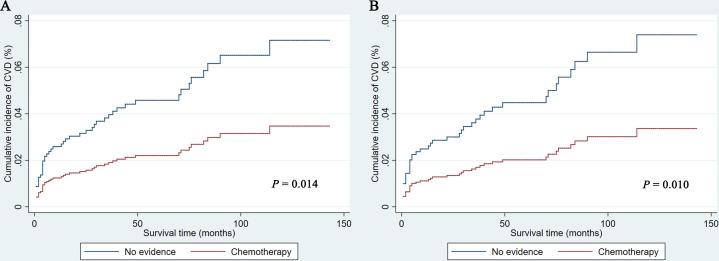
We obtained 2,020 PCNSL participants and 88,613 non-central nervous system lymphoma (NCNSL) participants with chemotherapy from Surveillance, Epidemiology, and End Results (SEER) database from 2004 to 2015. A 1:3 propensity score matching (PSM) was used to reduce the imbalance between PCNSL participants with and without chemotherapy, as well as the imbalance between PCNSL and NCNSL participants with chemotherapy. Competing risks regressions were conducted to evaluate the independent influence of chemotherapy on CVD.
After 1:3 PSM, the CVD risk in PCNSL patients with chemotherapy was lower than those without chemotherapy [decreased 53%, adjusted HR, 0.469 (95% CI, 0.255-0.862; = 0.015)] as well as NCNSL patients with chemotherapy [decreased 36%, adjusted HR in model 1, 0.636 (95% CI, 0.439-0.923; = 0.017)]. The CVD risk of chemotherapy decreased in PCNSL patients with age at diagnosis >60 years old [adjusted HR, 0.390 (95% CI, 0.200-0.760; = 0.006)], and those patients diagnosed at 2010 to 2015 [adjusted HR, 0.339 (95% CI, 0.118-0.970; = 0.044)].
PCNSL patients with chemotherapy are associated with lower CVD risk. Our findings may provide new foundations for that chemotherapy is the first-line treatment for PCNSL patients, according to a cardiovascular risk perspective.
研究接受化疗的原发性中枢神经系统淋巴瘤(PCNSL)患者的心血管死亡(CVD)风险。
我们从2004年至2015年的监测、流行病学和最终结果(SEER)数据库中获取了2020名接受化疗的PCNSL参与者和88613名接受化疗的非中枢神经系统淋巴瘤(NCNSL)参与者。采用1:3倾向评分匹配(PSM)来减少接受化疗和未接受化疗的PCNSL参与者之间的不平衡,以及接受化疗的PCNSL和NCNSL参与者之间的不平衡。进行竞争风险回归以评估化疗对CVD的独立影响。
经过1:3 PSM后,接受化疗的PCNSL患者的CVD风险低于未接受化疗的患者[降低53%,调整后HR,0.469(95%CI,0.255 - 0.862;P = 0.015)]以及接受化疗的NCNSL患者[降低36%,模型1中调整后HR,0.636(95%CI,0.439 - 0.923;P = 0.017)]。诊断时年龄>60岁的PCNSL患者[调整后HR,0.390(95%CI,0.200 - 0.760;P = 0.006)]以及2010年至2015年诊断的患者[调整后HR,0.339(95%CI,0.118 - 0.970;P = 0.044)]化疗后的CVD风险降低。
接受化疗的PCNSL患者的CVD风险较低。从心血管风险角度来看,我们的研究结果可能为化疗作为PCNSL患者的一线治疗提供新的依据。