Department of Urology, The ChenJiaqiao Hospital of ShaPingba District of Chongqing City, Chongqing, 401331, People's Republic of China.
Department of Urology, The Second Affiliated Hospital of Chongqing Medical University, No.76, Linjiang Road, Yuzhong District, Chongqing, 400010, People's Republic of China.
J Cancer Res Clin Oncol. 2023 Sep;149(12):10203-10215. doi: 10.1007/s00432-023-04867-z. Epub 2023 Jun 3.
The objective of this study was to investigate non-cancer causes of death and associated risk factors after bladder cancer (BC) diagnosis.
Eligible BC patients were obtained from the SEER database. SEER*Stat software 8.3.9.2 was used to calculate the standardized mortality ratios (SMRs). The proportions of different non-cancer cause of death were calculated and analyzed in different follow-up periods. Multivariate competing risk model was used to analyze the risk factors for death of BC and non-cancer diseases.
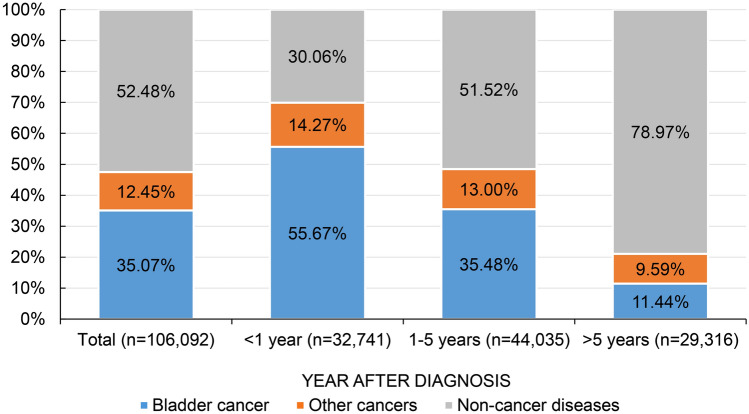
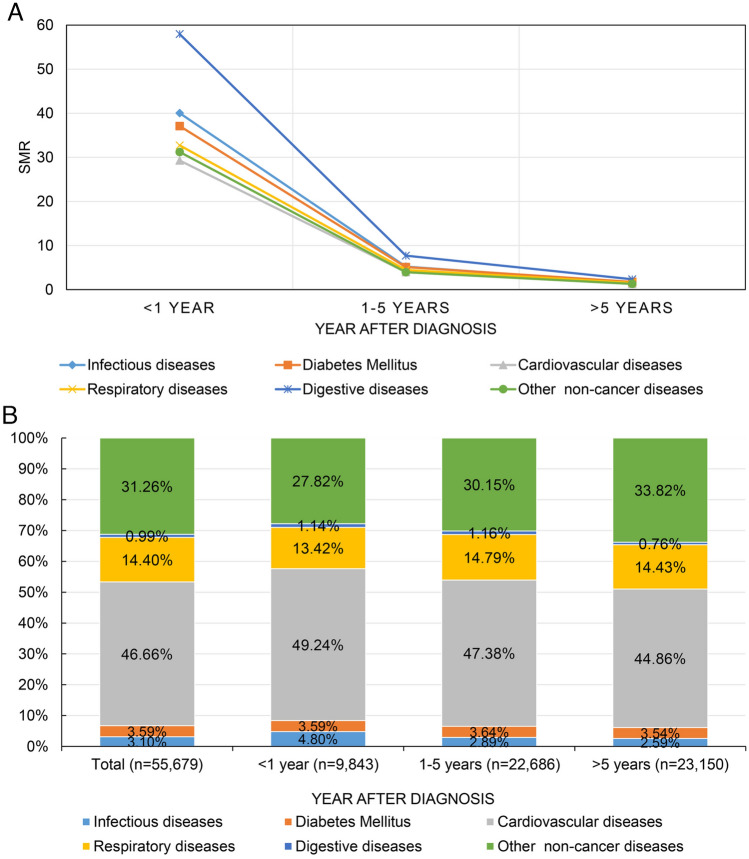
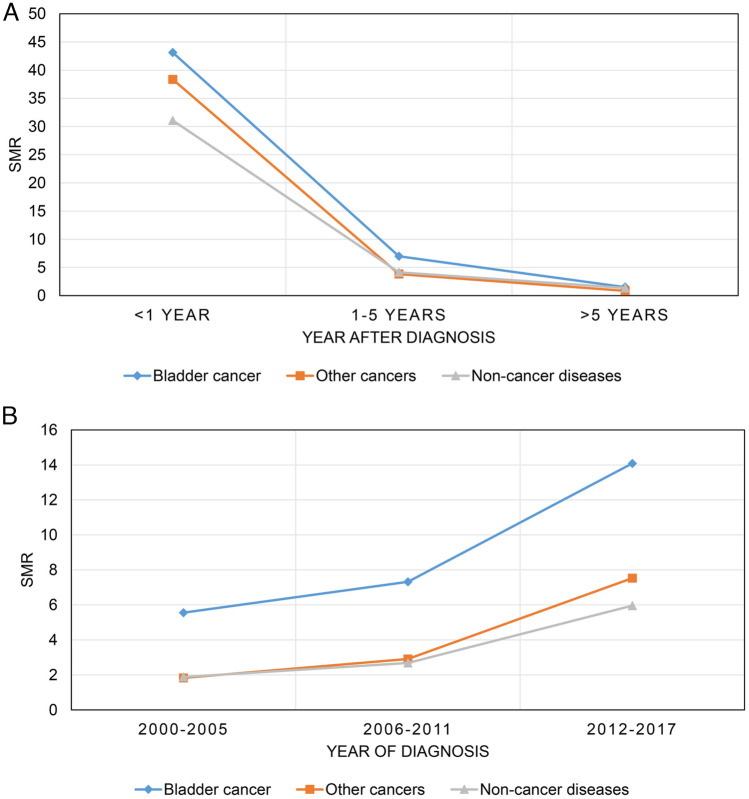
In total, 240,954 BC patients were included and 106,092 patients experienced death, with 37,205 (35.07%), 13,208 (12.45%) and 55,679 (52.48%) patients experienced BC, other cancer and non-cancer disease-related deaths, respectively. Overall SMR for BC patients who died from non-cancer diseases was 2.42 (95% CI [2.40-2.44]). Cardiovascular diseases were the most common non-cancer cause of death, followed by respiratory diseases, diabetes mellitus, and infectious diseases. Multivariate competing risk analysis identified the following high-risk factors for non-cancer mortality: age > 60 years, male, whites, in situ stage, pathological type of transitional cell carcinoma, not receiving treatment (including surgery, chemotherapy, or radiation), and widowed.
Cardiovascular diseases are the leading non-cancer cause of death in BC patients, followed by respiratory disease, diabetes mellitus and infectious diseases. Physicians should pay attention to the risk of death from these non-cancer diseases. Also, physicians should encourage patients to engage in more proactive self-surveillance and follow up.
本研究旨在探讨膀胱癌(BC)诊断后非癌症死亡的原因和相关危险因素。
从 SEER 数据库中获取符合条件的 BC 患者。使用 SEER*Stat 软件 8.3.9.2 计算标准化死亡率比(SMR)。计算并分析不同随访期不同非癌症死因的比例。多变量竞争风险模型用于分析 BC 和非癌症疾病死亡的危险因素。
共纳入 240954 例 BC 患者,其中 106092 例患者死亡,37205(35.07%)、13208(12.45%)和 55679(52.48%)例患者分别死于 BC、其他癌症和非癌症疾病。死于非癌症疾病的 BC 患者的总体 SMR 为 2.42(95%CI[2.40-2.44])。心血管疾病是非癌症死亡的最常见原因,其次是呼吸疾病、糖尿病和传染病。多变量竞争风险分析确定了非癌症死亡率的以下高危因素:年龄>60 岁、男性、白人、原位期、移行细胞癌的病理类型、未接受治疗(包括手术、化疗或放疗)和丧偶。
心血管疾病是 BC 患者非癌症死亡的主要原因,其次是呼吸疾病、糖尿病和传染病。医生应注意这些非癌症疾病的死亡风险。此外,医生应鼓励患者进行更积极主动的自我监测和随访。