Rizzo Caterina, Loconsole Daniela, Pandolfi Elisabetta, Ciofi Degli Atti Marta Luisa, van Summeren Jojanneke, Paget John, Russo Luisa, Campagna Ilaria, Croci Ileana, Gesualdo Francesco, Concato Carlo, Linardos Giulia, Bartolucci Veronica, Ciampini Sara, Muda Andrea Onetti, Raponi Massimiliano, Chironna Maria
Clinical Pathways and Epidemiology, Bambino Gesù Children's Hospital, IRCCS, Rome, Italy.
Department of Biomedical Science and Human Oncology, University of Bari, Bari, Italy.
Front Pediatr. 2021 May 11;9:620598. doi: 10.3389/fped.2021.620598. eCollection 2021.
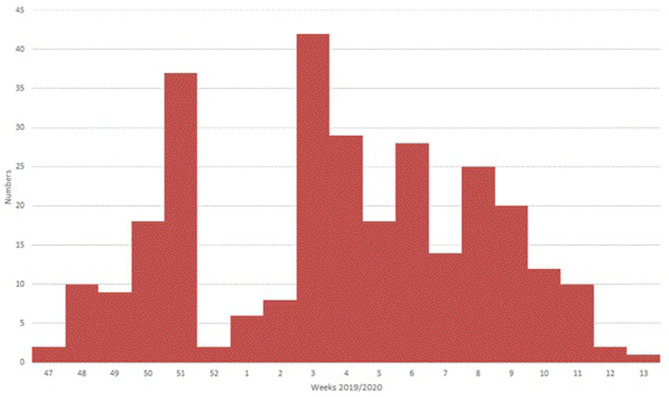
In December 2019, a novel coronavirus named SARS-CoV-2 started circulating in China and this led to a major epidemic in Northern Italy between February and May 2020. Young children (aged <5 years) seem to be less affected by this coronavirus disease (COVID-19) compared to adults, although there is very little information on the circulation of this new virus among children in Italy. We retrospectively tested nasopharyngeal swabs for SARS-CoV-2 in samples collected in young children between November, 2019 and March, 2020 in the context of the RSV ComNet study. Two networks of primary care pediatricians in Lazio (Central Italy) and Puglia (Southern Italy) collected nasopharyngeal swabs from children, aged <5 years, presenting with symptoms for an acute respiratory infection (ARI). The RSV ComNet study is a multicenter study implemented to estimate the burden of RSV in young children (aged <5 years) in the community. Swabs were sent to a central reference laboratory and tested for 14 respiratory viruses through RT-PCR. All collected samples were retrospectively tested for SARS-CoV-2 using RT-PCR (Istituto Superiore di Sanità protocol). A total of 293 children with ARI were identified in the two participating networks. The highest number of cases were recruited in weeks 51/2019 and 3/2020. The majority of patients (57%) came from the Lazio region. All of the 293 samples tested negative for SARS-Cov2. Rhinovirus was the most frequently detected virus (44%), followed by RSV (41%) and influenza viruses (14%). Our study shows that in Lazio (a region of intermediate SARS-COV-2 incidence) and Puglia (a region of low incidence), the SARS-Cov2 virus did not circulate in a sample of ARI pediatric cases consulting primary care pediatricians between November 2019 and March 2020.
2019年12月,一种名为严重急性呼吸综合征冠状病毒2(SARS-CoV-2)的新型冠状病毒开始在中国传播,这导致2020年2月至5月期间意大利北部发生了一场重大疫情。与成年人相比,幼儿(年龄<5岁)似乎受这种冠状病毒病(COVID-19)的影响较小,尽管关于这种新病毒在意大利儿童中的传播情况的信息非常少。在呼吸道合胞病毒社区监测网络(RSV ComNet)研究的背景下,我们对2019年11月至2020年3月期间收集的幼儿样本进行了SARS-CoV-2的鼻咽拭子回顾性检测。意大利中部拉齐奥大区和南部普利亚大区的两个基层医疗儿科医生网络收集了年龄<5岁、出现急性呼吸道感染(ARI)症状的儿童的鼻咽拭子。RSV ComNet研究是一项多中心研究,旨在评估社区中幼儿(年龄<5岁)的呼吸道合胞病毒负担。拭子被送往一个中央参考实验室,并通过逆转录聚合酶链反应(RT-PCR)检测14种呼吸道病毒。所有收集的样本都使用RT-PCR(意大利国家卫生研究院方案)进行了SARS-CoV-2的回顾性检测。在两个参与网络中总共确定了293例ARI儿童。病例数最多的是在2019年第51周和2020年第3周招募的。大多数患者(57%)来自拉齐奥大区。所有293个样本的SARS-CoV-2检测均为阴性。鼻病毒是最常检测到的病毒(44%),其次是呼吸道合胞病毒(41%)和流感病毒(14%)。我们的研究表明,在拉齐奥(SARS-CoV-2发病率中等的地区)和普利亚(发病率低的地区),2019年11月至2020年3月期间,在向基层医疗儿科医生咨询的ARI儿科病例样本中,SARS-CoV-2病毒未传播。