Vathiotis Ioannis A, Yang Zhi, Reeves Jason, Toki Maria, Aung Thazin Nwe, Wong Pok Fai, Kluger Harriet, Syrigos Konstantinos N, Warren Sarah, Rimm David L
Department of Pathology, Yale School of Medicine, New Haven, CT, USA.
Yale Cancer Center, Yale School of Medicine, New Haven, CT, USA.
NPJ Precis Oncol. 2021 May 28;5(1):45. doi: 10.1038/s41698-021-00184-1.
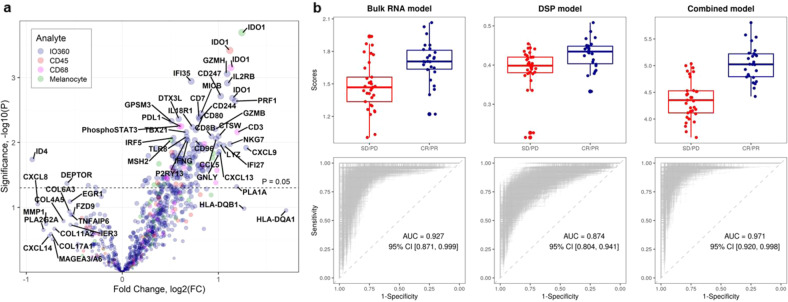
Immunotherapy has reshaped the field of cancer therapeutics but the population that benefits are small in many tumor types, warranting a companion diagnostic test. While immunohistochemistry (IHC) for programmed death-ligand 1 (PD-L1) or mismatch repair (MMR) and polymerase chain reaction (PCR) for microsatellite instability (MSI) are the only approved companion diagnostics others are under consideration. An optimal companion diagnostic test might combine the spatial information of IHC with the quantitative information from RNA expression profiling. Here, we show proof of concept for combination of spatially resolved protein information acquired by the NanoString GeoMx® Digital Spatial Profiler (DSP) with transcriptomic information from bulk mRNA gene expression acquired using NanoString nCounter® PanCancer IO 360™ panel on the same cohort of immunotherapy treated melanoma patients to create predictive models associated with clinical outcomes. We show that the combination of mRNA and spatially defined protein information can predict clinical outcomes more accurately (AUC 0.97) than either of these factors alone.
免疫疗法重塑了癌症治疗领域,但在许多肿瘤类型中,受益人群规模较小,因此需要配套诊断检测。虽然用于程序性死亡配体1(PD-L1)的免疫组化(IHC)或错配修复(MMR)以及用于微卫星不稳定性(MSI)的聚合酶链反应(PCR)是仅有的获批配套诊断方法,但其他方法也在考虑之中。一种最佳的配套诊断检测可能会将免疫组化的空间信息与RNA表达谱分析的定量信息相结合。在此,我们展示了一个概念验证,即将通过NanoString GeoMx®数字空间分析系统(DSP)获取的空间分辨蛋白质信息与使用NanoString nCounter®泛癌IO 360™检测板从同一组接受免疫治疗的黑色素瘤患者中获取的大量mRNA基因表达的转录组信息相结合,以创建与临床结果相关的预测模型。我们表明,mRNA和空间定义的蛋白质信息相结合比单独的任何一个因素都能更准确地预测临床结果(曲线下面积为0.97)。