Institute of Microbiology, Academy of Sciences of the Czech Republic, Prague, Czech Republic; University of Chemistry and Technology, Prague, Prague, Czech Republic.
Institute of Microbiology, Academy of Sciences of the Czech Republic, Prague, Czech Republic.
J Biol Chem. 2021 Jul;297(1):100833. doi: 10.1016/j.jbc.2021.100833. Epub 2021 May 26.
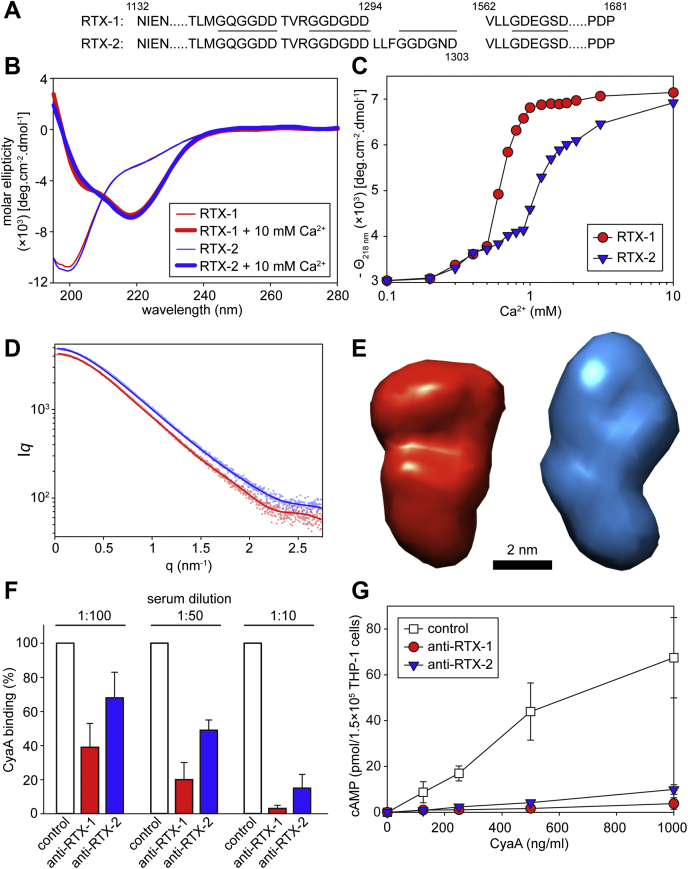
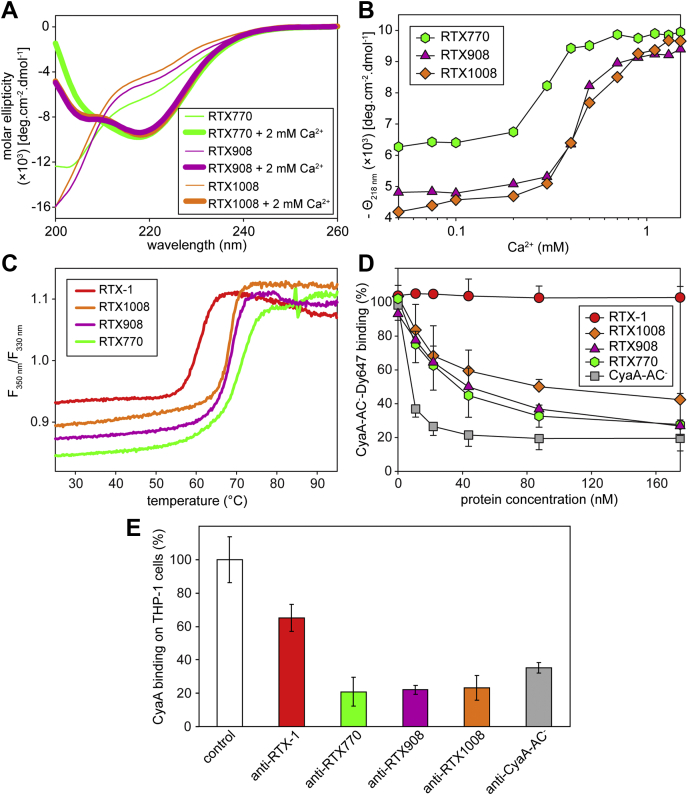
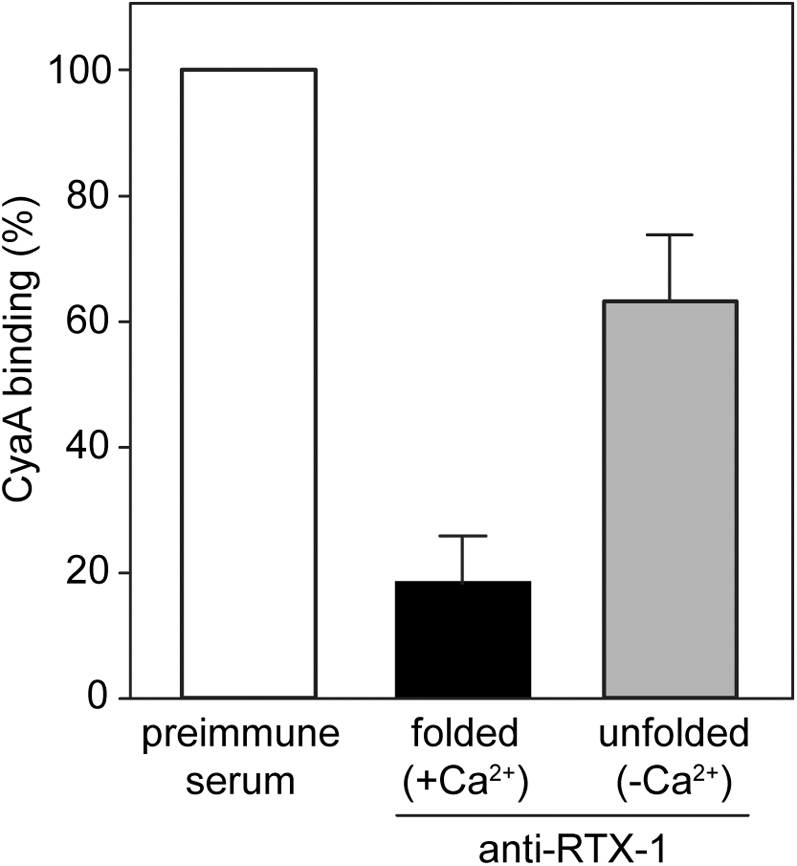
The whooping cough agent Bordetella pertussis secretes an adenylate cyclase toxin (CyaA) that through its large carboxy-proximal Repeat-in-ToXin (RTX) domain binds the complement receptor 3 (CR3). The RTX domain consists of five blocks (I-V) of characteristic glycine and aspartate-rich nonapeptides that fold into five Ca-loaded parallel β-rolls. Previous work indicated that the CR3-binding structure comprises the interface of β-rolls II and III. To test if further portions of the RTX domain contribute to CR3 binding, we generated a construct with the RTX block II/III interface (CyaA residues 1132-1294) linked directly to the C-terminal block V fragment bearing the folding scaffold (CyaA residues 1562-1681). Despite deletion of 267 internal residues of the RTX domain, the Ca-driven folding of the hybrid block III/V β-roll still supported formation of the CR3-binding structure at the interface of β-rolls II and III. Moreover, upon stabilization by N- and C-terminal flanking segments, the block III/V hybrid-comprising constructs competed with CyaA for CR3 binding and induced formation of CyaA toxin-neutralizing antibodies in mice. Finally, a truncated CyaAΔ toxin bound and penetrated erythrocytes and CR3-expressing cells, showing that the deleted portions of RTX blocks III, IV, and V (residues 1295-1561) were dispensable for CR3 binding and for toxin translocation across the target cell membrane. This suggests that almost a half of the RTX domain of CyaA is not involved in target cell interaction and rather serves the purpose of toxin secretion.
百日咳杆菌分泌一种腺苷酸环化酶毒素(CyaA),该毒素通过其富含天冬氨酸和甘氨酸的羧基近端重复进入毒素(RTX)结构域与补体受体 3(CR3)结合。RTX 结构域由五个特征性甘氨酸和天冬氨酸富含的九肽组成,折叠成五个钙结合的平行 β-螺旋。先前的工作表明,CR3 结合结构包含β-螺旋 II 和 III 的界面。为了测试 RTX 结构域的其他部分是否有助于 CR3 结合,我们生成了一个构建体,其中 RTX 结构域 II/III 界面(CyaA 残基 1132-1294)直接与携带折叠支架的 C 末端结构域 V 片段(CyaA 残基 1562-1681)相连。尽管 RTX 结构域内部缺失了 267 个残基,但 Ca 驱动的杂交β-螺旋 III/V 结构域的折叠仍然支持在β-螺旋 II 和 III 的界面形成 CR3 结合结构。此外,在 N 和 C 末端侧翼片段的稳定作用下,包含 III/V 杂交结构域的构建体与 CyaA 竞争 CR3 结合,并在小鼠中诱导形成 CyaA 毒素中和抗体。最后,截短的 CyaAΔ毒素结合并穿透红细胞和表达 CR3 的细胞,表明 RTX 结构域的 III、IV 和 V 缺失部分(残基 1295-1561)对于 CR3 结合和毒素穿过靶细胞膜的转运是可有可无的。这表明 CyaA 的 RTX 结构域的近一半不参与靶细胞相互作用,而是用于毒素分泌。