Chateau-Joubert Sophie, Hopfe Miriam, Richon Sophie, Decaudin Didier, Roman-Roman Sergio, Reyes-Gomez Edouard, Bieche Ivan, Nemati Fariba, Dangles-Marie Virginie
Unité d'Histologie et d'Anatomie Pathologique, Ecole Nationale Vétérinaire d'Alfort, 94704 Maisons-Alfort, France; Laboratoire d'anatomo-cytopathologie, BioPôle Alfort, Ecole Nationale Vétérinaire d'Alfort, 94704 Maisons-Alfort, France.
Biologics Testing Solutions, Charles River Biopharmaceutical Services GmbH, Max-Planck-Str. 15A, 40699 Erkrath, Germany.
Transl Oncol. 2021 Aug;14(8):101133. doi: 10.1016/j.tranon.2021.101133. Epub 2021 May 26.
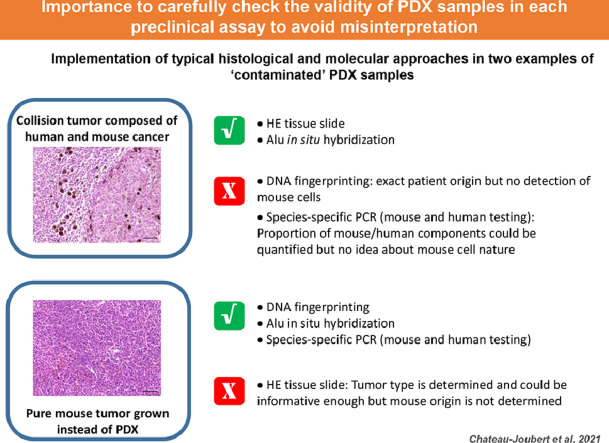
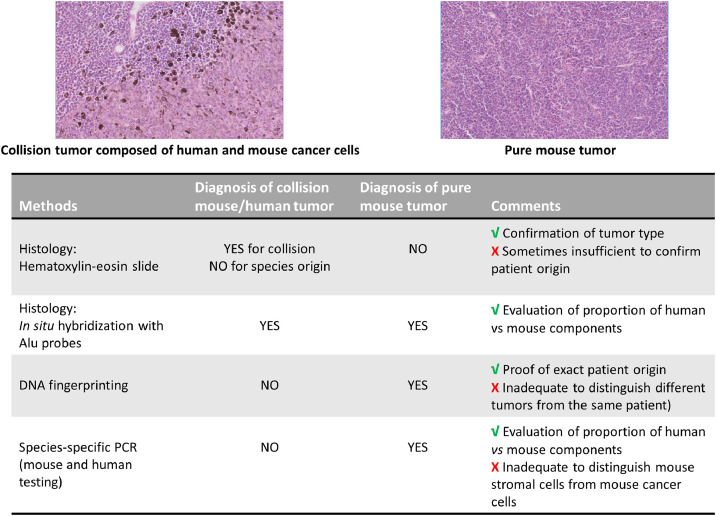
Patient-derived tumor xenograft (PDX) is now largely recognized as a key preclinical model for cancer research, mimicking patient tumor phenotype and genotype. Immunodeficient mice, well-known to develop spontaneous lymphoma, are required for PDX growth. As for all animal models used for further clinical translation, a robust experimental design is strongly required to lead to conclusive results. Here we briefly report unintentional co-engraftment of mouse lymphoma during expansion of well-established PDXs to illustrate the importance of systematic check of the PDX identity to avoid misinterpretation. Besides, this quality control based on complementary approaches deserves a more detailed description in materials and methods section to ensure experimental validity and reproducibility.
患者来源的肿瘤异种移植(PDX)目前在很大程度上被认为是癌症研究的关键临床前模型,可模拟患者肿瘤的表型和基因型。PDX生长需要免疫缺陷小鼠,而众所周知,这种小鼠会自发发生淋巴瘤。对于所有用于进一步临床转化的动物模型而言,强烈需要一个稳健的实验设计以得出确凿的结果。在此,我们简要报告在已建立的PDX扩增过程中意外出现的小鼠淋巴瘤共移植情况,以说明系统检查PDX身份以避免误解的重要性。此外,基于互补方法的这种质量控制在材料和方法部分应得到更详细的描述,以确保实验的有效性和可重复性。