Fernández-Arribas J, Moreno T, Bartrolí R, Eljarrat E
Institute of Environmental Assessment and Water Research (IDAEA)-CSIC, Jordi Girona 18-26, 08034 Barcelona, Spain.
Institute of Environmental Assessment and Water Research (IDAEA)-CSIC, Jordi Girona 18-26, 08034 Barcelona, Spain.
Environ Int. 2021 Sep;154:106654. doi: 10.1016/j.envint.2021.106654. Epub 2021 May 18.
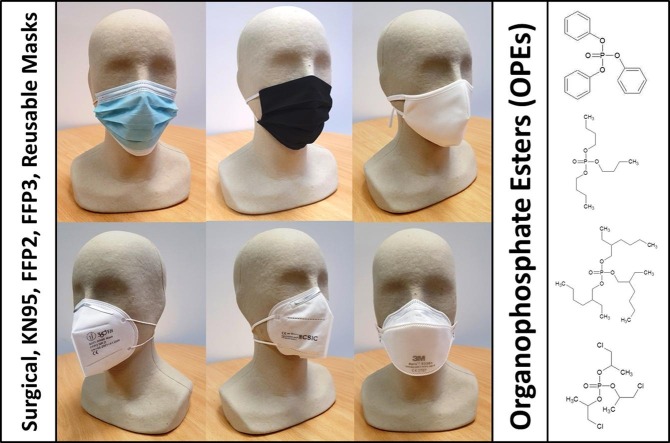
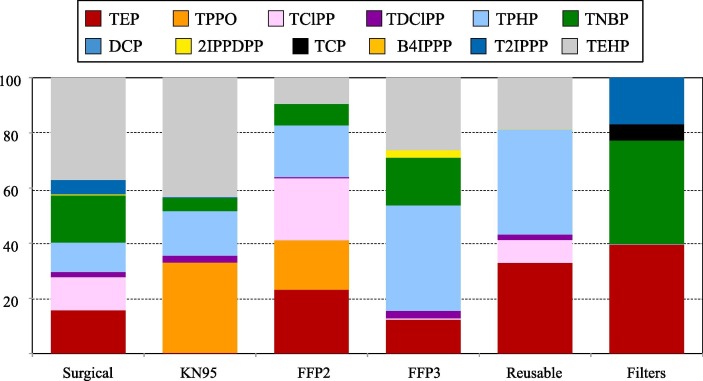
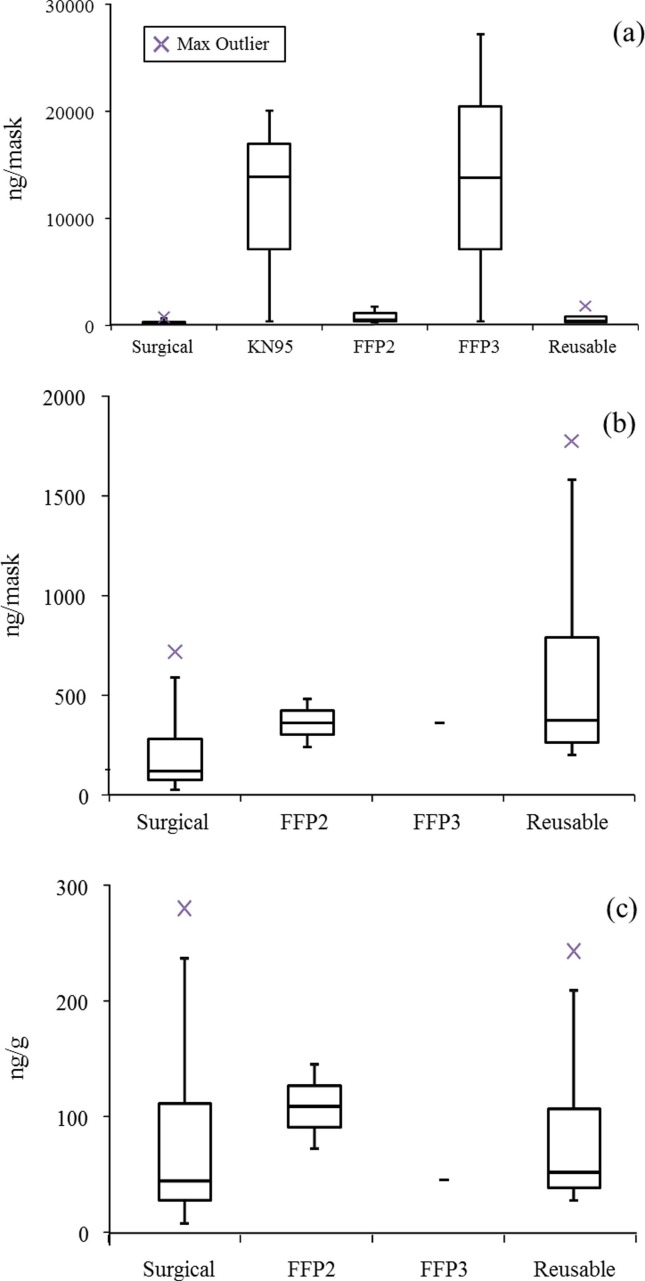
For the first time, organophosphate ester (OPE) content was studied in different types of surgical, self-filtering (KN95, FFP2, and FFP3) and reusable face masks used for COVID-19 prevention. OPEs were detected in all mask samples, although in highly variable amounts which ranged from 0.02 to a maximum of 27.7 µg/mask, with the highest mean concentrations obtained for KN95 masks (11.6 µg/mask) and the lowest for surgical masks (0.24 µg/mask). Twelve out of 16 tested analytes were detected, with TEP, TPHP, TNBP, TEHP and TClPP being the most common OPEs as well as present at the highest concentrations. The non-carcinogenic and carcinogenic risks of OPE inhalation were calculated as being always several orders of magnitude lower than threshold levels, indicating that the use of face masks is safe with regard to OPE contamination. However, given the wide range of OPEs observed in different masks, it can be concluded that some masks (e.g. reusable) are less OPE-contaminated than others (e.g. KN95). With regard to environmental pollution, the disposal of billions of face masks is adding to the already substantial levels of microplastics and associated toxic additives worldwide, an impact that is lessened by use of reusable masks, which also have the lowest economic cost per user. However, in situations of relatively high risk of viral inhalation, such as poorly ventilated indoor public spaces, we recommend the use of FFP2 masks.
首次对用于预防新冠病毒的不同类型手术口罩、自过滤口罩(KN95、FFP2和FFP3)及可重复使用口罩中的有机磷酸酯(OPE)含量进行了研究。在所有口罩样本中均检测到了OPE,不过含量差异很大,范围从0.02微克/口罩到最高27.7微克/口罩,其中KN95口罩的平均浓度最高(11.6微克/口罩),手术口罩的平均浓度最低(0.24微克/口罩)。在16种测试分析物中检测到了12种,其中三(2-氯乙基)磷酸酯(TEP)、三(2-丙基)磷酸酯(TPHP)、三正丁基磷酸酯(TNBP)、三(2-乙基己基)磷酸酯(TEHP)和三(4-氯苯基)磷酸酯(TClPP)是最常见的OPE,且浓度最高。计算得出吸入OPE的非致癌风险和致癌风险始终比阈值水平低几个数量级,这表明就OPE污染而言,使用口罩是安全的。然而,鉴于在不同口罩中观察到的OPE范围很广,可以得出结论,一些口罩(如可重复使用口罩)的OPE污染程度低于其他口罩(如KN95口罩)。关于环境污染,数十亿个口罩的处置正在增加全球已经相当高的微塑料及相关有毒添加剂水平,而使用可重复使用口罩可减轻这种影响,而且每位用户的经济成本也最低。然而,在病毒吸入风险相对较高的情况下,如通风不良的室内公共场所,我们建议使用FFP2口罩。