Department of Health Services Research, Faculty of Medicine, University of Tsukuba, 1-1-1 Tenno-dai, Tsukuba, Ibaraki, 305-8575, Japan.
Health Services Research and Development Center, University of Tsukuba, 1-1-1 Tenno-dai, Tsukuba, Ibaraki, 305-8575, Japan.
BMC Health Serv Res. 2021 May 30;21(1):531. doi: 10.1186/s12913-021-06495-0.
To evaluate the effects of prevention services provided by long-term care insurance (LTCI) for older adults who require support from LTCI in Kashiwa City, Japan.
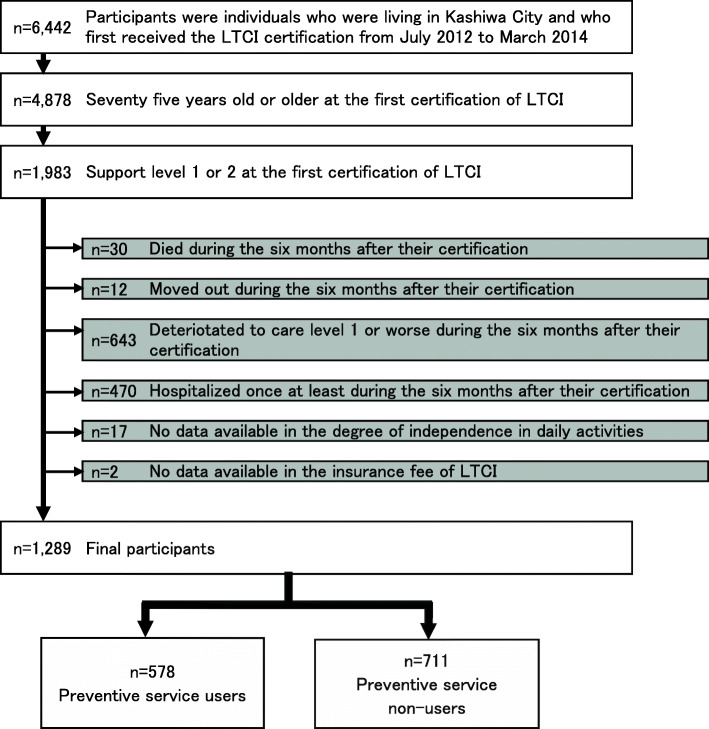
We conducted an analysis using the following population-based longitudinal data in Kashiwa City between April 2012 and March 2015: Data of National Health Insurance and LTCI claims, the survey for certification of LTCI, the register, and premium tier classification. All data was linked using the pre-assigned anonymous identifying numbers. We analyzed the Cox regression model using the time for the deteriorations of levels of certified care need in LTCI as an outcome and the use of preventive care services as the primary exposure among participants aged 75 years or older, who had either support levels 1 or 2 at the beginning of this analysis. The study was further stratified by both age and initial support level.
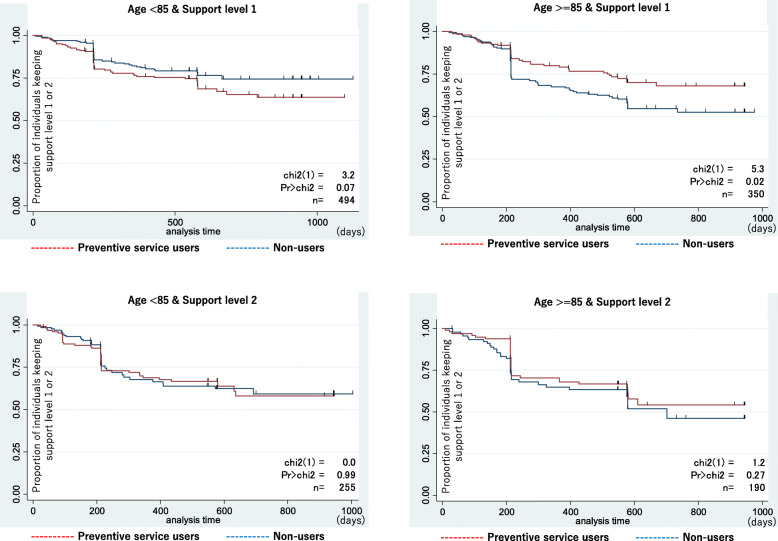
The final analysis included 1289 participants. The primary result showed, among all participants, that preventive service was not effective (hazard ratio 0.96, 95% confidence interval 0.78-1.19). In our sub-analysis, the preventive service was effective in avoiding deteriorations only among those aged 85 and older with support level 1 (HR 0.65, 95% CI 0.43-0.97) out of four groups.
The preventive services of LTCI in Kashiwa City showed a significant effect on the deterioration among subjects aged 85 or older, whose disability level were low (support level 1). Our results suggest that the prevention services provided by LTCI may not be effective for all older individuals; to provide these services efficiently, local governments, as insurers of LTCI, will need to identify the specified groups that may benefit from the preventive services. Additionally, it is necessary to re-examine what preventive interventions may be effective, or redesign the health system if necessary, for those who were not affected by the intervention.
评估日本柏市长期护理保险(LTCI)为需要 LTCI 支持的老年人提供的预防服务的效果。
我们使用 2012 年 4 月至 2015 年 3 月期间在柏市进行的以下基于人群的纵向数据进行了分析:国民健康保险和 LTCI 索赔数据、LTCI 认证调查、登记册和保费等级分类。所有数据均使用预先分配的匿名识别号进行链接。我们使用 Cox 回归模型分析了时间作为 LTCI 认证护理需求水平恶化的结果,以及参与者中年龄在 75 岁及以上的预防保健服务的使用情况,他们在本分析开始时的支持水平为 1 或 2。该研究进一步按年龄和初始支持水平进行分层。
最终分析包括 1289 名参与者。主要结果表明,在所有参与者中,预防服务无效(危险比 0.96,95%置信区间 0.78-1.19)。在我们的亚分析中,预防服务在四个组中仅对年龄在 85 岁及以上且支持水平为 1 的参与者有效(HR 0.65,95%CI 0.43-0.97)。
柏市 LTCI 的预防服务对残疾程度较低(支持水平 1)的 85 岁及以上受试者的恶化有显著影响。我们的结果表明,LTCI 提供的预防服务可能对所有老年人都没有效果;为了有效地提供这些服务,作为 LTCI 承保人的地方政府需要确定可能从预防服务中受益的特定群体。此外,如果干预措施对某些人没有影响,则有必要重新检查哪些预防干预措施可能有效,或者有必要重新设计卫生系统。