Karlsson Philip A, Tano Eva, Jernberg Cecilia, Hickman Rachel A, Guy Lionel, Järhult Josef D, Wang Helen
Department of Medical Biochemistry and Microbiology, Biomedical Center, Uppsala University, Uppsala, Sweden.
Department of Medical Sciences, Uppsala University Hospital, Uppsala, Sweden.
Front Microbiol. 2021 May 13;12:664665. doi: 10.3389/fmicb.2021.664665. eCollection 2021.
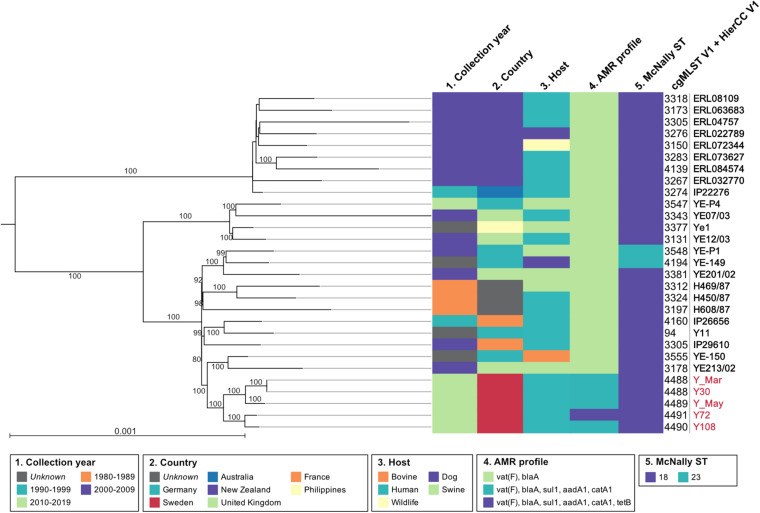
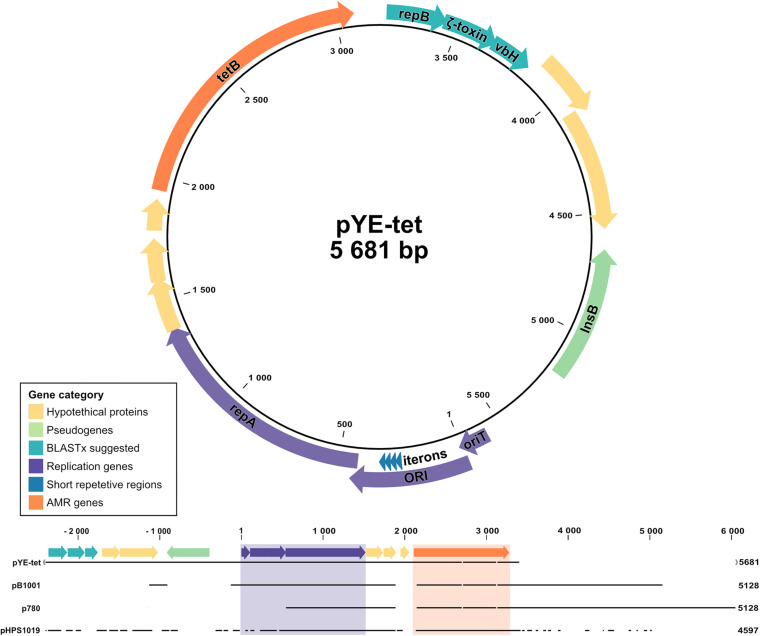
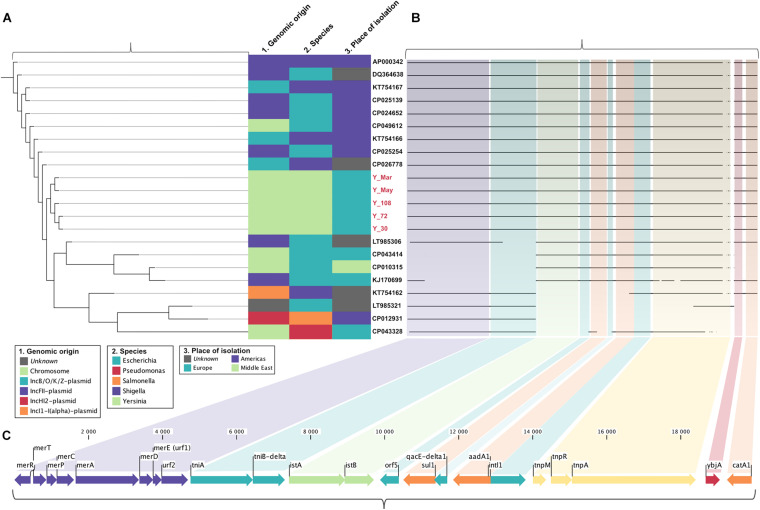
The foodborne pathogen causes gastrointestinal infections worldwide. In the spring of 2019, the Swedish Public Health Agency and Statens Serum Institut in Denmark independently identified an outbreak caused by 4/O:3 that after sequence comparison turned out to be a cross-border outbreak. A trace-back investigation suggested shipments of fresh prewashed spinach from Italy as a common source for the outbreak. Here, we determined the genome sequences of five clinical isolates during the Swedish outbreak using a combination of Illumina HiSeq short-read and Nanopore Technologies' MinION long-read whole-genome sequencing. WGS results showed that all clinical strains have a fully assembled chromosome of approximately 4.6 Mbp in size and a 72-kbp virulence plasmid; one of the strains was carrying an additional 5.7-kbp plasmid, pYE-tet. All strains showed a high pathogen probability score (87.5%) with associated genes for virulence, all of which are closely related to an earlier clinical strain Y11 from Germany. In addition, we identified a chromosomally encoded multidrug-resistance cassette carrying resistance genes against chloramphenicol (), streptomycin (), sulfonamides (), and a mercury resistance module. This chromosomally encoded Tn transposon has previously been reported associated with IncFII plasmids in : a clinical isolate from Japan in 1950s, a outbreak from Australia in 1997, and serovar Typhimurium. Interestingly, we identified an additional 5.7-kbp plasmid with B (encoding an ABC transporter), , and its own ORI and ORIt sites, sharing high homology with small B- plasmids from . This is the first time that Tn and plasmids have been reported in . Taken together, our study showed that the Swedish outbreak strains acquired multi-antibiotic and metal-resistance genes through horizontal gene transfer, suggesting a potential reservoir of intraspecies dissemination of multidrug-resistance genes among foodborne pathogens. This study also highlights the concern of food-chain contamination of prewashed vegetables as a perpetual hazard against public health.
食源性病原体在全球范围内引发胃肠道感染。2019年春季,瑞典公共卫生署和丹麦国家血清研究所独立确认了由4/O:3引起的一次疫情,经序列比对后发现这是一次跨境疫情。追溯调查表明,来自意大利的新鲜预洗菠菜运输是此次疫情的共同源头。在此,我们结合Illumina HiSeq短读长测序和纳米孔技术公司的MinION长读长全基因组测序,测定了瑞典疫情期间五株临床分离株的基因组序列。全基因组测序结果显示,所有临床菌株都有一条大小约为4.6 Mbp的完全组装染色体和一个72-kbp的毒力质粒;其中一株菌株还携带一个额外的5.7-kbp质粒pYE-tet。所有菌株的致病概率得分都很高(87.5%),且带有与毒力相关的基因,所有这些基因都与德国早期的临床菌株Y11密切相关。此外,我们鉴定出一个染色体编码的多药耐药盒,携带针对氯霉素()、链霉素()、磺胺类药物()的耐药基因以及一个汞抗性模块。这种染色体编码的Tn转座子此前已报道与IncFII质粒相关,如20世纪50年代来自日本的一株临床分离株、1997年澳大利亚的一次疫情以及鼠伤寒血清型。有趣的是,我们鉴定出一个额外的5.7-kbp质粒,带有B(编码一个ABC转运蛋白)、,以及其自身的ORI和ORIt位点,与来自的小B-质粒具有高度同源性。这是首次在中报道Tn和质粒。综上所述,我们的研究表明,瑞典疫情菌株通过水平基因转移获得了多抗生素和金属抗性基因,提示食源性病原体种内多药耐药基因传播存在潜在储存库。本研究还凸显了预洗蔬菜的食物链污染作为对公众健康的持续危害这一问题。