Biomedical Graduate Course, School of Health and Life Science, Pontifical Catholic University of Rio Grande do Sul, Porto Alegre, Brazil.
Laboratory of Clinical and Experimental Immunology, School of Health and Life Science, Pontifical Catholic University of Rio Grande do Sul, Porto Alegre, Brazil.
Front Immunol. 2021 May 12;12:657363. doi: 10.3389/fimmu.2021.657363. eCollection 2021.
Coronavirus disease 2019 (COVID-19) is caused by severe acute respiratory syndrome coronavirus 2 (SARS-CoV-2) infections, resulting in a range of clinical manifestations and outcomes. Laboratory and immunological alterations have been considered as potential markers of disease severity and clinical evolution. Type I interferons (IFN-I), mainly represented by IFN-α and β, are a group of cytokines with an important function in antiviral responses and have played a complex role in COVID-19. Some studies have demonstrated that IFN-I levels and interferon response is elevated in mild cases, while other studies have noted this in severe cases. The involvement of IFN-I on the pathogenesis and outcomes of SARS-CoV-2 infection remains unclear. In this study, we summarize the available evidence of the association of plasma protein levels of type I IFN with the severity of COVID-19.
The PRISMA checklist guided the reporting of the data. A systematic search of the MEDLINE (PubMed), EMBASE, and Web of Science databases was performed up to March of 2021, looking for articles that evaluated plasma protein levels of IFN-I in mild, severe, or critical COVID-19 patients. Comparative meta-analyses with random effects were performed to compare the standardized mean differences in plasma protein levels of IFN-I of mild versus severe and mild versus critical patients. Meta-regressions were performed to test the moderating role of age, sex, time that the IFN-I was measured, and limit of detection of the assay used in the difference between the means.
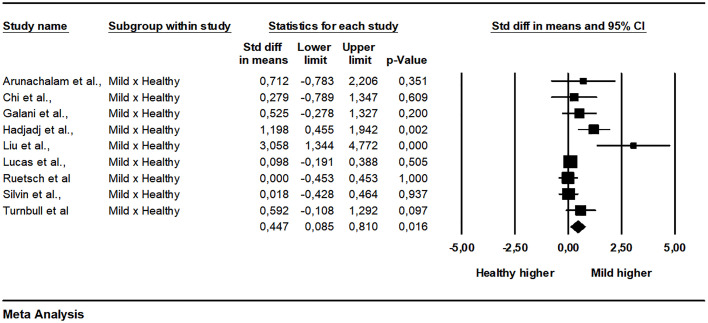
There was no significant difference in plasma levels of IFN-α when comparing between mild and severe patients (SMD = -0.236, 95% CI -0.645 to 0.173, p = 0.258, I2 = 82.11), nor when comparing between patients mild and critical (SMD = 0.203, 95% CI -0.363 to 0.770, p = 0.481, I2 = 64.06). However, there was a significant difference between healthy individuals and patients with mild disease (SMD = 0.447, 95% CI 0.085 to 0.810, p = 0.016, I2 = 62.89).
Peripheral IFN-α cannot be used as a severity marker as it does not determine the clinical status presented by COVID-19 patients.
由严重急性呼吸综合征冠状病毒 2(SARS-CoV-2)感染引起的 2019 年冠状病毒病(COVID-19),导致了一系列临床表现和结局。实验室和免疫学改变被认为是疾病严重程度和临床演变的潜在标志物。I 型干扰素(IFN-I),主要由 IFN-α 和 IFN-β 组成,是一组在抗病毒反应中具有重要功能的细胞因子,在 COVID-19 中发挥了复杂的作用。一些研究表明,在轻症病例中,IFN-I 水平和干扰素反应升高,而其他研究则表明在重症病例中升高。IFN-I 对 SARS-CoV-2 感染的发病机制和结局的影响仍不清楚。在本研究中,我们总结了目前关于 I 型 IFN 血浆蛋白水平与 COVID-19 严重程度的关联的证据。
本研究采用 PRISMA 清单报告数据。系统检索了 MEDLINE(PubMed)、EMBASE 和 Web of Science 数据库,截至 2021 年 3 月,检索评估轻、重、危 COVID-19 患者 IFN-I 血浆蛋白水平的文章。采用随机效应比较荟萃分析比较轻、重患者和轻、危患者 IFN-I 血浆蛋白水平的标准化均数差。进行元回归分析以检验年龄、性别、测量 IFN-I 的时间以及所用检测方法的检测限在均值差异中的调节作用。
在比较轻、重患者时,IFN-α 血浆水平无显著差异(SMD=-0.236,95%CI-0.645 至 0.173,p=0.258,I2=82.11),在比较轻、危患者时也无显著差异(SMD=0.203,95%CI-0.363 至 0.770,p=0.481,I2=64.06)。然而,与健康个体相比,轻症患者 IFN-α 水平显著升高(SMD=0.447,95%CI 0.085 至 0.810,p=0.016,I2=62.89)。
外周血 IFN-α 不能作为严重程度的标志物,因为它不能确定 COVID-19 患者的临床状况。