Normandie University, UNIROUEN, Inserm, U1234, FOCIS Center of Excellence PAn'THER, Rouen University Hospital, Department of Immunology and Biotherapy, Rouen, France.
Department of Dermatology, French Reference Center for Auto Immune Blistering Diseases, Rouen University Hospital, Normandie University, Rouen, France.
Front Immunol. 2021 May 14;12:666022. doi: 10.3389/fimmu.2021.666022. eCollection 2021.
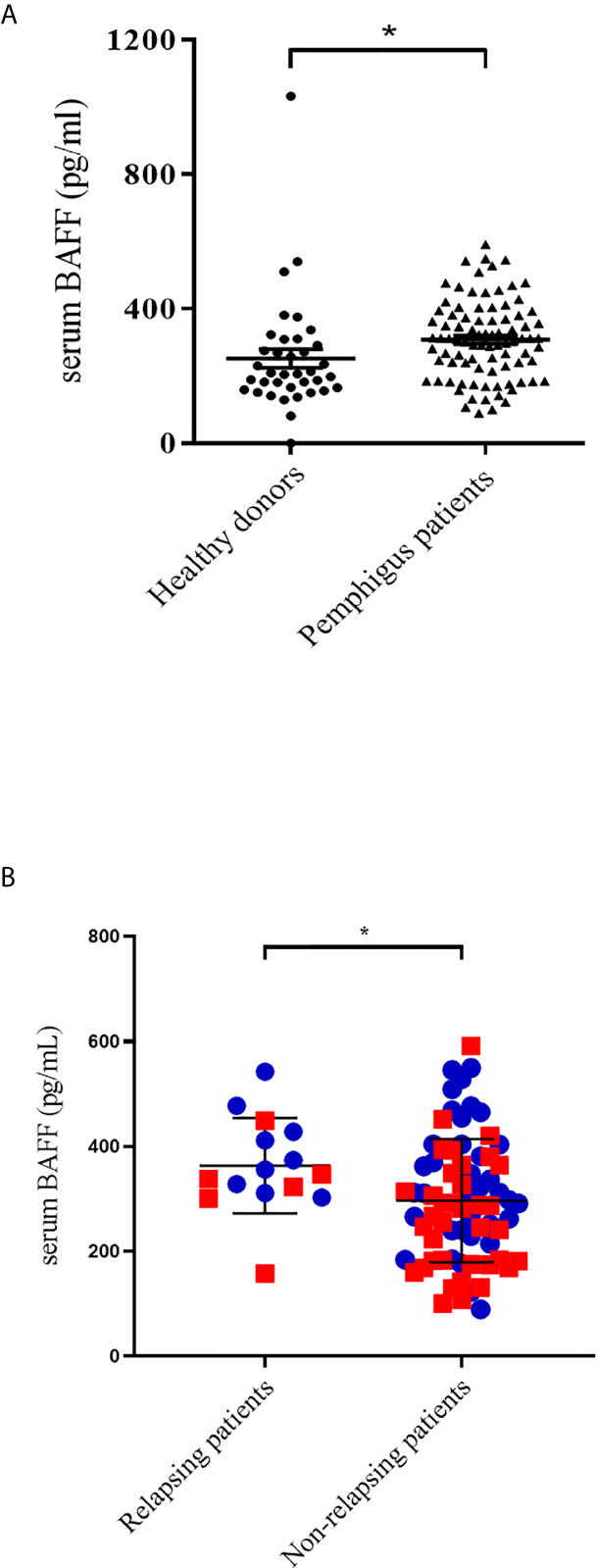
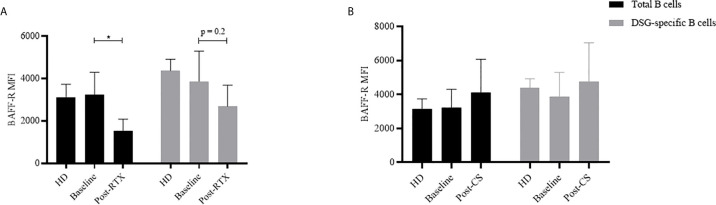
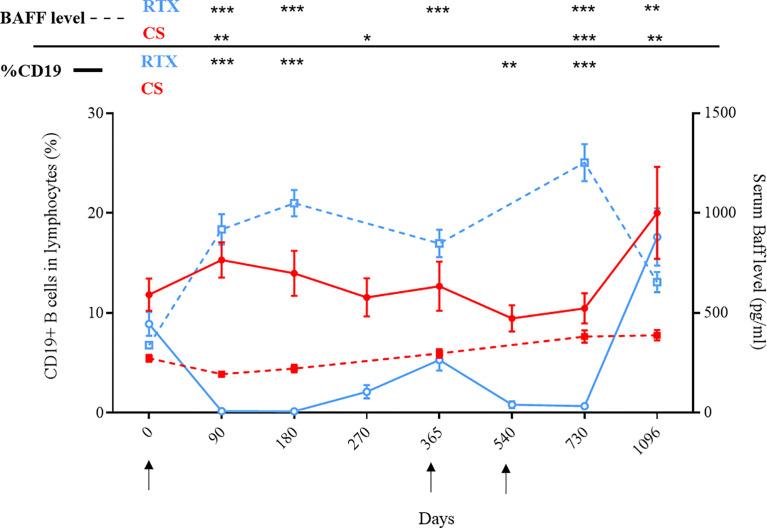
The efficacy of the B-cell-depleting agent rituximab has been reported in immune diseases but relapses are frequent, suggesting the need for repeated infusions. The B-cell activating factor (BAFF) is an important factor for B cell survival, class switch recombination and selection of autoreactive B cells, as well as maintaining long-lived plasma cells. It has been hypothesized that relapses after rituximab might be due to the increase of serum BAFF levels. From the Ritux3 trial, we showed that baseline serum BAFF levels were higher in pemphigus patients than in healthy donors (308 ± 13 pg/mL versus 252 ± 28 pg/mL, p=0.037) and in patients with early relapse compared who didn't (368 ± 92 vs 297 ± 118 pg/mL, p=0.036). Rituximab and high doses of CS alone have different effects on the BAFF/BAFF-R axis. Rituximab led to an increase of BAFF levels associated to a decreased mRNA (Day 0: 12.3 ± 7.6 AU vs Month 36: 3.3 ± 4.3 AU, p=0.01) and mean fluorescence intensity of BAFF-R in non-autoreactive (Day 0: 3232 vs Month 36: 1527, mean difference: 1705, 95%CI: 624 to 2786; p=0.002) as well as on reappearing autoreactive DSG-specific B cells (Day 0: 3873 vs Month 36: 2688, mean difference: 1185, 95%CI: -380 to 2750; p=0.20). Starting high doses of corticosteroids allowed a transitory decrease of serum BAFF levels that re-increased after doses tapering whereas it did not modify BAFF-R expression in autoreactive and non-autoreactive B cells. Our results suggest that the activation of autoreactive B cells at the onset of pemphigus is likely to be related to the presence of high BAFF serum levels and that the decreased BAFF-R expression after rituximab might be responsible for the delayed generation of memory B cells, resulting in a rather long period of mild pemphigus activity after rituximab therapy. Conversely, the incomplete B cell depletion and persistent BAFF-R expression associated with high BAFF serum levels might explain the high number of relapses in patients treated with CS alone.
B 细胞耗竭剂利妥昔单抗在免疫性疾病中的疗效已有报道,但复发频繁,提示需要重复输注。B 细胞激活因子(BAFF)是 B 细胞存活、类别转换重组和自身反应性 B 细胞选择以及维持长寿浆细胞的重要因素。据推测,利妥昔单抗治疗后的复发可能是由于血清 BAFF 水平升高所致。从 Ritux3 试验中,我们发现天疱疮患者的血清 BAFF 水平高于健康供体(308±13 pg/ml 与 252±28 pg/ml,p=0.037),且早期复发患者高于无复发患者(368±92 与 297±118 pg/ml,p=0.036)。利妥昔单抗和高剂量 CS 单独对 BAFF/BAFF-R 轴有不同的影响。利妥昔单抗导致 BAFF 水平升高,同时 BAFF-R 的 mRNA 水平降低(第 0 天:12.3±7.6 AU 与第 36 个月:3.3±4.3 AU,p=0.01)和平均荧光强度降低(非自身反应性:第 0 天:3232 与第 36 个月:1527,平均差异:1705,95%CI:624 至 2786;p=0.002)以及再次出现的自身反应性 DSG 特异性 B 细胞(第 0 天:3873 与第 36 个月:2688,平均差异:1185,95%CI:-380 至 2750;p=0.20)。开始高剂量的皮质类固醇允许血清 BAFF 水平短暂下降,随后在剂量减少后再次升高,而在自身反应性和非自身反应性 B 细胞中,BAFF-R 的表达并没有改变。我们的研究结果表明,天疱疮发病时自身反应性 B 细胞的激活可能与高血清 BAFF 水平有关,而利妥昔单抗后 BAFF-R 表达降低可能是记忆 B 细胞生成延迟的原因,导致利妥昔单抗治疗后天疱疮活动的时间较长。相反,由于单独使用 CS 治疗的患者存在不完全的 B 细胞耗竭和持续的 BAFF-R 表达以及高 BAFF 血清水平,可能解释了这些患者复发次数较多的原因。