Veselá Petra, Vašutová Martina, Edwards-Jonášová Magda, Holub Filip, Fleischer Peter, Cudlín Pavel
Department of Carbon Storage in the Landscape, Global Change Research Institute of the Czech Academy of Sciences, Brno, Czechia.
Department of Forest Protection and Wildlife Management, Faculty of Forestry and Wood Technology, Mendel University in Brno, Brno, Czechia.
Front Plant Sci. 2021 May 14;12:641232. doi: 10.3389/fpls.2021.641232. eCollection 2021.
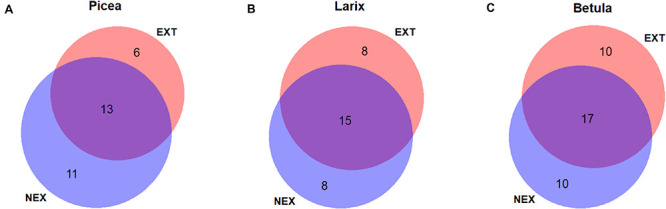
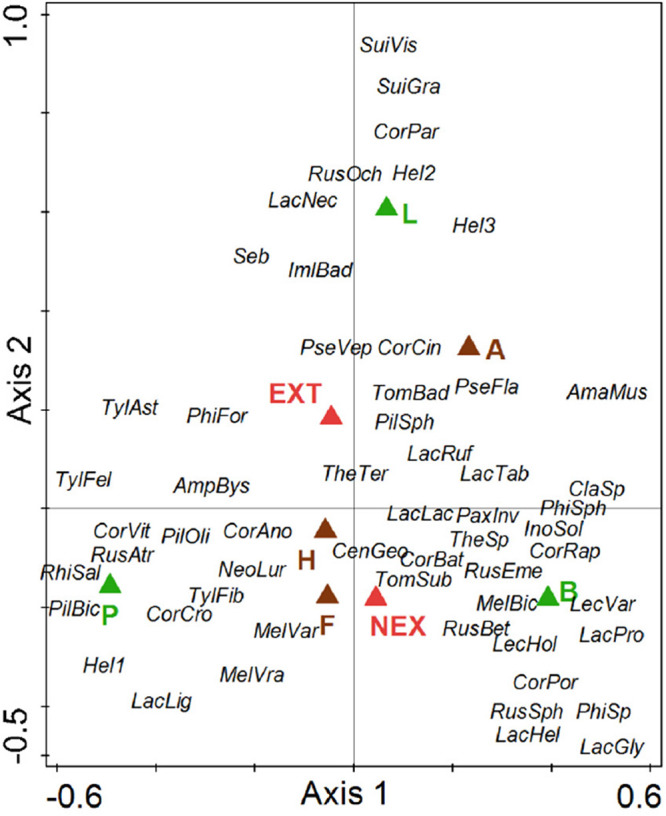
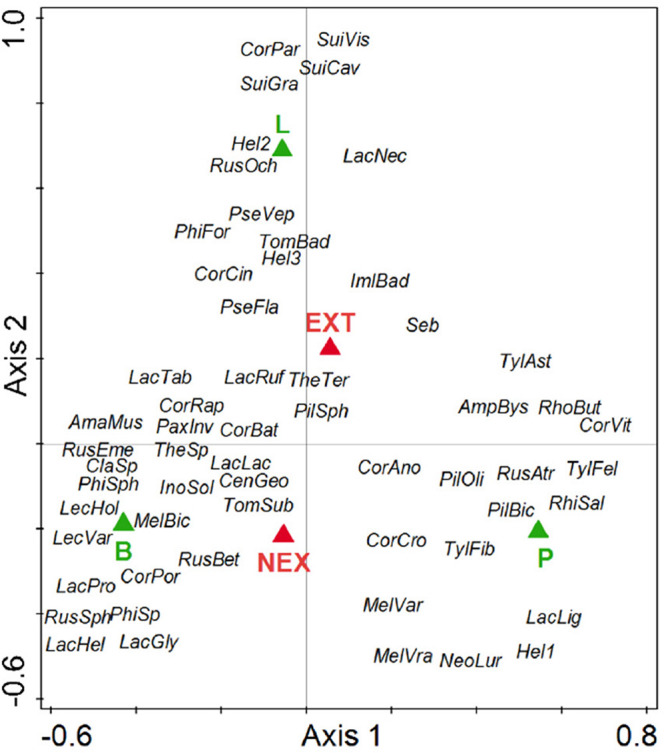
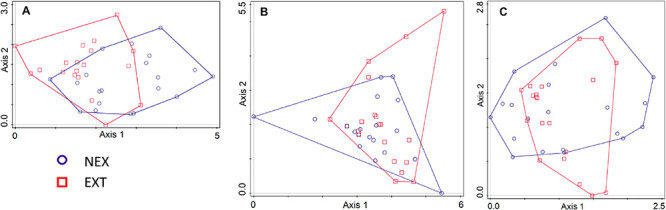
Due to ongoing climate change, forests are expected to face significant disturbances more frequently than in the past. Appropriate management is intended to facilitate forest regeneration. Because European temperate forests mostly consist of trees associated with ectomycorrhizal (ECM) fungi, understanding their role in these disturbances is important to develop strategies to minimize their consequences and effectively restore forests. Our aim was to determine how traditional (EXT) and nonintervention (NEX) management in originally Norway spruce () forests with an admixture of European larch () affect ECM fungal communities and the potential to interconnect different tree species ECM networks 15 years after a windstorm. Ten plots in NEX and 10 plots in EXT with the co-occurrences of Norway spruce, European larch, and silver birch () were selected, and a total of 57 ECM taxa were identified using ITS sequencing from ECM root tips. In both treatments, five ECM species associated with all the studied tree species dominated, with a total abundance of approximately 50% in the examined root samples. Because there were no significant differences between treatments in the number of ECM species associated with different tree species combinations in individual plots, we concluded that the management type did not have a significant effect on networking. However, management significantly affected the compositions of ECM symbionts of Norway spruce and European larch but not those of silver birch. Although this result is explained by the occurrence of seedlings and ECM propagules that were present in the original forest, the consequences are difficult to assess without knowledge of the ecology of different ECM symbionts.
由于气候变化仍在持续,预计森林将比过去更频繁地面临重大干扰。适当的管理旨在促进森林更新。因为欧洲温带森林大多由与外生菌根(ECM)真菌相关的树木组成,了解它们在这些干扰中的作用对于制定将其后果降至最低并有效恢复森林的策略至关重要。我们的目标是确定在原本混有欧洲落叶松()的挪威云杉()森林中,传统(EXT)和非干预(NEX)管理如何影响ECM真菌群落以及在一场风暴过后15年不同树种ECM网络相互连接的潜力。在NEX中选取了10个样地,在EXT中选取了10个样地,这些样地同时生长有挪威云杉、欧洲落叶松和白桦(),并使用ECM根尖的ITS测序鉴定出了总共57个ECM分类单元。在两种处理中,与所有研究树种相关的5种ECM物种占主导,在所检查的根样本中总丰度约为50%。由于在各个样地中,不同树种组合相关的ECM物种数量在处理之间没有显著差异,我们得出结论,管理类型对网络连接没有显著影响。然而,管理显著影响了挪威云杉和欧洲落叶松的ECM共生体组成,但对白桦的没有影响。尽管这一结果可以用原始森林中存在的幼苗和ECM繁殖体的出现来解释,但如果不了解不同ECM共生体的生态学知识,后果很难评估。