Department of Sociology, University of New Brunswick, Fredericton, NB, Canada.
Department of Economics, Dalhousie University, Halifax, NS, Canada.
Front Public Health. 2021 May 14;9:670082. doi: 10.3389/fpubh.2021.670082. eCollection 2021.
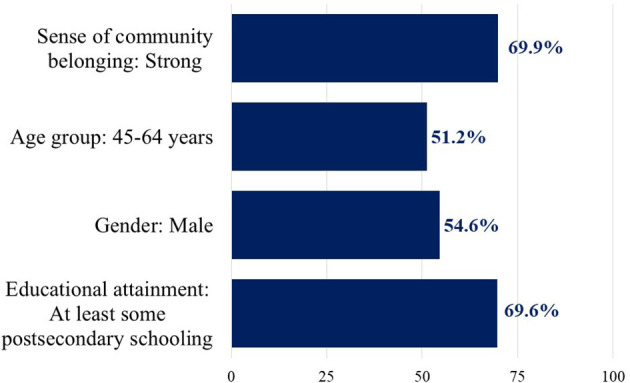
Social isolation has been identified as a substantial health concern in aging populations, associated with adverse chronic disease outcomes and health inequalities; however, little is known about the interconnections between social capital, diabetes management, and hospital burdens. This study aimed to assess the role of community belonging with the risk of potentially avoidable hospitalization among aging adults living with diabetes in Canada. The study leveraged a novel resource available through Statistics Canada's Social Data Linkage Environment: the Canadian Community Health Survey linked to administrative health records from the hospital Discharge Abstract Database. A population-representative sample of 13,580 community-dwelling adults aged 45 and over with diabetes was identified. Multiple logistic regression was used to assess the association of individuals' sense of community belonging with the risk of diabetes-related hospitalization over the period 2006-2012. Most (69.9%) adults with diabetes reported a strong sense of belonging to their local community. Those who reported weak community belonging were significantly more likely to have been hospitalized for diabetes (χ = 13.82; < 0.05). The association between weak community attachment and increased risk of diabetes hospitalization remained significant [adjusted OR: 1.80 (95%CI: 1.12-2.90)] after controlling for age, education, and other sociodemographic and behavioral factors. The COVID-19 pandemic has resurfaced attention to the need to better address social capital and diabetes care in public health strategies. While the causal pathways are unclear, this national study highlighted that deficits in social attachments may place adults with diabetes at greater risk of acute complications leading to hospitalization.
社会隔离已被确定为老龄化人口中的一个重大健康问题,与不良的慢性疾病结果和健康不平等有关;然而,人们对社会资本、糖尿病管理和医院负担之间的相互关系知之甚少。本研究旨在评估社区归属感在加拿大患有糖尿病的老年人群体中与潜在可避免住院风险之间的关系。该研究利用了加拿大统计局社会数据链接环境中提供的一种新资源:加拿大社区健康调查与医院出院摘要数据库中的行政健康记录相链接。确定了一个具有代表性的、年龄在 45 岁及以上、患有糖尿病的 13580 名社区居民样本。使用多变量逻辑回归评估个体的社区归属感与 2006-2012 年期间糖尿病相关住院风险之间的关系。大多数(69.9%)患有糖尿病的成年人表示强烈的归属感。那些报告社区归属感较弱的人更有可能因糖尿病住院(χ=13.82;<0.05)。在控制年龄、教育和其他社会人口统计学和行为因素后,社区联系薄弱与糖尿病住院风险增加之间的关联仍然显著[调整后的比值比:1.80(95%可信区间:1.12-2.90)]。COVID-19 大流行重新引起了人们对需要更好地解决社会资本和糖尿病护理在公共卫生策略中的重视。虽然因果关系尚不清楚,但这项全国性研究强调,社会联系的不足可能会使患有糖尿病的成年人面临更大的急性并发症导致住院的风险。