Keemu Hannes, Vaura Felix, Maksimow Anu, Maksimow Mikael, Jokela Aleksi, Hollmén Maija, Mäkelä Keijo
Departments of Orthopaedics and Traumatology (H.K., A.J., and K.M.) and Perioperative Services, Intensive Care, and Pain Medicine (A.M.), Turku University Hospital and the University of Turku, Turku, Finland.
MediCity Research Laboratory, University of Turku, Turku, Finland.
JB JS Open Access. 2021 Apr 20;6(2). doi: 10.2106/JBJS.OA.20.00067. eCollection 2021 Apr-Jun.
Synovial fluid bacterial culture is the cornerstone of confirmation or exclusion of periprosthetic joint infection (PJI). The aim of this study was to assess synovial fluid and serum biomarker patterns of patients with total joint arthroplasty (TJA), and the association of these patterns with PJI.
Synovial fluid and serum samples were collected from 35 patients who were admitted to the Arthroplasty Unit of the Department of Orthopaedics and Traumatology at Turku University Hospital. Of the 25 patients who were included in the study, 10 healthy patients with an elective TJA for osteoarthritis served as the control group, and 15 patients who were admitted due to clinical suspicion of PJI with local redness, swelling, wound drainage, pain, and/or fever and who had a positive synovial fluid bacterial culture served as the study group. Logistic regression was used to assess the ability of 37 biomarkers (including cytokines, chemokines, and growth factors) with commercially available tests to detect PJIs.
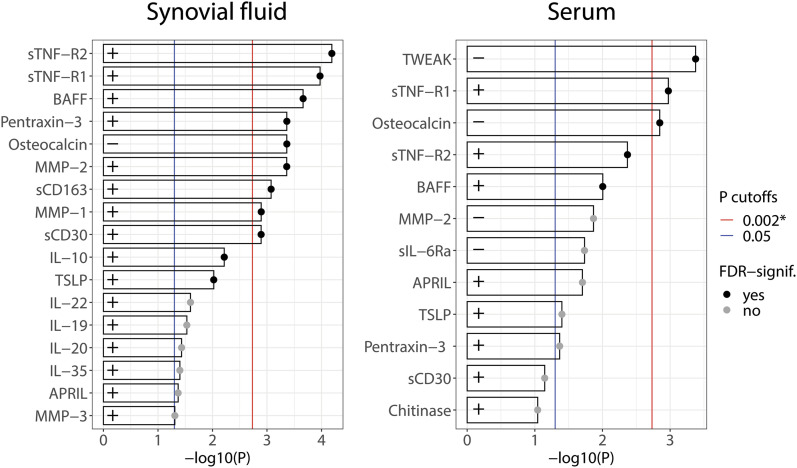
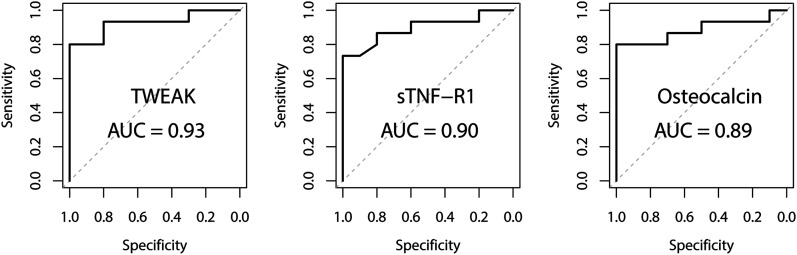
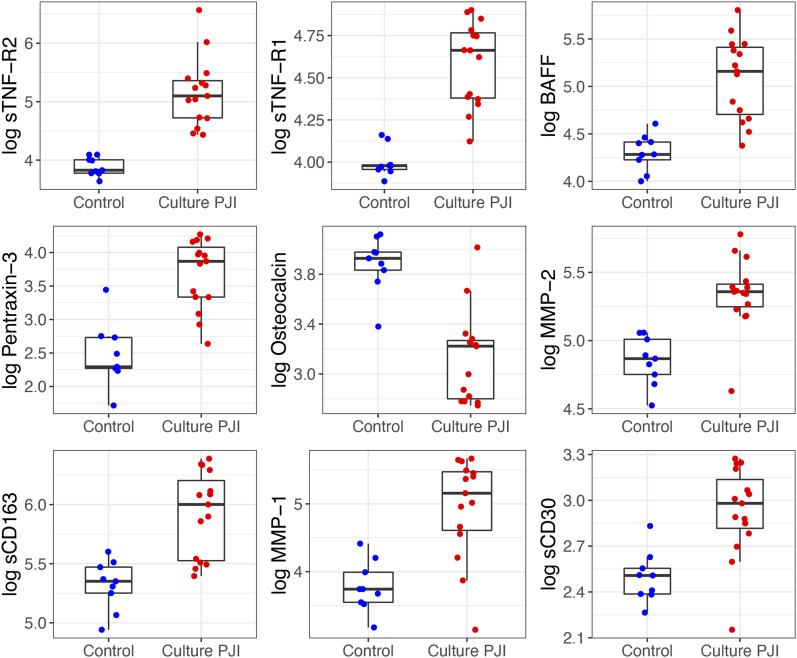
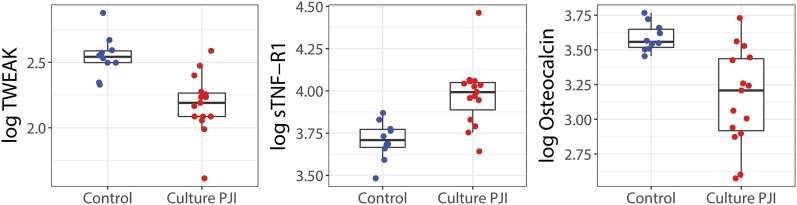
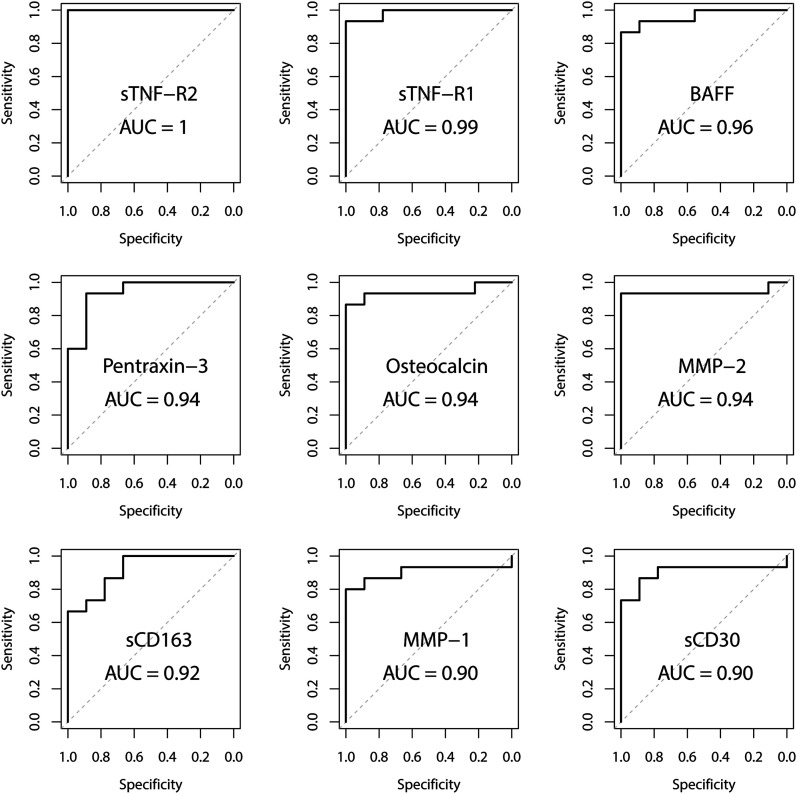
In synovial fluid, the concentrations of sTNF-R1 and sTNF-R2 (soluble tumor necrosis factor receptors 1 and 2) and BAFF (B-cell activating factor, also known as TNFSF13B) were significantly higher in the PJI group (p < 0.002). In serum, the sTNF-R1 concentration was significantly higher in the PJI group, whereas the TWEAK (tumor necrosis factor-like weak inducer of apoptosis) and osteocalcin concentrations were significantly lower (p < 0.002). The sensitivity for detecting PJI using synovial fluid was 1.00 for sTNF-R2, 0.93 for sTNF-R1, and 0.87 for BAFF/TNFSF13B. The specificity of all 3 synovial markers was 1.00. The sensitivity using serum was 0.80 for TWEAK, 0.73 for sTNF-R1, and 0.80 for osteocalcin. The specificity of all 3 serum markers was 1.00.
Synovial sTNF-R2 is a promising new biomarker for detecting PJI. We are not aware of any previous reports of the use of sTNF-R2 in PJI diagnosis. More research is needed to assess the clinical importance of our findings.
Diagnostic Level II. See Instructions for Authors for a complete description of levels of evidence.
滑液细菌培养是确诊或排除人工关节周围感染(PJI)的基石。本研究旨在评估全关节置换术(TJA)患者的滑液和血清生物标志物模式,以及这些模式与PJI的关联。
从图尔库大学医院骨科与创伤科关节置换病房收治的35例患者中采集滑液和血清样本。在纳入研究的25例患者中,10例因骨关节炎接受择期TJA的健康患者作为对照组,15例因临床怀疑PJI(伴有局部红肿、肿胀、伤口引流、疼痛和/或发热)且滑液细菌培养呈阳性而入院的患者作为研究组。采用逻辑回归分析评估37种生物标志物(包括细胞因子、趋化因子和生长因子)通过商用检测方法检测PJI的能力。
在滑液中,PJI组的sTNF-R1和sTNF-R2(可溶性肿瘤坏死因子受体1和2)以及BAFF(B细胞活化因子,也称为TNFSF13B)浓度显著更高(p < 0.002)。在血清中,PJI组的sTNF-R1浓度显著更高,而TWEAK(肿瘤坏死因子样凋亡弱诱导剂)和骨钙素浓度显著更低(p < 0.002)。使用滑液检测PJI时,sTNF-R2的敏感性为1.00,sTNF-R1为0.93,BAFF/TNFSF13B为0.87。所有3种滑液标志物的特异性均为1.00。使用血清检测时,TWEAK的敏感性为0.80,sTNF-R1为0.73,骨钙素为0.80。所有3种血清标志物的特异性均为1.00。
滑液sTNF-R2是一种有前景的用于检测PJI的新生物标志物。我们未发现此前有关于sTNF-R2用于PJI诊断的报道。需要更多研究来评估我们研究结果的临床重要性。
诊断性II级。有关证据水平的完整描述,请参阅作者须知。