Department of Psychological Medicine, Section of Eating Disorders, Institute of Psychiatry, Psychology and Neuroscience, King's College London, London, UK.
Psychiatry Unit, Department of Health Sciences, University of Florence, Florence, Italy.
Int J Eat Disord. 2021 Aug;54(8):1509-1518. doi: 10.1002/eat.23556. Epub 2021 May 31.
Eating disorders are psychiatric illnesses characterized by extreme eating behaviors, such as sustained food restriction or loss of control over eating. Symptoms are thought to be maintained by a variety of mechanisms, one of which may be the socio-cognitive impairments associated with eating disorders. While some previous work has addressed socio-cognitive impairments in eating disorders, this work has relied mostly on self-report data.
Here we employed computerized tests of (a) mentalizing (ability to infer the mental states of others); (b) empathy (the degree to which the emotional states of others can be identified and the degree to which the states of others impact one's own emotional state); and (c) imitation (the degree to which observation of another's actions prompts the performance of those actions); in a group of 78 women with an eating disorder and a matched control group of 66 healthy women.
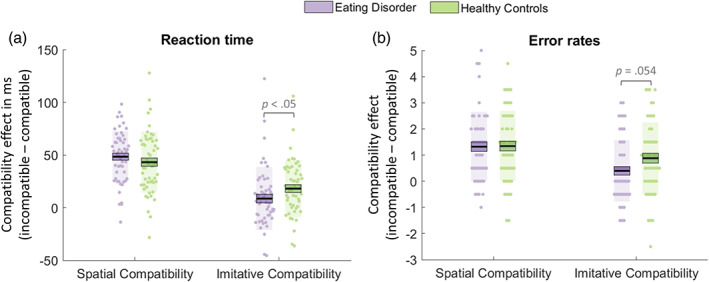
People with eating disorders showed both hyper- and hypo-mentalizing and reduced accuracy of emotional and cognitive mental state inference. They displayed less imitation of observed actions, but no differences in empathy compared to healthy controls. Although anxiety and depressive symptoms had significant effects on mentalizing, most of the observed inter-group differences persisted.
Women with eating disorders have difficulties mentalizing and imitating observed actions despite intact non-social automatic imitation, compared to healthy controls. These findings provide an indication that intervention modules to strengthen specific areas of social cognition might be helpful to improve patients' social skills.
饮食失调是一种以极端饮食行为为特征的精神疾病,如持续的食物限制或对进食失去控制。人们认为这些症状是由多种机制维持的,其中一种可能是与饮食失调相关的社会认知障碍。虽然之前的一些研究已经探讨了饮食失调中的社会认知障碍,但这些研究主要依赖于自我报告数据。
在这里,我们在 78 名饮食失调症女性患者和 66 名健康女性对照者中,采用计算机测试评估了(a)心理理论(推断他人心理状态的能力);(b)同理心(识别他人情绪状态的程度以及他人的状态对自己情绪状态的影响程度);(c)模仿(观察他人行为后执行这些行为的程度)。
饮食失调症患者表现出过度和不足的心理理论以及情绪和认知心理状态推断准确性降低。他们的模仿行为较少,但与健康对照组相比,同理心没有差异。尽管焦虑和抑郁症状对心理理论有显著影响,但大多数组间差异仍然存在。
与健康对照组相比,患有饮食失调症的女性在心理理论和模仿观察行为方面存在困难,尽管她们在非社会自动模仿方面没有受损。这些发现表明,强化特定社会认知领域的干预模块可能有助于改善患者的社交技能。